Cross aversion
I Am LegendCross aversion is a conditional rule governing the vampires’ response to the cross. Robert Neville initially treats it as one item in a larger cluster of reported vampire traits, alongside their daytime confinement, avoidance of garlic, death by staking, and supposed blindness to mirrors. Unlike a simple physical weakness, however, the cross proves to depend on the individual vampire’s prior religious identity and on the mental disturbances produced by vampirism. Its apparent supernatural force is therefore both practical and cultural: the object can repel one vampire while leaving another unaffected.
Definition and Early Hypothesis
Robert Neville begins with the inherited belief that vampires fear the cross, but his scientific habits make him distrust explanations that depend on mysticism. He has already discovered that several traditional claims are false or incomplete: vampires are visible in mirrors, and neither bats nor wolves are literal transformations of infected beings. The cross consequently becomes a problem to test rather than a legend to accept. He asks whether its power has a logical explanation that can be separated from superstition.
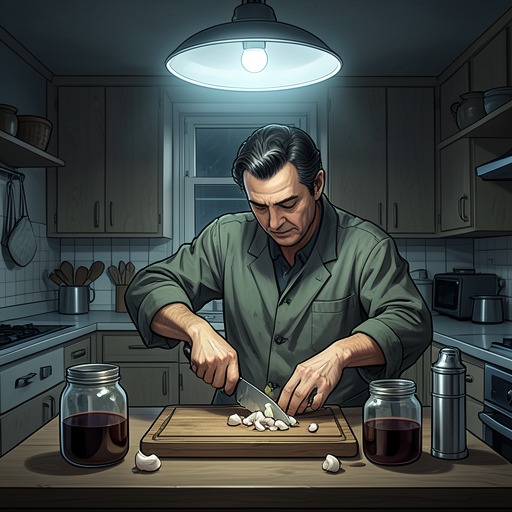
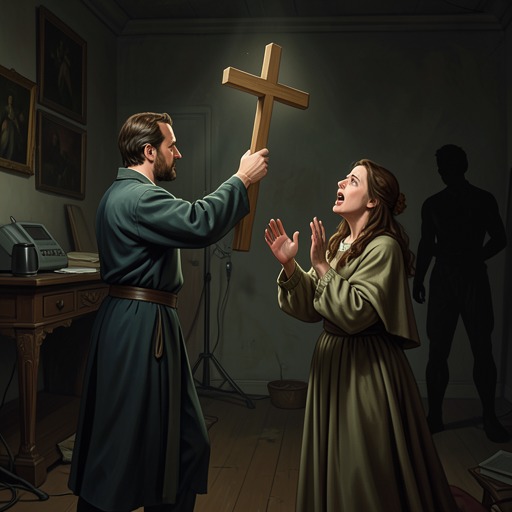
The rule is established through controlled observation. After constructing a small wooden structure outside the house and hanging strings of onions from it, Robert Neville uses a gold cross as the next defensive instrument. He takes an infected woman from her bed, binds her to a chair, and places the cross directly before her. When she wakes, her reaction is immediate: she jerks her eyes away, twists against the chair, snarls, and recoils as he swings the object before her face. Her terror confirms that the cross can function as a barrier, but her response does not yet explain why it works.
The scene also exposes the physical and emotional cost of Robert Neville’s experiments. He is forced to restrain the impulse and sexual agitation that arise when he approaches infected women, and he must repeatedly persuade himself that the procedure is necessary. The cross is thus tested within a morally compromised setting: it is an instrument of inquiry and defense, but its use is inseparable from confinement, coercion, and the violence Robert Neville inflicts on those he classifies as specimens.
Religious Identity as the Condition
Robert Neville eventually rejects the idea that every vampire should fear every cross. Ruth explains that her group protected a house with boarded windows, crosses, and garlic, but Robert Neville points out that such defenses could not work uniformly. His formulation is that a Jew, Hindu, Muslim, or atheist would have no reason to fear a specifically Christian symbol, and a vampire who had belonged to one of those traditions would not automatically acquire the same fear after infection. The cross’s efficacy therefore depends on the religious meaning it held before vampirism.
Ruth’s account supplies the decisive comparison. When she confronted Ben Cortman with a cross, he laughed at her; when she held a Torah before him, she obtained the reaction she wanted. She used the Torah to drive him back to the door after he struck her on the head, demonstrating that the relevant mechanism is not the shape of a sacred object but the former believer’s conditioned dread of that object. Robert Neville’s theory gives this observation a broader structure: the cross became the standard defense in European vampire legend because Europe was predominantly Catholic, allowing a culturally specific response to be mistaken for a universal law.
This explanation changes the status of the cross in the novel. It remains effective, but its power is neither independent of human consciousness nor equally distributed among the infected. The object operates through memory, belief, and the symbolic history carried by the person who faces it. What appears to be a supernatural rule is consequently revealed as a psychological and cultural rule embedded in the vampire’s earlier life.
Psychological Mechanism and Mythic Residue
Robert Neville develops a further explanation by linking cross aversion to the trauma of becoming a vampire. He imagines the newly risen or infected person awakening to the confirmation of a previously dreaded condition: death has not brought rest, the body is driven by an alien need, and the mind must absorb the shock of discovering that old fears have become real. Such trauma could fracture whatever rational control remains.
Within that account, the cross becomes the focus of a renewed and intensified dread when it was formerly an object of worship. The vampire is forced to confront the vindication of a fear associated with the sacred, and the damaged mind converts that fear into active repulsion. Robert Neville connects the same psychological collapse with the vampire’s inability to face its own image and with its loneliness, nocturnal existence, and compulsive attachment to soil. Cross aversion is therefore part of a network of symptoms rather than an isolated magical exception.
Robert Neville treats other traditional elements more skeptically. Fear of running water is explained as a surviving legend associated with witches, while the cross is given a more personal route through religious memory. The novel preserves the atmosphere of vampire folklore but subjects its rules to investigation, separating inherited narrative patterns from the biological and psychological conditions that might have produced them.
Limits, Contrasts, and Narrative Significance
The cross is powerful only when the person confronting it recognizes its authority. This limitation makes it a sharper symbol of the novel’s conflict between superstition and science than a universally effective weapon would be. Robert Neville’s experiments do not simply abolish the legend; they refine it. The cross still repels some vampires, but the reason lies in the interaction between infection and preexisting belief.
The rule also anticipates the novel’s larger challenge to fixed categories. Vampires are not governed by one uniform condition: their symptoms vary, their minds may be deranged, and their responses preserve traces of individual history. Even the living vampires who visit Robert Neville’s house are understood by him as psychologically disordered people who believe themselves to be true vampires, suggesting that identity and behavior cannot be reduced to appearance alone. Cross aversion belongs to this unstable border between disease, conviction, and social meaning.
Its final significance is ethical as well as explanatory. Robert Neville uses the cross to classify, restrain, and test infected bodies, but the object also reveals how strongly his own categories depend on inherited stories. The experiment begins with the question of whether a legend can be logically explained and ends with the recognition that the legend has survived because belief has material effects. The cross does not prove that folklore is simply true; it shows that belief, once embodied in a traumatized and altered mind, can become a force with physical consequences.