Dakon
I Am LegendGarlic is the central defensive object in Robert Neville’s isolated life, first functioning as a practical barrier against the vampires and later becoming evidence in his investigation of the vampiris bacillus. Its smell fills Robert Neville’s house, clothes, and eventually his sense of bodily identity; its preparation structures his week; and its effect on Ruth transforms a familiar household safeguard into a diagnostic test. The object therefore joins survival routine, scientific discovery, infection, and grief.
Defensive Use and Household Routine
Garlic is installed wherever Robert Neville needs to maintain a boundary. When the cracked mirror fastened to the front door begins to shed its silver-backed glass, he decides that it is the last mirror he will replace and plans to put garlic there instead, because garlic always works. The choice is practical rather than decorative: the mirror is failing as an object of protection and observation, while garlic remains dependable against the vampires.
His hothouse supplies the material for this defense. Near noon, Robert Neville collects a basketful of garlic, even though the quantity once made him physically ill. The odor has become so constant that it seems to have entered the house, his clothes, and sometimes his flesh; he hardly notices it anymore. The habituation reveals the cost of survival. Garlic protects him, but it also makes ordinary domestic life impossible, turning the house into an environment organized around the threat outside.
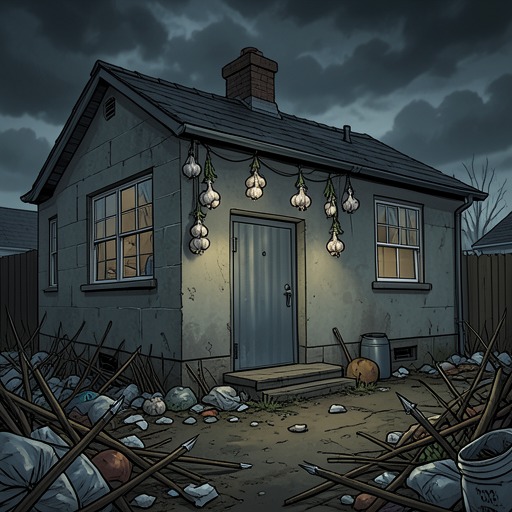
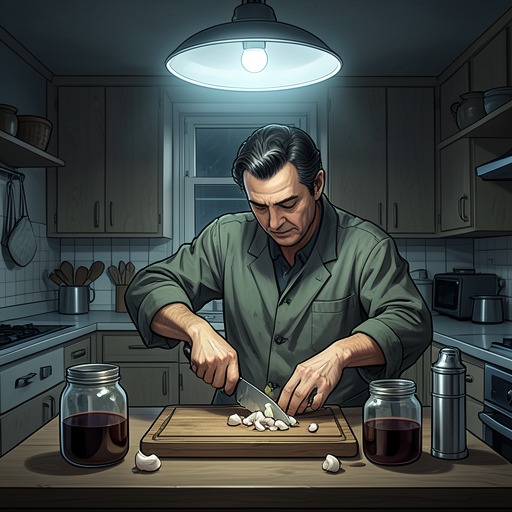
The preparation is laborious and exact. Robert Neville separates each bulb into its small cloves, cuts the pink, leathery cloves in half, punches holes through them with an icepick, and strings them on wire into approximately twenty-five necklaces. He hangs the new necklaces over the boarded windows, replacing older strings whose smell has weakened. The procedure must be repeated twice a week, and until he discovers something better, it is his first line of defense.
The defense has developed in response to repeated attacks. When garlic necklaces once hung directly over the windows, the vampires threw rocks from a distance, breaking the panes. Robert Neville eventually covered the windows with plywood and then replaced that temporary covering with evenly spaced planks. The result makes his house resemble a gloomy sepulcher, although three air-conditioning units make the enclosed space bearable. Garlic thus works together with boards, nails, and mechanical cooling in a defensive system shaped by recurrence rather than by a single emergency.
From Folklore to Chemical Investigation
For seven months Robert Neville uses garlic without knowing why it repels the vampires. His investigation begins when he reads that garlic belongs to the Liliaceae family and contains several allyl sulphides. The entry lists garlic’s composition, including its water, protein, fat, carbohydrates, fiber, and ash, but he rejects these common constituents as possible explanations. He focuses instead on the characteristic odor and flavor produced by an essential oil amounting to about 0.2 percent of the bulb’s weight, composed mainly of allyl sulphide and allyl isothiocyanate.
The shift is characteristic of Robert Neville’s method. He does not simply accept the traditional rule that garlic repels vampires; he tries to isolate the active substance behind the observed effect. The household object becomes a source of experimental questions. If the oil is responsible, he wonders whether related plants such as leek, onion, shallot, or chive might work as well, which would explain why the vampires’ avoidance might be attached to a chemical property rather than to a supernatural essence.
His first test produces a negative result. Robert Neville injects allyl sulphide into a vampire and waits for half an hour, but nothing happens. The failure confuses and enrages him because garlic hung around the house keeps the vampires away, while the oil extracted from garlic has no immediate effect when placed in the body. The experiment forces him to distinguish between the presence of a substance in the bloodstream and exposure to garlic as an odor or external stimulus. Garlic resists a simple causal explanation even as it continues to work in practice.
The larger investigation eventually places garlic within a biological model. Robert Neville identifies a germ on his thirty-seventh blood slide and names it vampiris; he understands the cylindrical organism as a bacillus moving through the blood by means of flagella. The discovery overturns centuries of fearful superstition in a single microscopic image. Garlic is no longer merely an inherited weapon from vampire lore. It becomes one observable effect within an infectious system that Robert Neville can study, test, and revise.
Infection, Diagnosis, and the Limits of the Test
Garlic’s most decisive later use occurs when Ruth is staying with Robert Neville. He prepares cloves by tearing them apart and mashing them into a pulp, then brings the dish close to her face. Ruth turns away and begins to retch. Robert Neville quietly concludes that she is one of the vampires, treating her reaction as a clear sign of infection.
The conclusion rests on knowledge he has gained through earlier research. Robert Neville has learned that garlic acts as an allergen in a system infected with the vampiris bacillus. Exposure stimulates sensitized tissues and produces an abnormal reaction to further contact with garlic. This explains why injecting allyl sulphide into a vampire accomplished little: the relevant response requires exposure to the odor, not merely the placement of the chemical inside the veins.
The garlic test is powerful but not infallible. Ruth claims that she has been wandering for a week, and Robert Neville recognizes that exhaustion and weakness could make anyone retch when confronted with a large amount of garlic. The object therefore supplies evidence rather than absolute certainty. His interpretation is scientifically grounded, but it is also shaped by fear, prior experience, and the urgent need to classify the person before him as safe or dangerous.
Garlic’s operation also contrasts with other supposed methods of killing vampires. Robert Neville discovers that ordinary bullets are ineffective because the bacilli produce a powerful body glue that seals bullet openings almost as soon as they are made. Garlic does not function as a projectile or penetrate the body in the same manner; its importance lies in the infected system’s abnormal sensitivity to contact with its odor. The contrast helps move the narrative away from a catalogue of supernatural rules toward a physiology of infection.
Grief, Memory, and the Material Boundary of the Self
Although garlic is chiefly a defensive and scientific object, its presence is inseparable from Robert Neville’s grief. His house is saturated with it while he remains alone, drinking, pacing, and struggling with memories of Virginia Neville and Kathy Neville. At night he dreams about Virginia and cries out in his sleep; elsewhere, recalled scenes of Kathy’s body being taken from him and Virginia’s death return with overwhelming force. Garlic belongs to the same sealed environment as these memories, an object that guards the survivor while also helping define the prison in which he mourns.
The relation between garlic and his body becomes especially suggestive because Robert Neville no longer merely smells it around him. He imagines it in his flesh. The defensive substance has crossed from the exterior of the house into clothing and bodily perception, blurring the line between the protected self and the contaminated world outside. His survival depends on making the boundary firm, yet repeated use makes that boundary part of him.
The object also accompanies his emotional withdrawal. Robert Neville describes himself as a man who is alone and finds domestic chores unimportant, while garlic work, stake-making, repairs, and other forms of defense continue with mechanical regularity. This contrast makes garlic more than a tool. It is one of the repetitive tasks through which he preserves a minimal order when ordinary human purposes have collapsed. Its recurrence gives shape to days otherwise dominated by loneliness, sexual frustration, drinking, and anticipatory fear.
When Robert Neville explains to Ruth that Virginia Neville returned after he had buried her, he remembers her as a dead figure who came back to drink his blood. Garlic stands on the other side of that transformation: it is the household substance that recognizes what grief and resemblance can conceal. It cannot restore the dead or resolve his attachment to Virginia Neville, but it gives him a material procedure for confronting the possibility that a familiar body has become something else.
Narrative Significance
Garlic embodies the novel’s movement from superstition to empirical understanding without losing the terror of the original legend. It works before Robert Neville knows its mechanism, and that gap between effective practice and incomplete explanation drives his investigation. The necklaces over the windows are at once folk protection, repeated domestic labor, and an uncontrolled experiment conducted under siege.
Its significance is also ethical and psychological. Garlic protects Robert Neville by making his house inhospitable to the infected, but the same property turns Ruth’s body into evidence and intensifies Robert Neville’s suspicion of intimacy. The object can establish a boundary, reveal infection, and preserve life; it cannot tell him what to do with the person the test identifies. In that tension, garlic becomes a compact expression of Robert Neville’s predicament: survival demands classification, while memory and attachment continually resist clean divisions between loved one, stranger, patient, and threat.