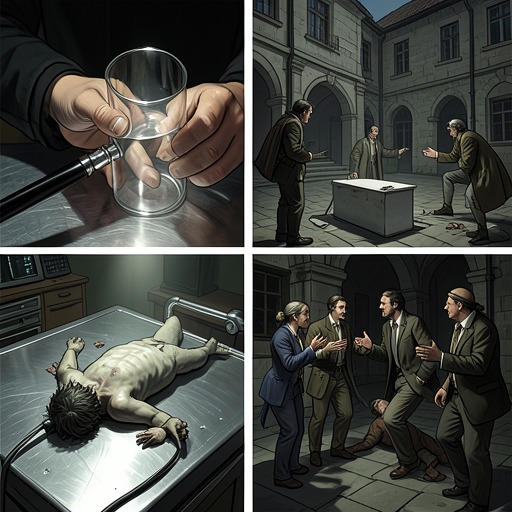
Disposal of the vampire bodies
I Am LegendThe disposal of the vampire bodies is one of Robert Neville's most consequential recurring actions: he collects the dead from the streets, transports them in his Willys station wagon, and pushes them into a gigantic burning pit outside Compton. The work protects his immediate environment from accumulating corpses, but it also makes him the agent of a harsh plague regime, linking domestic survival to public incineration, memory, and the destruction of the world that existed before the epidemic.
Definition and Setting
The process begins after daylight, when the vampires are vulnerable and the streets are empty. Robert Neville first checks the sky; a clear, nearly cloudless morning means that he can go outside. Near his house, he finds bodies left on the sidewalk or partly hidden in shrubbery. Both are women, reflecting the recurring pattern of female bodies among the dead he encounters. He backs the Willys station wagon from the garage, puts on heavy gloves, and drags the bodies across the lawn onto a canvas tarpaulin before fastening the vehicle's rear gate.
The destination is a corpse-burning pit reached by driving up Compton Boulevard, past the oil derricks and through the silent streets of Compton. The field has been excavated into one enormous pit, and the fire below is always burning. A sooty cloud hangs over the ground, making the site visible before Robert Neville reaches it. The pit is therefore not an improvised private bonfire but a landscape-scale response to the 1975 plague, a permanent mechanism for removing infected bodies from the city.
Procedure and Physical Cost
At the pit, Robert Neville wears gloves and a gas mask. He parks, lowers the rear gate, pulls out a body, drags it to the edge, stands it on its feet, and shoves it down the incline. The corpse bumps and rolls onto the great heap of smoldering ashes. He repeats the action with the second body, then throws a sack of rocks after them and hurries back to the car. The sequence is brutally practical: each motion reduces a human body to a problem of weight, transport, and disposal, while the gloves, mask, tarpaulin, and vehicle form a protective apparatus around the work.
The procedure nevertheless remains intensely physical and repellent to him. At the pit Robert Neville breathes harshly and feels as though he is strangling even through the gas mask. After driving half a mile away, he strips off the mask and gloves, draws in fresh air, drinks burning whisky from a flask, and lights a cigarette. Sometimes he must visit the burning pit every day for weeks, and every visit makes him sick. The repeated need to perform the task converts emergency into routine without making the routine bearable.
The disposal circuit is part of a larger day of extermination. After lunch, Robert Neville goes from house to house and uses all forty-seven of his stakes. The bodies taken to the pit are thus not isolated casualties but the material remainder of his systematic campaign against the vampire population. He has already killed most of those he can locate, yet he knows that a few remain ahead of him; disposal closes each day's operation without ending the threat.
Memory, Classification, and Moral Strain
The burning pit carries a private loss as well as a public one. Somewhere below it is Kathy Neville, whose body has been consumed with the other dead. The mass grave therefore collapses the distinction between plague sanitation and family mourning. Robert Neville cannot preserve Kathy's remains or separate her from the general population of the dead; his practical duty repeatedly brings him back to a site that contains the physical trace of his daughter.
The work also exposes the unstable boundary between human feeling and instrumental action. Robert Neville tells himself that, because he is a man and alone, cleaning, washing, changing bedding, and other domestic tasks have no importance to him. Yet the disposal of bodies demands a different, harsher form of labor: he forces himself to collect, carry, and burn the dead because leaving them in the streets would prolong the danger. His house becomes saturated with garlic, while his nights are organized around music, alcohol, soundproofing, and attempts to contain bodily craving. Against that interior disorder, the disposal route offers a sequence of controlled acts, even though the control breaks down at the pit.
The work is especially difficult when the bodies are women. During a house-to-house killing, Robert Neville's hands fumble on the stake and mallet because the vampires are still alive, and he recognizes a senseless sexual demand returning in his body. He forces it down and has to persuade himself that killing is the right action. The later sight of drained women in daylight is stripped of attraction, but the earlier encounter shows that the disposal of bodies cannot be separated from the desire, shame, fear, and violence that structure his encounters with the infected.
Disease, Evidence, and the Limits of the Old Order
Robert Neville's treatment of the corpses is also connected to his investigation of vampirism. He tests inherited vampire beliefs against observation: vampires are not invisible in mirrors, do not transform into bats or wolves, and vampire dogs are still dogs rather than supernatural shapeshifters. At the same time, his observations of bodies and disease transmission lead him toward a biological account. A recorded text explains that flies and mosquitoes can mechanically disseminate many bacterial diseases, while sunlight rapidly kills many germs; these statements become part of the chain through which he understands the epidemic.
His later realization that bacteria can mutate changes the meaning of earlier procedures. He had believed himself immune to infection because time had repeatedly proved that their infection did not take hold in him. But mutation reveals that the disease is not fixed and that the world of vampirism can change beyond the categories he has used to contain it. The bodies in the pit are therefore not merely dead monsters awaiting removal. They are evidence of an evolving biological catastrophe, and the burning of them may control immediate contamination without restoring the lost social order.
The disposal routine also depends on observation and controlled visibility. Robert Neville once watched the vampires through a peephole, but stopped when the women saw him and posed obscenely to entice him outside. He continues to monitor the lawn and identify surviving figures, including Ben Cortman by the lamppost, while the vampires' nighttime cries penetrate the house. The asymmetry later reverses: dark cars arrive with spotlights, guns, axes, and pikes, their beams sweeping around Cimarron Street and exposing the vampire faces. The watcher becomes the watched, and the house that had supported his collection and destruction of bodies becomes the site from which he is captured.
Consequences and Narrative Significance
The burning pit gives physical form to the novel's central reversal. Robert Neville believes he is preserving normal life by killing and disposing of the infected, but the scale of the epidemic has made his actions resemble the operations of a solitary exterminator. The new society that ultimately attacks him also comes in organized vehicles and armed force, treating Robert Neville as a dangerous remnant of an obsolete world. His private disposal of vampire bodies anticipates the institutional violence later directed against him.
The action's final consequence is not safety but exhaustion and isolation. After more than three years alone in his house, Robert Neville is attacked at night, wounded in the chest, and taken to a barred cubicle. He remembers the dark men and the assault before fully understanding where he is, then recognizes that the red stain on his bandage is growing and concludes that he is going to die. The pit has consumed the bodies of others, including Kathy Neville; the new order now turns the same logic of removal upon him. What began as the disposal of vampire bodies ends by defining Robert Neville himself as a body to be confined and destroyed.