Execution of Robert Neville
I Am LegendRobert Neville's execution is the final reversal of the novel's social and moral order. After more than three years of defending his house and killing vampires, Robert Neville is captured, badly wounded, and placed in a barred cubicle while the new vampire society prepares to kill him. Ruth identifies him as "the last of the old race" and explains that the people outside are waiting for his execution. Facing death, Robert Neville understands that the vampires no longer see him as a survivor or investigator but as a monstrous remnant whose existence threatens their newly established normality.
Causes and Background
The execution grows out of the conflict between Robert Neville's solitary resistance and the organized power of the new vampire society. Earlier, Robert Neville had watched vampires through the peephole of Robert Neville's house, using the house as both refuge and observation post. He eventually stopped looking at the women outside because they had seen him and adopted provocative postures to entice him into the open. His concealment therefore never meant that he had escaped observation; the watchers outside were also studying the man behind the peephole.
The reversal becomes explicit when the new vampire society comes by night in dark cars carrying spotlights, guns, axes, and pikes. Their vehicles and weapons turn the neighborhood into an assault formation, while the beams of light expose the vampires gathered near Cimarron Street. Robert Neville immediately considers defending his house with the pistols in his bureau and the sub-machine gun on his workbench. The confrontation is not a random attack by a mob but an organized operation by a society capable of issuing orders, assigning personnel, and enforcing a collective judgment.
Ruth later explains the society's reasoning. She tells Robert Neville that the attackers had orders to bring him in unharmed and that his firing on them caused his injuries. She also describes the new society as primitive but historically intelligible, comparing it to a revolutionary group repossessing society through violence. Its violence is presented as survival rather than as an exception to its political order: the new society believes that the dead and the living cannot exist beside one another and that those whose brains are impaired must be destroyed. Robert Neville's own history of killing becomes the justification turned against him.
Capture and Confinement
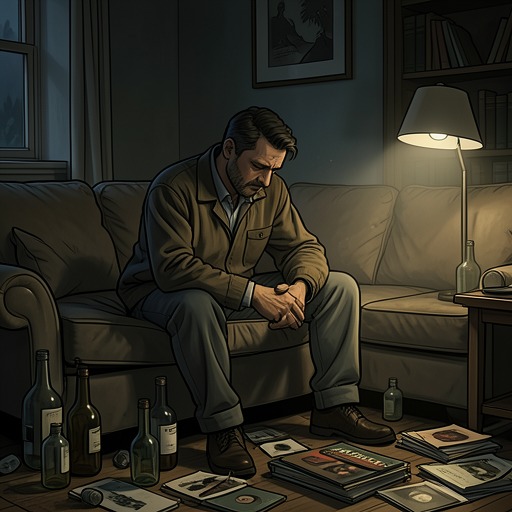
The assault leaves Robert Neville with a severe chest wound. When consciousness returns, he remembers the dark men and the attack on his house before turning toward the barred windows of the small cubicle. The bars make his new position unmistakable. The man who once watched the street through a peephole is now enclosed, visible only within a controlled space, and held for a public decision made outside it.
Ruth visits him while he is in pain and tells him that it is too late to escape. Her statement carries both immediate and historical force: Robert Neville admits that he had considered leaving and had even packed to go, but he could not abandon the house because he had grown accustomed to it. The house had become more than shelter. It was a habit, a defensive system, and the last structure through which he could still imagine himself as a person belonging to the old world.
Ruth tells him that the people outside are terrified of him, hate him, and want his life. When Robert Neville asks whether they are waiting for his death, she corrects him: they are waiting for his execution. The distinction places his fate inside a legal and social ritual. He is not merely being killed by enemies; he is being processed by the victorious society as a criminal, a biological threat, and a symbolic remnant.
Ruth's Intervention
Ruth cannot prevent the execution, but she tries to alter its manner. She warns Robert Neville that the society intends to execute him even though he is wounded and explains that the crowd has been waiting outside all night. She then removes a tiny packet from beneath her brassiere and presses it into his right palm, telling him that it is all she can do to make things easier. Her gesture is secretive and intimate, but it takes place within an official visit that she herself experiences as partly performed. After giving him the packet, she kisses him and says that he will soon be with Virginia Neville.
Ruth's final glance at his hand makes the packet's purpose clear without requiring her to state it openly. She tells him to take the pills soon, then leaves and locks the door behind her. Robert Neville's farewell to Ruth and to everything else marks the collapse of his remaining personal attachments, yet the pills also preserve a final measure of agency. The society controls the cell, the crowd, the legal sentence, and the timing of the public killing; Robert Neville can still decide whether his death will become its spectacle.
Public Judgment and Reversal
Despite his wound, Robert Neville forces himself upright, stands, and crosses the room on legs that barely respond. He reaches the window and looks down at the street, which is filled with people moving through the gray morning light. The crowd's sound first rises in startled cries and then stops altogether when its members see him. The silence turns the window into a stage and Robert Neville into the displayed object of collective attention.
That moment produces the execution's decisive revelation. Looking at the white faces below, Robert Neville realizes that he is now the abnormal one. Normality is no longer defined by the experience of one surviving man; it has become a majority concept, the standard established by the many. The vampires' society has made its own condition ordinary and has reclassified Robert Neville's resistance as pathological, dangerous, and inhuman.
The crowd's fear completes the reversal. Robert Neville sees awe, horror, and shrinking terror on the faces below and understands that they regard him as a scourge worse than the disease with which they have learned to live. His earlier violence survives in their memory as evidence: the bloodless bodies of their loved ones make him, from their perspective, an invisible terror whose continued existence requires removal. Robert Neville does not hate them when he understands this. His tightening hand around the packet shows that he wants an end without further violence and refuses, as far as he can, to turn his death into another scene of butchery.
Death and Significance
Robert Neville swallows Ruth's pills while leaning against the wall. As the final lethargy enters his limbs, he understands that he does not belong to the new people of the earth. In their eyes he is anathema and a black terror, just as the vampires had once been to him. The execution therefore completes a circle: the hunter becomes the hunted, the defender becomes the public menace, and the solitary definition of humanity gives way to the collective definition imposed by the new society.
His closing thought, "I am legend," gives the execution its final historical meaning. Robert Neville is not remembered as the ordinary man he believed himself to be, nor as the scientific investigator who fought an epidemic. He becomes a legendary terror within the mythology of the society that replaces his world. The pills deny that society a fully controlled killing, but they cannot prevent it from transforming him into a foundational story. His death is thus both an execution and a birth: the old world loses its last representative, while a new superstition begins to grow around the evidence of his existence.