Generator
I Am LegendThe generator is the mechanical center of Robert Neville’s isolated household and one of the few devices that separates organized survival from collapse. It supplies the electricity that lets him preserve food, illuminate and cool the house, and maintain a defensible routine while the vampires gather outside. More than a convenience, it is an active condition of his continued resistance: when it falters, his entire shelter becomes precarious; when it survives an attack, it restores the practical foundations of his life.
Function in Daily Survival
Robert Neville depends on the generator for the ordinary processes that have become extraordinary under epidemic conditions. Its power supports the lights in the house, the air-conditioning unit that draws away the oppressive odor of prepared garlic, and the refrigeration that keeps frozen food from spoiling. These functions allow him to transform the house into a controlled interior against an uncontrollable exterior. His defense therefore rests not only on weapons and garlic but also on the steady conversion of fuel into light, cooling, preservation, and domestic order.
The generator also appears in his written list of necessary tasks, where checking it stands alongside practical errands such as obtaining water and tools. That placement makes its maintenance part of a recurring survival discipline rather than a single technical problem. Robert Neville’s days are organized around inspection, repair, cleaning, and preparation; the generator is one of the objects through which he measures whether that organization can continue.
Failure and Material Vulnerability
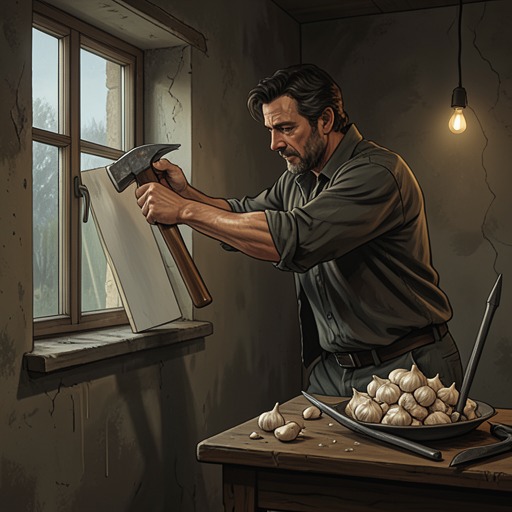
The generator does not remain an invisible tool. While Robert Neville is preparing garlic, the wall light flickers before returning to normal brightness, and he reacts with disgust because the generator has begun malfunctioning again. He knows that he must consult the manual, inspect the wiring, and perhaps install a new generator if repair proves too difficult. The incident converts electricity from a taken-for-granted service into a visible threat. A brief change in the light is enough to remind him that the house’s security depends on machinery that can fail.
This vulnerability complicates Robert Neville’s image as a self-sufficient survivor. He can stake vampires, gather garlic, retrieve vehicles, and repair structural damage, but none of those abilities guarantees power. The generator imposes a material limit on his independence: his will can direct maintenance, but it cannot abolish wear, broken wiring, or the need for replacement parts. The object thus gives his solitude a practical cost. He is alone not only with his fear and anger but also with every technical failure that ordinary society once distributed among specialists.
Survival Through Repair
The generator’s greatest importance becomes clear after the vampires attack the house. They damage it with a torn wire and several blows from cudgels, but they apparently do not understand its importance and leave it substantially intact. Robert Neville repairs it the morning after the attack, quickly enough to prevent the frozen food from spoiling. The repair turns the aftermath from total defeat into a damaged continuation of life, preserving resources that he believes can no longer be replaced because the city has lost its electricity.
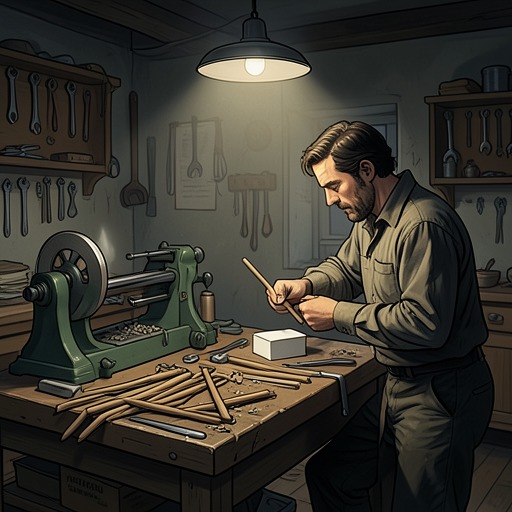
The surrounding labor shows how the generator belongs to a larger network of material supports. Robert Neville must clear broken bulbs, fuses, wiring, plugs, solder, spare motor parts, and scattered gasoline, while replacing a washing machine that the attackers have ruined beyond repair. He also mops up gasoline spilled from the drums. The generator is therefore not an isolated machine but the point around which fuel, electrical components, food, tools, and repair skills converge. Its survival makes the other salvaged materials useful; their availability, in turn, makes its continued operation possible.
Repair also gives Robert Neville a temporary outlet for the fury produced by the attack. He finds that restoring the garage, repairing the house, and replacing damaged equipment can absorb his energy and break the monotony of carrying away bodies, restoring the exterior, and hanging garlic. The generator’s practical repair consequently has a psychological effect. It cannot remove his loneliness, but it gives him a sequence of tasks through which anger becomes labor and labor briefly becomes control.
Contrast With the Vampire Threat
The generator’s importance is heightened by the vampires’ presence outside the house. Robert Neville sits behind a peephole listening to their movement and enduring their attempts to provoke him, while the illuminated interior remains the space in which he reads, plays music, drinks, and prepares defenses. The generator helps sustain that contrast between a furnished, powered refuge and the restless figures circling beyond it. When the water runs outside and the vampires notice it, their attention reveals how even simple household systems can become part of the nightly contest between the house and its predators.
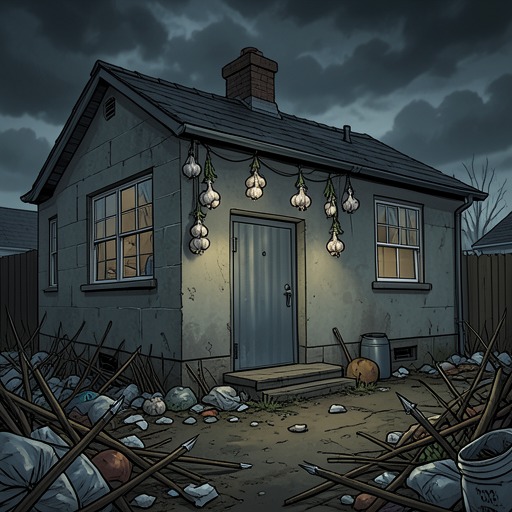
Yet the machine cannot make the house invulnerable. The vampires eventually approach in dark cars with spotlights, guns, axes, and pikes, and their organized assault breaches the defensive world Robert Neville has maintained for more than three years. The generator may preserve food and light, but it cannot prevent the new society from identifying, surrounding, and capturing him. Its partial success is therefore sharply defined: it sustains resistance for a time, while the changing social and biological order around him eventually overwhelms the isolated household.
Narrative Significance
As an object, the generator embodies the difference between survival as endurance and survival as infrastructure. Robert Neville’s persistence appears heroic because he works alone, but the generator exposes the hidden conditions of that heroism: fuel must be obtained, wiring must be understood, parts must be available, and repairs must be completed before sunset or before food spoils. His shelter is not a timeless fortress. It is a temporary assemblage of machines, materials, routines, and human attention.
The generator also reinforces the novel’s movement from private technical explanation toward biological and social transformation. Robert Neville investigates the vampires scientifically and eventually recognizes that bacteria can mutate, but scientific understanding does not grant absolute control over events. The generator offers a smaller, concrete version of the same lesson. It can be checked, repaired, and replaced, yet it remains subject to breakdown; its usefulness is real precisely because it is contingent. When the house is finally attacked and Robert Neville wakes wounded behind barred windows, the generator’s earlier successes are recast as the fragile interval during which one man could still mistake maintained machinery for a lasting order.