Hysterical blindness
I Am LegendHysterical blindness is the psychological condition Robert Neville invokes to explain how some vampire phenomena can exist alongside the physical effects of the vampiris bacillus. Its decisive significance lies in the change it produces in his method: after long attributing everything to infection or dismissing whatever did not fit the germ as superstition, he allows physical and psychological causes to operate together. The result is not merely a new medical hypothesis but a reinterpretation of the vampire as a traumatized, divided being whose perceptions have been reorganized by terror, guilt, and social collapse.
Definition and Discovery
A psychology text gives Robert Neville the starting point for the idea by defining hysterical blindness as a condition that may be partial or complete and may include one object, several objects, or every object. The definition supplies a precise alternative to the simpler assumption that a vampire’s failure to see something must be caused by damaged eyes or by the bacillus itself. It makes perception selective: what cannot be seen may be determined by the mind as much as by the body.
The idea returns to Neville while he is sitting in the living room with a psychology text on his lap, after a quotation sends his thoughts back to an earlier revival meeting. The recollection is therefore not an isolated scientific observation. It is part of an extended effort to understand the plague’s survivors and the apparently contradictory rules governing them. His investigation advances through a delayed act of recognition: material that once seemed incidental becomes useful when a new conceptual framework allows him to read it differently.
From Germ Theory to a Combined Explanation
Neville’s earlier approach had been rigid. He had persisted in attributing all vampire phenomena to the germ, and when particular traits did not fit the bacilli, he tended to judge them as superstition. He had considered psychological explanations only vaguely and had never granted them much authority. The notion of hysterical blindness signals his release from those unyielding preconceptions.
He now accepts that some phenomena may be physically caused while others are psychological. This distinction preserves the reality of infection without forcing every legend into a biological mechanism. It also changes Neville himself: the investigator who once divided evidence into germ-based fact and irrational superstition becomes capable of treating belief, trauma, and perception as interacting forces. His private amusement at having been a kind of blind man carries an ironic force, because the man studying blindness recognizes that his own prior certainty had limited what he could see.
Trauma, Dread, and Selective Perception
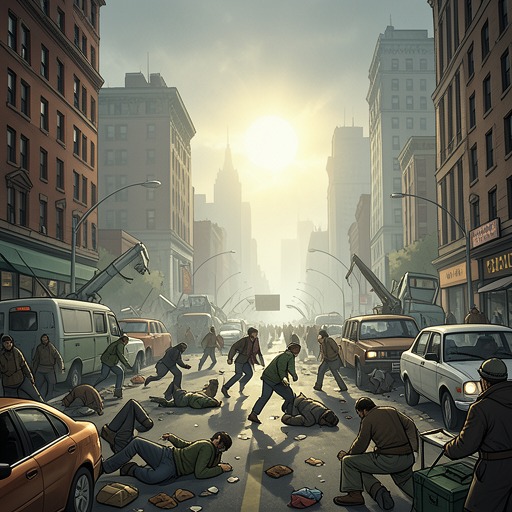
Neville connects hysterical blindness to the shock suffered by plague victims who regain consciousness beneath heavy soil and discover that death has not brought rest. Their bodies claw their way out of the earth, driven by a strange and hideous need. For Neville, this awakening is not simply a physical transformation. It is a traumatic rupture capable of undoing whatever stability remains in the mind.
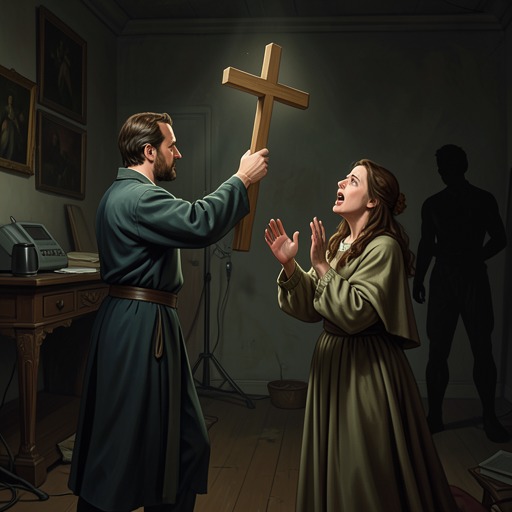
The cross becomes the first major application of the theory. A person who has been forced to accept the reality of the dread formerly attached to a sacred object may suffer a psychological collapse when that dread is vindicated. The cross’s power can therefore arise from the victim’s mental response to terror and belief rather than from an independent supernatural force. The vampire’s repulsion is understood as a learned or intensified psychic block created by the collision between former worship and present horror.
Neville extends the same logic to the vampire’s blindness before its own image. He proposes that self-hatred, produced by the shock of becoming the abhorred creature feared in life, may create a block in the weakened mind. The vampire then becomes unable to perceive its own reflection because the image is psychologically intolerable. This explanation turns the missing reflection into more than a visual defect: it expresses a consciousness that cannot accommodate its transformed identity.
Perception and the House Under Siege
The novel repeatedly stages perception through restricted spaces, making hysterical blindness part of a wider pattern of seeing and not seeing. Robert Neville observes from behind a peephole, but he stops looking directly at the women outside after they notice him and strike vile, enticing postures intended to draw him from the house. He can hear them even when he refuses to watch them, and the sound interferes with his attempt to preserve music and interior concentration. His house becomes a defensive apparatus organized around controlled visibility.
That arrangement reverses as the story progresses. Ben Cortman approaches the lawn and echoes Neville’s muttered invitation to come out, while Neville remains motionless behind the peephole. Later, when Ruth asks which vampire is outside, Neville identifies the figure by the lamppost and explains that he has killed most of them, though a few remain beyond his reach. His power depends on seeing and classifying the infected from a protected position; the vampires’ own altered perceptions make their behavior intelligible to him, but they do not make him safe.
The final reversal comes when the new society arrives at night in dark cars equipped with spotlights, guns, axes, and pikes. Their beams sweep around the boulevard corner toward Cimarron Street, exposing the bloodless faces outside and disorienting the vampires with blinding light. Robert Neville is watching from the peephole when the observers become exposed and the observer becomes the target. After the attack, he awakens injured in a small cubicle with barred windows and remembers the dark men and the assault on his house. The movement from peephole to spotlights to barred windows transforms visibility into a mechanism of control: the one who once studied the vampire at a distance is finally confined and displayed within the new order.
Significance
Hysterical blindness allows the vampire legend to be rebuilt from overlapping biological and psychological materials. Crosses, reflections, and other traditional signs are not simply accepted as supernatural facts, nor are they all erased by the discovery of the bacillus. They become symptoms of minds damaged by plague, resurrection, dread, and self-recognition. The theory also deepens the novel’s central irony. Robert Neville believes himself to be the clear-sighted scientific observer, yet his earlier certainty prevented him from recognizing the psychological dimension of the evidence.
As a state of selective perception, hysterical blindness also anticipates the novel’s broader reversal of normality. Neville can see the infected as objects of study, while the emerging society sees Neville as the abnormal remnant. His explanations may clarify the mechanisms of the old vampire myths, but they cannot preserve his authority over the world those explanations describe. The concept therefore belongs both to his scientific investigation and to the novel’s final critique of vision itself: seeing is never only a matter of open eyes, because fear, belief, identity, and power determine what each person is able—or permitted—to recognize.