Kathy Neville
I Am LegendKathy Neville is Robert Neville’s young daughter and one of the central absences governing his life after the plague. She is remembered as a small blonde child, protected in illness by a makeshift shelter, and ultimately carried away to a mandatory fire after her death. Her loss is not a concluded piece of backstory: it returns in dreams, bodily shock, and compulsive memory, making Kathy a continuing presence in Robert Neville’s isolation and a decisive cause of his resistance to the plague’s impersonal burial system.
Identity and Place in the Family
Kathy is presented through Robert Neville’s recollections as a very young child. In the domestic scenes that survive in his memory, she sleeps in her room with her small blonde head motionless on the pillow and her cheeks pink with heavy sleep. Robert checks on her before dressing, even while dust from the storms has spread across the house. Because the dust repeatedly settles over her, he erects a tentlike shelter over her bed, nailing one edge of a shelter half to the wall and supporting the other with poles lashed to the bed. The improvised protection shows both the physical degradation of the household and the ordinary parental care that Robert continues to perform amid catastrophe.
Kathy’s place in the family is also defined by the contrast between her fragile domestic presence and the violent public measures imposed by the plague. Somewhere beneath the corpse-burning pit is Kathy’s body, a fact that turns the pit from a general instrument of epidemic control into the location of a personal wound. Robert’s knowledge that she is there prevents the fires from becoming an abstract necessity. They are the place where his child was taken from him and where the state’s emergency law converted parental grief into an enforced act of disposal.
Death and the Burning Pit
Kathy dies during the plague, and her body is removed under the law requiring every dead person to be transported immediately to the fires. Funeral parlors are closed, and morticians are prevented from practicing; the authorities believe that only flames can destroy the bacteria responsible for the disease and prevent its communication. Robert understands the public rationale, but Kathy’s death exposes the emotional violence concealed by that rationale. He cannot regard her body as an infected object whose destruction is merely sanitary procedure.
Robert later sees the event in a traumatic mental replay. A great fire roars yellow, sending dense, grease-thick clouds into the sky. Kathy’s tiny body is in his arms when a man approaches and snatches her away as though taking a bundle of rags. Robert lunges after him, screaming her name, while men in canvas and masks hold him back. His shoes gouge trenches in the earth as he is dragged away. The scene ends with a blow to his jaw, the sweep of daylight into darkness, and Robert sitting rigidly in Ben Cortman’s car while a gigantic pail of smoke rises above the ground. Kathy’s death is therefore remembered not as a quiet medical loss but as an ordeal of helpless witnessing, physical restraint, and forced separation.
Memory, Grief, and Recurrence
Kathy remains active in Robert’s inner life after her burial. He dreams about Virginia Neville and cries out in his sleep, gripping the sheets with frantic fingers, while memories of the family’s destruction return through bodily disturbance rather than orderly explanation. At one point, the room seems to lose its balance when the remembered scene rises again in his mind; pain strikes his knee, and he stumbles toward the living room, frozen before the bedroom door. The recollection of Kathy’s removal is inseparable from the larger collapse of his household and from the fear that death has transformed the people he loved into threats.
Her death also intensifies Robert’s determination to protect Virginia Neville’s remains. When he finds the iron door of Virginia’s crypt slightly ajar, he imagines that the vampires may have reached her and vows to burn down the city if they have touched her. He opens the door expecting violation, but the sealed casket remains untouched. Later, when Virginia dies, Robert refuses to surrender her to the fire because Kathy has already been consumed by that system. The two losses thus become structurally linked: Kathy’s burning is the precedent that makes Virginia’s burial an act of defiance.
Consequences for Robert Neville
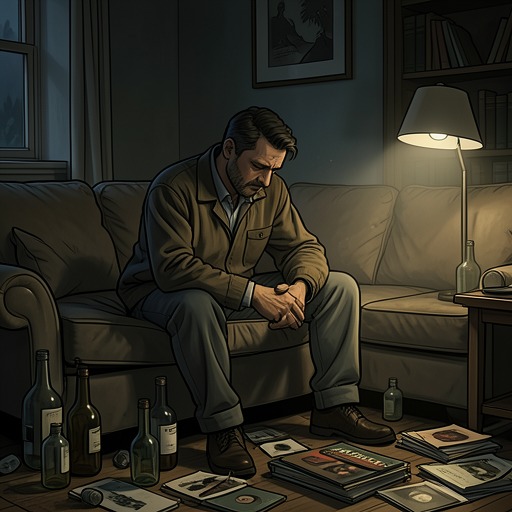
Kathy’s death contributes to Robert’s emotional collapse and to the repetitive, self-protective routines through which he survives. After burying Virginia, he lies fully clothed on his bed, half drunk, staring at the black ceiling while the darkness spins with fireflies. The measured details of the clock and the two days since the burial emphasize how grief has reduced time to physical counting. Kathy’s earlier loss remains part of this accumulated bereavement, a wound that has not been replaced by Virginia’s death but deepened by it.
The surviving dog briefly opens a new channel for Robert’s attachment. When he discovers a dog roving across the lawn, he is shocked into motion and repeatedly calls to it, promising that he will not hurt it. He leaves milk and hamburger outside, surrounding the food with garlic bulbs in the hope that the vampires will not interfere. When the dog finally limps out from between the houses, Robert waits without moving and then picks it up, restraining its snapping jaws while its nearly hairless body squirms in terror. The dog licks his palm, and tears run down his cheeks. In a week the dog is dead. Its brief appearance and death echo the earlier loss of Kathy: Robert tries to protect a vulnerable living being, but disease and the ruined world again defeat his care.
Kathy also remains present in Robert’s account of Virginia’s return. Speaking to Ruth, he explains that Virginia came back after he had buried her, appearing as an outline or shadow and no longer being the woman he had known. The horror culminates in the realization that his own wife has returned to drink his blood. Kathy is not named in this confession, but her earlier death forms part of the same emotional history: Robert’s loved ones are first removed by plague and fire, then threatened by reanimation and vampiric transformation. Kathy’s significance lies in the way her loss makes every later return, burial, and act of bodily preservation both intimate and terrifying.
Narrative Significance
Kathy Neville’s limited direct presence is proportionate to the nature of Robert’s grief. She is not developed through an independent sequence of actions; she survives as an image of childhood vulnerability, a remembered body, and a name torn from Robert during the fire. This absence gives her narrative force. The child asleep beneath a dust-covered shelter and the tiny body carried toward the flames belong to sharply opposed registers, yet the novel binds them together to show how catastrophe invades ordinary family life.
Her death also anchors the conflict between human feeling and institutional survival logic. The plague law treats burning as necessary because it destroys the bacteria, but Robert experiences the same process as the destruction of an irreplaceable person. Kathy therefore helps explain why Robert’s later actions are driven by more than scientific curiosity or physical self-preservation. His investigations of disease, his defenses, and his refusal to accept the world’s new rules all unfold in the shadow of a child whom the emergency order reduced to contaminated matter. Through Kathy, private mourning becomes the emotional measure by which Robert judges the post-plague world.