Mandatory plague-body incineration law
I Am LegendThe Mandatory plague-body incineration law governs the disposal of plague dead in the devastated society of I Am Legend. Its stated purpose is biological containment: only flames can destroy the bacteria responsible for the plague, and immediate removal is intended to prevent the disease from communicating or spreading through corpses. Yet the law’s decisive significance is not merely medical. By requiring every body to be transported to the fires, it removes burial from the survivors’ control and makes the state, rather than the family, the final authority over the dead.
Causes and Public-Health Logic
The law emerges from a crisis in which ordinary institutions have collapsed. Funeral parlors are closed, and the few morticians still healthy enough to work are forbidden to practice. The rule therefore substitutes a centralized disposal system for individualized funerals: everyone, without exception, must be taken to the fires immediately upon death. The urgency reflects the perceived danger of the plague body. Robert Neville understands that the bacteria must be destroyed by fire, so incineration is presented as the only reliable barrier against further transmission.
The broader disease model later gives the rule a more specific scientific rationale. Robert Neville discovers a visible bacillus in infected blood and names it vampiris. His research leads him to understand the plague as a bacterial disease capable of rapid spread, with flies and mosquitoes functioning as mechanical carriers. The germ can circulate through blood, alter bodily activity, live on fresh blood, and, when deprived of it, sporulate; spores released from a decomposing host can seek new hosts and begin another infection. Within that framework, a corpse is not simply a memorial object. It is a possible biological source, and the law treats it accordingly.
The rule also belongs to a wider system of contamination control. Robert Neville’s house is sealed with boards, garlic, and air-conditioning, while sunlight, blood, stakes, and the opening of a body are all connected to the operation of the disease. He eventually understands that air can transform the germ from a symbiotic organism into a virulently parasitic one, and that opening infected flesh prevents the body from sealing itself. Incineration thus appears as the institutional counterpart to his private defenses: both seek to control the passage of infection across bodily and architectural boundaries.
Enforcement and the Suppression of Burial
The law does more than prescribe a sanitary procedure; it prohibits competing forms of care. Cemeteries are locked and watched, and men have been shot while attempting to bury their loved ones. Burial is therefore not treated as a harmless alternative but as a threat to public safety. The state’s emergency logic makes the dead administratively mobile: bodies must be collected, transported, and consumed by fire before relatives can reclaim them.
Its enforcement is visible in Robert Neville’s confrontation with a man who challenges his refusal to go to the fire. Neville repeatedly insists that he will not take his wife there, while the man appeals to the law and grows suddenly furious when Neville resists. The exchange shows how completely the rule has entered ordinary social behavior. The man does not need to explain the medical theory; the obligation itself is presumed self-evident. Neville’s private decision is interpreted as defiance of the collective order rather than as an act of mourning.
The fires are represented as a permanent landscape of emergency. Robert Neville drives along Compton Boulevard toward a field excavated into one enormous pit, where a fire is always burning beneath a pall of smoke. Wearing gloves and a gas mask, he drags bodies from his Willys station wagon and pushes them down the incline onto the smoldering ashes. The procedure is impersonal and physically repetitive, reducing individual deaths to contaminated matter requiring immediate destruction. The scale of the pit makes the law’s abstraction visible: a public rule about “everyone” becomes a vast accumulation of anonymous bodies.
Robert Neville’s Defiance
Robert Neville knows the law and understands its stated necessity, but knowledge does not overcome his refusal to surrender Virginia Neville. After her death, he sews her into a blanket until only her face remains visible, then covers her mouth, nose, and eyes. The act is both concealment and preservation. He is trying to protect her from the official process that would transform his wife into a plague object, even while he recognizes the danger that the law claims to manage.
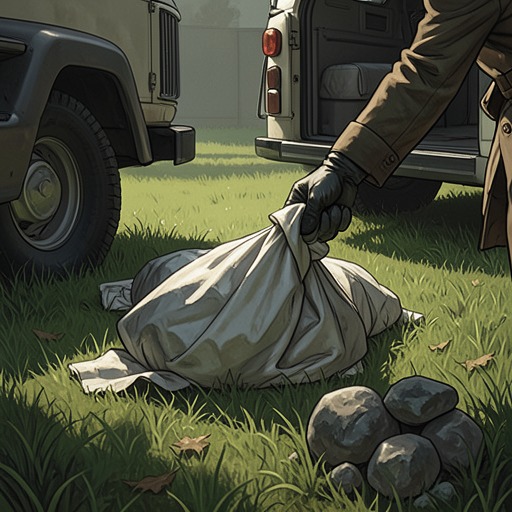
When he is stopped, his resistance becomes explicit. He refuses to drive to the fire and reverses away from the man demanding compliance. The deserted streets allow him to evade immediate detection, and he avoids the watched cemeteries because burial there would be impossible and dangerous. Instead, he drives quietly into a high-weeded lot, carries Virginia from the car, and places her on an open patch of ground. His choice restores, however briefly, the old relation between spouse and body: he remains responsible for where she lies, rather than allowing an emergency apparatus to determine her final destination.
The defiance is not presented as simple ignorance of public health. Robert Neville has already encountered the logic that makes fire necessary, and his later scientific work confirms the reality of bacterial transmission. His rebellion is therefore a conflict between two forms of responsibility. One demands that every body be destroyed for the sake of the living; the other insists that a husband cannot prove his love by delivering his wife to a bonfire. The law forces those responsibilities into opposition instead of allowing them to coexist.
Social and Ethical Consequences
The rule converts mourning into a test of obedience. Robert Neville asks himself how many husbands could take the women who had shared their lives and love and drop them into the flames, how many parents could incinerate adored children, and how many children could throw beloved parents onto a bonfire. These questions reveal the law’s emotional violence. Its universal wording erases the distinctions that make grief personal: spouse, child, parent, and stranger become identical units of infectious risk.
At the same time, the law demonstrates the logic of emergency power. Ordinary rights over the dead are suspended, cemeteries are closed, and force may be used against those who resist. The measure protects the living by denying the bereaved authority over their own family members. It is therefore both a public-health intervention and a form of biological governance, deciding which practices are permissible and which bodies must be removed from social space.
The later reorganization of society sharpens the law’s ambiguity. The emerging new vampire society also justifies killing in the name of survival, arguing that the living cannot coexist with impaired dead whose existence has been reduced to a single purpose. Its program repeats the structure of the old emergency rule: classify a population as dangerous, deny it continued coexistence, and destroy it for the protection of the group. The difference is that what began as state sanitation becomes, in the new order, a broader political principle of exclusion.
Narrative Significance
The Mandatory plague-body incineration law links the novel’s scientific and emotional plots. Its medical basis drives Robert Neville toward investigation of the vampiris bacillus, while its enforcement forces him to confront the limits of scientific necessity. The law helps explain why the fires dominate the landscape, why burial becomes an act of rebellion, and why the dead are never merely absent: they remain potential carriers, objects of fear, and symbols of the social order’s willingness to sacrifice intimacy for control.
Its deepest irony is that the rule is designed to prevent communication, yet it communicates a stark moral message. Fire is supposed to stop bacteria from reaching new hosts, but it also declares that the dead have lost the protection of family, ritual, and place. Robert Neville’s refusal to burn Virginia Neville preserves a private ethical boundary against that declaration. Later, when the new society identifies Robert Neville himself as a threat to be eliminated, the same logic turns back upon him: the man who once resisted the disposal of the infected dead becomes a body that a reorganized society may decide must be destroyed for its own survival.