Microscope
I Am LegendThe microscope is the decisive scientific instrument in Robert Neville’s investigation of vampirism. It changes the vampires from figures governed by folklore into bodies containing an observable microorganism, yet it also demonstrates that an instrument does not automatically produce knowledge: Neville must learn how to obtain, prepare, illuminate, and interpret evidence. Its final revelation—that bacteria can mutate—shifts his understanding again, turning the microscope from a device of discovery into the means by which he recognizes the limits of his earlier conclusions.
Acquisition and Material Failure
Robert Neville approaches the microscope as the first practical step in transforming scattered observations into research. After considering evidence about bacteria, sunlight, and the mechanical transmission of disease by insects, he restrains his urge to begin investigating without preparation and repeatedly tells himself that obtaining a microscope must come first. The instrument therefore enters the narrative as a promise of method: it offers a way to move beyond guesses about wooden stakes, garlic, and other inherited rules. When Neville buys his first microscope, however, the object becomes conspicuously resistant to his intentions. Its base is badly leveled, vibration disturbs it, the moving parts wobble, the mirror slips, and the instrument lacks the substage needed for a condenser or polarizer. Its single nosepiece makes changes in magnification awkward, while its lenses are unusable. Because Neville knows nothing about microscopes, he has chosen the first instrument he encounters. After three days of frustration, he throws it against the wall and stamps it into pieces. The broken microscope exposes the material conditions hidden by the abstract idea of scientific investigation: a tool must be stable, adjustable, and technically suitable before it can extend human perception.
Learning to Use the Instrument
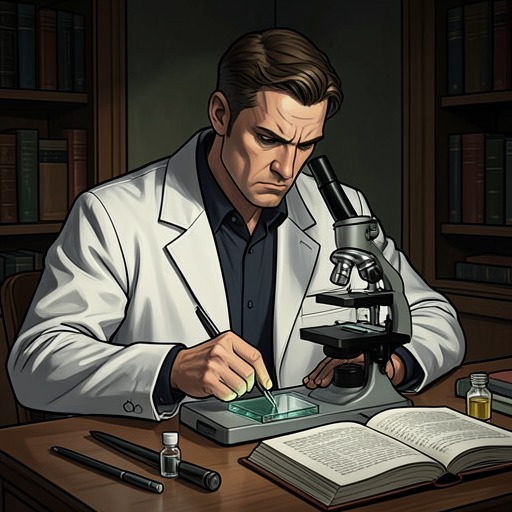
The destruction of the first microscope does not end Neville’s inquiry; it redirects it. Once calm, he goes to the library for a book on microscopes. On his next search he finds a capable instrument with a triple nose stage, a substage for condenser and polarizer, a firm base, smooth movement, an iris diaphragm, and good lenses. The contrast between the two devices makes his earlier failure a lesson in preparation rather than a mere accident. Neville then spends substantial time learning the microscope’s operations. He practices directing light with the mirror, works across magnifications from a three-inch power to a one-twelfth-inch power, and learns to use cedar-wood oil with the highest-power lens. The training is costly: he breaks thirteen slides while learning. Within three days of sustained attention, however, he can manipulate the adjustment heads quickly and regulate the diaphragm and condenser to obtain the necessary light. He also learns that mounting specimens requires control over dust, which appears enormous under magnification. Glass slips, cover glasses, pipettes, cells, forceps, Petri dishes, needles, and chemicals acquire systematic positions, and Neville discovers unexpected pleasure in this orderliness. The microscope thus reorganizes not only what he sees but how he works, making discipline part of his scientific response to isolation.
Discovery of Vampiris
The crucial specimen is blood taken from a woman. Preparing it takes days, and Neville succeeds only after repeated effort to mount a few drops correctly in a cell and center the cell on the slide. The thirty-seventh blood slide becomes the turning point. As he adjusts the spotlight, draw tube, mirror, diaphragm, and condenser, his growing heartbeat reflects his intuition that this examination will matter. Under the lens he sees that the cause is not a virus, which would be invisible in this form, but a germ moving delicately across the slide. He names it vampiris. Consulting bacteriology texts, he identifies the cylindrical organism as a bacillus: a rod of protoplasm propelled through blood by hairlike flagella projecting from its cell envelope. The microscope supplies the concrete evidence that his earlier deductions lacked. The vampire is no longer explained only through legend or ritual; its condition has a visible biological agent. The discovery also carries an immediate emotional contradiction. Neville understands that the germ is the murderer behind centuries of fearful superstition, and that he has completed the investigation that scientists had begun. Yet the answer arrives too late to provide an easy remedy. He feels crushed by the knowledge that he can identify the cause without knowing how to cure those still living. The microscope therefore produces both mastery and helplessness: it gives him a name and a form for the disease while revealing how much remains beyond his competence.
Reinterpretation and Final Significance
The microscope remains central when Ruth questions what Neville might do and he turns again to a glass slide. Later, after reading her letter and recognizing that its account is not wholly false, he places the microscope back on its base and looks through the eyepiece for a long time. What he sees changes his entire understanding. The compact principle he has encountered repeatedly but never fully appreciated becomes decisive: bacteria can mutate. This final use of the microscope revises the confidence attached to the original discovery. The vampiris bacillus is real, but its existence does not guarantee a single, stable disease pattern or a final explanation of the new society forming around vampirism. Mutation accounts for change where Neville had previously treated evidence as fixed, and it makes his earlier failure to foresee the transformation appear both intellectually understandable and devastatingly consequential. The same instrument that once revealed the germ now reveals instability within the germ’s biological history. As an object, the microscope is neither a passive prop nor a magical source of truth. Its poor construction initially defeats observation; its replacement demands instruction, patience, and ordered technique; its successful use opens a path from supernatural belief to bacteriology; and its later evidence undermines the security of a finished model. Through it, Neville’s relation to the material world becomes more exact but never complete. The microscope’s power lies precisely in this double action: it makes the invisible visible while forcing the observer to admit that visibility is only the beginning of knowledge.