Muzhou
I Am LegendWooden stakes are both weapons and instruments of knowledge in Robert Neville’s isolated war against the vampires. He makes them by hand, carries them through the streets, and repeatedly uses them to dispose of the infected dead. Their practical importance is immense, but their deeper significance lies in the way they expose the limits of legend. What begins as a ritual-looking act of vampire killing becomes one stage in Neville’s painstaking discovery of the Vampiris bacillus and its response to air.
Construction and Material Burden
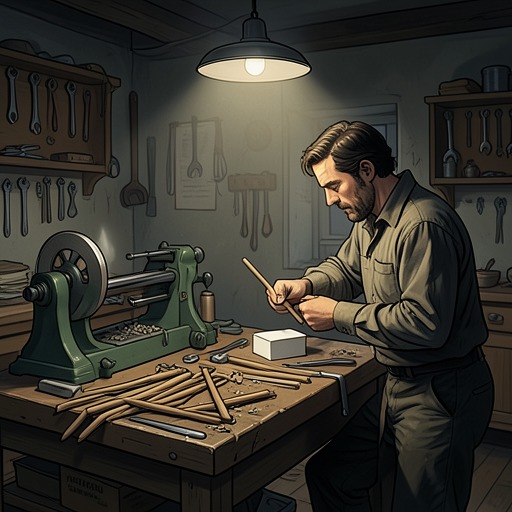
All afternoon, Robert Neville makes stakes because they are his first line of defense, even though the phrase has begun to sound hollow to him. He cuts thick doweling into nine-inch lengths with a band saw, then holds each piece against a whirling emery stone until its point is sharp as a dagger. The work is tiresome and monotonous. Hot-smelling wood dust settles into his pores, enters his lungs, and makes him cough, turning survival into a repetitive industrial chore rather than a heroic ritual.
The labor never seems to produce a lasting supply. However many stakes Robert Neville makes, they disappear almost immediately, and doweling becomes increasingly difficult to find. He anticipates that he will eventually have to turn rectangular lengths of wood into usable weapons, an inconvenience that reveals the material limits of his defense. The stakes are not inexhaustible symbols or supernatural talismans; they are consumable objects whose manufacture absorbs time, timber, bodily effort, and attention that Robert Neville would rather devote to finding a better method of disposal.
He also uses music to endure the work. While the lathe runs, Beethoven’s Third, Seventh, and Ninth symphonies play through the loudspeaker he installed in the bedroom. The contrast is stark: disciplined musical form fills the hours while the repetitive shaping of wood answers a world governed by infection and violence. The stakes therefore belong to a domestic system of survival in which craftsmanship, machinery, records, and barricades are all pressed into service against the night.
Use in Defense and Disposal
Robert Neville carries the stakes in a bag slung across his back and wears a holster containing his mallet. Before leaving the house, he locks the front door, then takes the tools into the streets as part of a carefully ordered routine. On one morning he has forty-seven stakes and uses all of them while moving from house to house. The number gives the campaign a stark arithmetic: each stake represents one more body handled, one more immediate threat removed, and one more depletion of the supply that must be rebuilt.
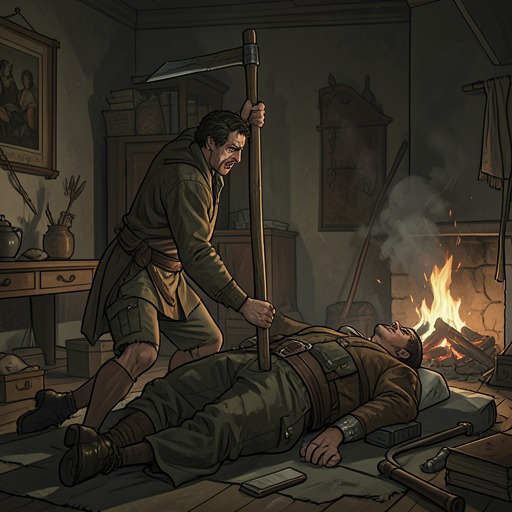
The weapon’s use is physically direct. Robert Neville drives it into bodies, sometimes accompanied by a mallet blow, and initially observes blood pulsing over the pale flesh. He experiments with the stomach, shoulder, neck, legs, and arms, finding the same broad result in each case. The repeated procedure converts violence into an improvised test. Each body becomes a site where an assumption can be checked, although the testing remains dangerous, exhausting, and emotionally corrosive.
The stakes also structure Robert Neville’s relation to visibility. At first he watches the vampires through a peephole, but he stops looking when the women outside begin striking obscene poses to lure him from the house. By daylight he drags their bodies across the lawn, throws them onto a canvas tarpaulin, gathers stones and bricks, and prepares to dispose of them. The stake is thus part of a larger cycle of surveillance, killing, transport, and removal, not an isolated weapon used in a single confrontation.
From Folklore to Experiment
Robert Neville initially assumes that a stake must strike the heart because that is what vampire legend teaches. Yet the material evidence resists the legend. Stakes placed in different parts of the body still kill, so he begins to suspect hemorrhage rather than a uniquely vulnerable heart. His attempt to explain the weapon’s effect proceeds through observation, hypothesis, and failure: the familiar rule is retained only until experience makes it untenable.
The decisive contradiction comes from a woman whose body dissolves with extraordinary speed after being staked. Robert Neville realizes that the result cannot be explained by blood loss. He had already seen that daylight could kill a vampire even when the heart was untouched and no garlic was present, and the rapidly decomposing woman supplies another challenge to the old model. Her body had been dead for so long that exposure to air caused the germs to produce spontaneous dissolution. The stake is now understood less as a magical instrument than as a device that changes the conditions inside the infected body.
When Robert Neville later explains the discovery to Ruth, he describes the stake as opening the flesh and allowing air to enter. The germ then becomes aerobic and changes from a symbiotic organism into a virulently parasitic one; it consumes the host. The stake also keeps the wound open so that the body’s sealing mechanism cannot function. The heart, once treated as the indispensable target, has no essential role. Robert Neville consequently changes his method: instead of spending endless hours making stakes, he cuts the wrists deeply enough to prevent the infected flesh from closing.
The weapon therefore marks an epistemological progression. It begins within the vocabulary of superstition, passes through a mistaken physiological theory, and finally contributes to a germ-based account of vampirism. Its apparent simplicity is deceptive. A sharpened piece of wood does not merely destroy a vampire; it supplies Robert Neville with a repeatable intervention whose results force him to revise what he thinks he knows.
Trauma, Memory, and Repeated Violence
Although the stakes are practical objects, their use is entangled with Robert Neville’s grief. He dreams about Virginia Neville and cries out in sleep, his fingers gripping the sheets like talons. Later, memories of the great fire, Kathy Neville’s small body, and the man who carried her away return with such force that the past becomes an enacted scene rather than a distant recollection. The repeated need to stake bodies keeps him moving, but it also places death before him again and again.
This emotional pressure is visible in his response to the woman whose decomposition exposes the limits of his theory. He is so unnerved that he stops his work, remains at home, drinks, and allows the bodies to pile up on the lawn while the house falls into disrepair. The stakes have not made death manageable; they have made his contact with death routine enough to conceal its accumulating effect until one anomalous corpse breaks through that routine.
The same pattern reaches into his encounter with Virginia Neville’s return. Robert Neville tells Ruth that he buried his wife, but that she came back as an outline or shadow and no longer resembled the person he had known. His attempt to keep her with him collapses when she wants only to drink his blood. In this context, the stake is not simply a defense against anonymous monsters. It belongs to the material world in which the dead can return altered, and in which love, burial, infection, and violence cannot be kept in separate categories.
Limits and Afterlife of the Weapon
The stake remains important even after Robert Neville understands that it is not the heart that matters. Its long use has trained him to interpret bodies through physical intervention, but the discovery of the bacillus changes the balance between craftsmanship and explanation. He no longer needs to regard the pointed weapon as the complete answer. Its value lies in what it reveals about air, wounds, infected tissue, and the body’s failed ability to seal itself.
The object also belongs to the defensive world that eventually fails him. Robert Neville spends more than three years alone in his house, watching and listening through its defenses, until the new vampire society arrives in dark cars with spotlights, guns, axes, and pikes. The attackers’ equipment overwhelms the older solitary system represented by the peephole, the mallet, and the bag of stakes. After the assault, Robert Neville wakes in a tiny cubicle with barred windows, wounded in the chest and certain that he is going to die. The wooden stake has helped him survive the old order, but it cannot preserve the social position from which he has fought.
Its final significance is therefore double. As a tool, the stake is effective, portable, renewable only through exhausting labor, and eventually replaceable by a more precise cutting method. As a narrative object, it connects folklore to science, bodily disposal to bereavement, and individual defense to the larger transformation of society. Robert Neville begins by making stakes because legend tells him what vampires are vulnerable to; he ends by understanding that the object’s power comes from a material process that legend had misnamed.