Neville discovers vampire bacteria
I Am LegendNeville’s discovery of the vampiris bacillus is the decisive scientific turning point in his investigation of vampirism. At the Los Angeles Public Library on April 7, 1976, he moves from scattered experiments and inherited superstition toward a provisional blood-based hypothesis, then confirms under the microscope that a visible bacillus inhabits the blood of the afflicted. The discovery explains how the vampire can be real without being supernatural, overturns Neville’s earlier resistance to germ theory, and changes the meaning of the plague from a collection of monstrous incidents into a disease with a material cause.
Causes and Background
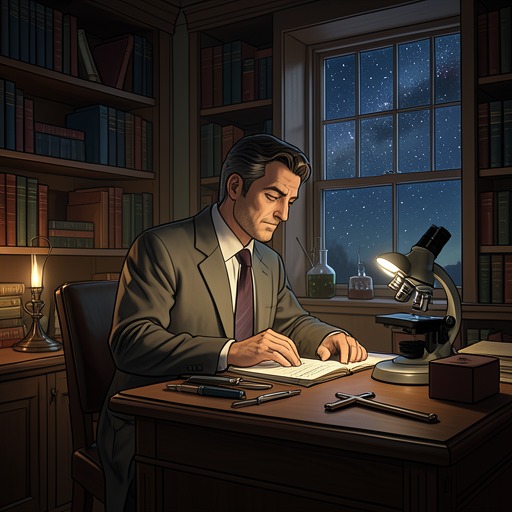
The discovery arises from Robert Neville’s prolonged isolation and frustration. His earlier experiments have produced no reliable answer, and after a half week of drinking, disgust, and desultory investigation he recognizes that isolated tests are wasting his time. If the catastrophe has a rational explanation, he decides, it must be approached through systematic research rather than through disconnected observations. The Los Angeles Public Library becomes the setting for this new phase: on April 7, 1976, Neville climbs to its second-floor science room, entering a space whose silence and accumulated knowledge contrast with the disorder and danger outside.
His first working principle is deliberately tentative. For lack of better knowledge, he chooses blood as the starting point, because every apparent feature of vampirism seems to involve blood, bodily transformation, and the relation between infection and the circulatory system. He begins by reading about blood rather than by assuming that traditional vampire lore is either wholly true or wholly false. His reading of the lymphatic system gives him a usable connection between blood and disease: plasma and blood cells can escape into tissue spaces, while lymphatic vessels return the material to the bloodstream. Knowledge that once seemed abstract now acquires a possible application to the affliction surrounding him.
The conceptual obstacle is Neville’s contempt for earlier people who had died defending germ theory while others mocked them in the name of vampires. The word “germs” initially feels inadequate to the scale of the disaster. He wonders whether his resistance is mere stubbornness or fear that a germ-based explanation would create a task too large for one man. He eventually adopts a compromise: bacteria and vampire lore need not cancel each other out. Bacteria could be the answer to the vampire, allowing the legendary signs to remain as observable effects while replacing supernatural causation with biological mechanism.
What Happens
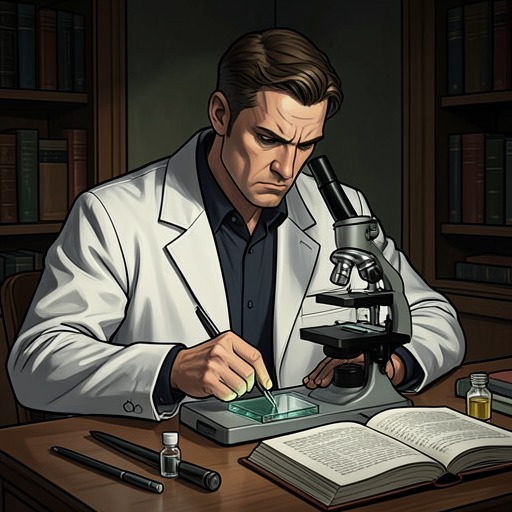
Neville obtains a blood specimen from a woman and spends days trying to prepare it correctly. The work is painstaking: he must mount a few drops in a cell, center the cell on the slide, and position the equipment precisely. His thirty-seventh slide becomes the moment of confirmation. He places it beneath the microscope, turns on the spotlight, adjusts the draw tube and mirror, and works the diaphragm and condenser into position. The sequence turns laboratory procedure into suspense, because his growing heartbeat registers the possibility that the accumulated observations may finally cohere.
Under the lens, Neville determines that the cause is not a virus, which could not be seen in this way. Instead, a germ moves delicately across the slide. He names it “vampiris,” marking the instant when an unexplained condition receives a specific biological identity. Consulting a bacteriology text, he classifies the organism as a bacillus: a cylindrical rod of protoplasm that propels itself through blood by means of tiny threads projecting from its cell envelope. These hairlike flagella lash the surrounding fluid and drive the organism forward, giving the infection a physical agency rather than an occult one.
For a long time Neville cannot continue working. The slide has supplied more than a laboratory result; it has supplied the cause of the vampire. In the moment he sees the germ, centuries of fearful superstition are recast as an incomplete account of a real phenomenon. Scientists were right that bacteria were involved, but the discovery is also personally isolating. Neville, thirty-six and a survivor, imagines himself completing the inquest and identifying the murderer: the germ within the vampire.
Biological Explanation and Scope
The bacillus allows Neville to reconstruct vampirism as an infection process. In the developing model, the organism can exist in a spore-bearing cycle. Spores are released and carried by storms, then lodge in minute abrasions produced by scaling dust. Once inside the skin, a spore germinates and multiplies by fission. As the population increases, surrounding tissue is destroyed and channels become plugged with bacilli; the destruction of tissue and organisms releases poisonous decomposed bodies into adjacent healthy tissue, and the poisons eventually reach the bloodstream.
This account removes the need for the familiar supernatural imagery. The process can occur without blood-eyed vampires hovering over beds, bats striking estate windows, or any other supernatural agent. Yet the conclusion is not that the vampire was imaginary. The vampire is real; what was false or incomplete was the traditional explanation of its reality. The discovery therefore preserves the observable horror while changing its category. Night attacks, bodily changes, and the plague’s spread belong to a disease ecology rather than to a world governed by magical rules.
The speed of the 1975 plague reinforces the new hypothesis. Neville asks whether vampires alone could have propagated the infection so rapidly through their nightly marauding. The comparison with historical plagues extends his reasoning beyond the immediate neighborhood. The fall of Athens, traditionally associated with bubonic plague, begins to resemble the 1975 catastrophe, and Neville becomes inclined to think that an earlier vampire infection may have been misunderstood in the same way. Vampirism is thus placed within a long history of epidemics that societies have explained through the knowledge available to them.
Consequences and Limits
The discovery gives Neville intellectual certainty but not practical mastery. The answer arrives when he feels it may already be too late, and that timing turns triumph into despair. He does not know how to cure the living, and he knows nothing about bacteriology beyond what he has just begun to study. The microscope has identified the enemy without providing a weapon against it. His response is to force himself back into study, converting helplessness into a new objective: if knowledge is insufficient, he must acquire more.
The discovery also changes the status of Neville’s daily defenses. Garlic, the peephole, soundproofing, and repeated observation remain part of his struggle, but they are no longer merely defenses against legendary creatures. He has begun to treat the vampire as an experimentally intelligible organism. His surveillance of the afflicted is consequently double-edged: he watches them from concealment, while they later watch and locate him through the same structures of visibility. The house, its peephole, and its barriers belong to a larger contest over who may observe, classify, and control whom.
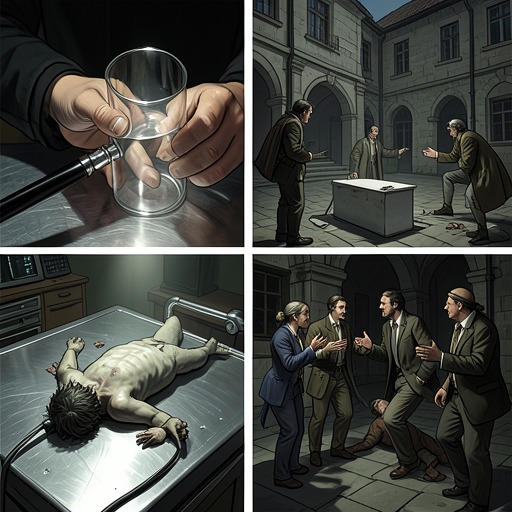
The event’s later significance depends on its reversal. Neville’s scientific explanation does not secure his social position. He continues to live among beings he calls vampires, killing most while trying to understand the few who remain. The new society that eventually surrounds his house arrives with cars, spotlights, guns, axes, and pikes, and Neville himself is captured and confined behind barred windows. The man who once treated others as diseased specimens becomes the isolated figure classified and imprisoned by a new collective order.
Narrative Significance
Neville’s discovery is the novel’s central movement from folklore to science, but it does not simply celebrate reason as a complete solution. It shows scientific thinking as a process of resistance, revision, observation, and uncertainty. Neville first rejects germs, then admits that bacteria may explain the evidence, then confirms a bacillus through painstaking microscopy. The shift matters because it changes not only what he knows but also what questions become possible.
At the same time, the event complicates the boundary between monster and patient. The vampire is neither reduced to a hallucination nor left as a supernatural exception. It is a real condition with a visible organism, a possible transmission route, and a history that may have been repeatedly misnamed. That explanation sharpens the tragedy: Neville has found the mechanism of the world’s transformation, but knowledge alone cannot restore the people he has lost or return him to the social world that once gave his categories their authority.
The discovery therefore becomes both an intellectual victory and a prelude to Neville’s displacement. His microscope grants him the truth of vampirism, yet truth does not guarantee recognition. By the end, the question is no longer only what causes the vampire, but who possesses the power to define normality. The bacillus makes the vampire scientifically legible; the later rise of the new society makes Neville socially illegible. His investigation succeeds as science even as it fails to save him as a member of humanity.