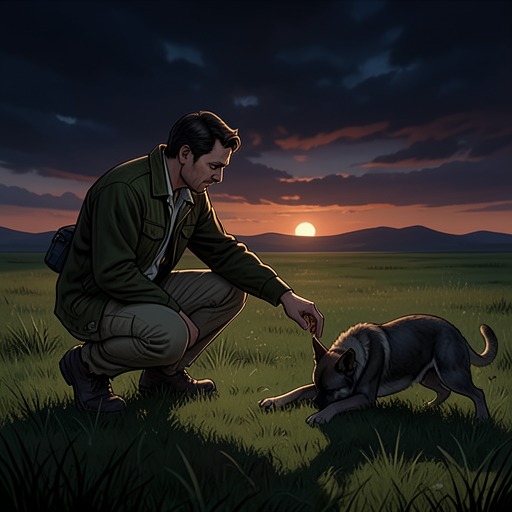
Robert Neville's attempt to save the dog
I Am LegendRobert Neville's attempt to save the dog is one of the clearest expressions of his desperate movement from solitary survival toward care. When a living dog appears after the epidemic has emptied his world, Neville treats it not as a minor animal encounter but as the possible return of companionship itself. He tries to protect the dog from infection, the vampires, and its own terror, yet the effort ends in death within a week. The rescue therefore becomes both a practical experiment in illness and a devastating repetition of the losses that have shaped Neville's existence.
Discovery and Immediate Hope
On the third morning after reaching a point of profound despair, Neville sees a dog roaming across the lawn. The animal is scrawny, limping, and frightened; when it hears the front door open, it jerks its head up and bounds away with its tail between its legs. The sight shocks Neville into immobility. After so long without another living companion, even this fearful, damaged animal seems to him immensely significant. He searches the neighborhood for an hour, calling for it, and returns home in hopeless dejection when it has vanished. His response reveals how completely isolation has altered the scale of value: the dog is not merely a stray but, to Neville, the highest surviving sign of life on the planet.
The next morning Neville discovers that milk and hamburger have disappeared from the lawn. Two women lie crumpled on the grass, but the dog is absent, and his relief is immediate. He reasons that the dog must have approached after dawn, when the streets were safe, and may have developed some way of surviving despite its condition. His hope is inseparable from fear, however. He has placed a ring of garlic bulbs around the food to keep the vampires away, then realizes that the same barrier might repel a sick dog. He also worries that the animal may carry the germ and that the vampires might kill it during the night. The rescue begins, therefore, inside an unstable chain of conjectures about infection, daylight activity, and exposure.
Luring and Capturing the Dog
Neville waits for the dog to return. At four in the afternoon it comes hobbling across the street, looking toward the house with cautious, white-rimmed eyes. Its paw is injured, and its body is so thin that Neville wants not only to win its affection but to repair it. Watching from the peephole, he experiences the dog's eating as a sudden restoration of normality: the animal slurps milk and devours hamburger while he smiles unconsciously. The scene briefly replaces the silence and menace surrounding the house with an ordinary act of feeding.
When the dog begins to leave, Neville moves quickly. The following afternoon, after spending the morning waiting at the dog's house without breakfast or lunch, he finally reaches down and picks it up as it limps toward the food. The dog snaps at him, but he closes one hand over its jaws and holds them together while its nearly hairless body struggles feebly in his grasp. Its terror makes the rescue morally and emotionally complicated. Neville is trying to save a creature that experiences his intervention as another threat, and his physical control must precede the trust he hopes to create.
Care, Calming, and Medical Uncertainty
Inside the house, the dog's panic continues. It snarls, clicks its teeth through the blanket, whines at a high pitch, and shakes uncontrollably. Neville kneels beside it, pins its gaunt body down, and speaks quietly and repeatedly for almost an hour. His voice becomes a low murmur intended to replace panic with reassurance. Gradually the struggling eases. The change comes not through force alone but through sustained attention: he keeps his hands steady, talks intermittently, and waits until the dog can tolerate his touch.
After initially cringing and snapping, the dog allows Neville's hand to rest on its warm neck. He scratches and caresses it, promising that it will soon be better. The animal's dulled, sick eyes turn toward him, and it licks his palm. Neville breaks down in tears, unable to maintain the emotional distance required by his other survival routines. The gesture creates a moment of reciprocal recognition across species: the dog remains ill and frightened, but its touch confirms the relationship Neville has been trying to establish.
The surrounding evidence keeps that tenderness under the pressure of disease. Neville has already been reading that flies and mosquitoes can disseminate bacterial diseases, so the dog's vulnerability belongs to the same infected ecology that governs his wider investigation. He cannot determine whether the animal carries a small, initially tolerable dose of bacilli, how it has endured nocturnal attacks, or whether its daylight activity indicates that the illness has not fully developed. Food, garlic, observation, and restraint are thus improvised forms of both nursing and experimentation, undertaken without any reliable prospect of success.
Death and Consequences
The dog dies in a week. Its death destroys the companionship Neville had barely managed to secure and confirms the cruel pattern by which hope enters his life only to become another object of mourning. He had searched for the dog, waited beside its food, risked being bitten, and spent an hour calming its shaking body; the short interval between its acceptance of his touch and its death makes the loss especially severe. The rescue has not failed because Neville withheld care. It fails because care cannot reverse the dog's illness.
The episode also changes the meaning of Neville's isolation. His longing is no longer directed only toward the lost Virginia or toward the human world that has vanished around him. The dog becomes a substitute companion without being a disposable substitute: Neville's claim that it is more than merely a dog shows that his need for relationship has expanded beyond human boundaries. Its death repeats the trauma of earlier bereavements while exposing his capacity for gentleness, patience, and responsibility. In that sense, the attempt to save the dog is a small but decisive counterforce to the violence surrounding him: Neville cannot restore the old world, but for a short time he can make himself answerable to one vulnerable living creature.