Robert Neville's defense of his house
I Am LegendRobert Neville's defense of his house is the central practical action by which he preserves a human refuge in a world controlled by vampires. It is not a single act but a repeated system of labor, surveillance, restraint, and violence: he fortifies the building, maintains garlic barriers, endures provocation outside, and finally fights his way back through the doorway when the attackers destroy the equipment on which his survival depends. The defense protects his body, but it also exposes how completely his identity, grief, sexuality, and hope have become tied to one besieged structure.
Fortification and Daily Labor
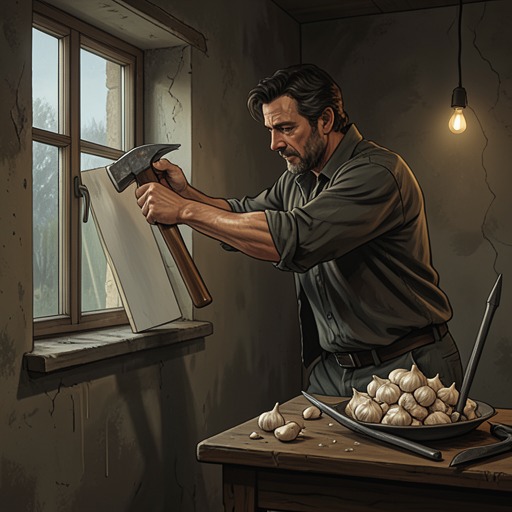
Robert Neville's first line of defense is garlic, prepared with methodical regularity. In the hothouse he separates the bulbs into their small cloves, cuts each clove in half, pierces the halves with an icepick, and strings them into roughly twenty-five necklaces. The smell, once so strong that it kept his stomach in constant turmoil, has become embedded in the house, his clothing, and even his sense of his own flesh. The work is therefore both practical and invasive: protection enters every room and follows him on his body.
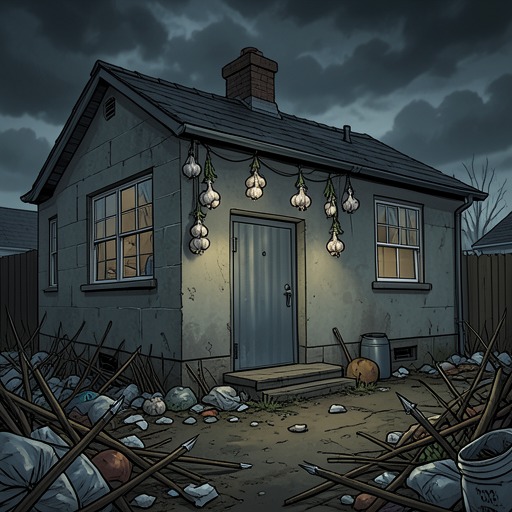
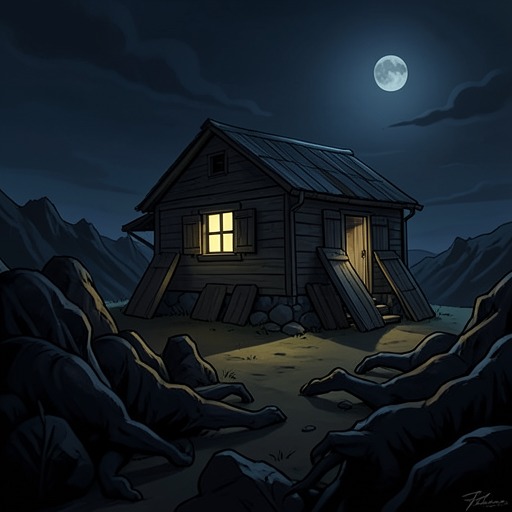
The defenses have developed through trial and failure. When Robert Neville first hung garlic over the windows, the vampires answered from a distance by throwing rocks. Broken glass forced him to cover the windows with plywood, but he eventually removed the plywood and nailed up orderly rows of planks instead. The result made the house resemble a gloomy sepulcher, yet the altered windows were safer than exposed panes. Three air-conditioning units made the sealed interior bearable, demonstrating how survival depends not on one magical barrier but on a chain of repairs and compromises. Twice each week he replaces the old garlic strings after their smell has weakened, treating the necklaces as a provisional shield until something more effective can be found.
This labor exists alongside an opposing kind of neglect. Robert Neville knows that the accumulated garbage must be ground up, paper plates and utensils burned, furniture dusted, sinks and bathroom fixtures cleaned, and bedding changed, but he does not feel like doing any of it. The narrative links that refusal to his isolation: as a man alone, he regards such domestic tasks as having no importance. The house is therefore defended against the vampires while slowly losing the ordinary maintenance that would make it a home.
The House Under Siege
The attackers do not merely wait outside; they use visibility and sound to turn the house into a psychological prison. Robert Neville once watched them through a peephole, but he stopped after the women saw him and adopted obscene postures intended to lure him outside. He avoids looking at them, yet he cannot escape their presence. Their voices, cries, and repeated displays invade his attempts to read or listen to music, while his wish to soundproof the house reveals the limits of physical protection. Plugs in his ears would silence the vampires, but they would silence the music as well, making retreat feel like surrender.
The pressure becomes bodily. Night after night, while the women pose outside, a knotting heat rises in Robert Neville's body and produces a craving he cannot rationally defeat. He paces with bloodless fists, turns to food, drink, films, or painfully loud music, and tries to read even as the words lose their power. The house thus contains more than an external siege: it becomes the chamber in which sexual frustration, fear, and anger are repeatedly compressed. His defensive posture depends on self-control, but the intruders continually test the boundary between controlled survival and impulsive violence.
His encounters with the vampires are also complicated by their human appearance. When he enters a room containing an apparently living woman, his hands fumble over the stake and mallet because killing women is especially difficult for him. The senseless physical demand that returns at such moments has to be forced down before he can act. Defense consequently requires him to suppress both compassion and desire, reducing intimate human forms to threats while never allowing himself to forget what they resemble.
The Assault and Counterattack
The decisive crisis begins when the vampires attack the house after Robert Neville returns from outside. He reaches the door pursued by several men, unlocks it, and forces his way inside; when an arm thrusts through the opening, he braces the door against it until bones snap, pushes the injured arm away, and drops the bar into place. Outside, the vampires howl, shout his name, and hurl bricks and rocks against the building. The reinforced entrance holds, but the violence makes the house feel less like a secure home than a besieged position.
The assault becomes catastrophic when the attackers overturn his station wagon and smash it apart. From the peephole, Robert Neville watches them break the windshield with stones, tear open the hood, strike the engine with clubs, and dent the frame. Their destruction removes an essential means of movement and transforms his defensive anger into fury. Then the electrical system fails: the lamp will not light, the refrigerator and freezer go off, and the food begins to spoil. In his words, the house has become a dead house. The loss of power is not a minor inconvenience; it erases the technological conditions that have helped him maintain a livable refuge.
Robert Neville responds by abandoning defense for direct attack. He tears open the bureau drawer, takes the loaded pistols, knocks up the bar, and opens the door toward the mob outside. He shoots the first man in the face, fires into two approaching women, and continues shooting until both pistols are empty. When the wounded attackers keep coming, he fights with fists, elbows, his head, and his feet. A slashed shoulder finally makes him recognize how hopeless the attempt is. He uses the doorway itself as a weapon and barrier, kicking the men back into the shrubbery before retreating inside.
He then slams and locks the door, bolts it, and drops the heavy bar into its slots. The action restores the physical boundary, but not the security that boundary once represented. Robert Neville stands in the blackened house listening to the vampires scream, beating weakly at the plaster while tears run down his cheeks and his bleeding hand throbs. The defense has succeeded in preventing immediate capture, yet the cost is total: the car is destroyed, the power is gone, the house is damaged, and the remaining refuge feels emptied of everything that gave it meaning.
Psychological and Moral Stakes
The house defense is inseparable from Robert Neville's effort to preserve a self after bereavement. He dreams about Virginia Neville and cries out while gripping the sheets, and memories return in sudden enacted scenes rather than orderly recollection. One such recurrence brings back the great fire, Kathy Neville's tiny body in his arms, and the man who snatches her away. The defensive violence outside therefore touches an earlier helplessness: each barricade and each blow attempts, impossibly, to prevent another loss.
Virginia Neville's return makes the structure especially unstable. Robert Neville tells Ruth that he buried his wife, but that she came back one night as an outline or shadow, no longer the same, wanting to drink his blood. The house is a place where the dead return as predators, so its defenses protect him not only from strangers but from the collapse of familiar categories such as wife, home, and safety. His grief afterward remains physically present: two days after burying Virginia Neville, he lies fully clothed on his bed, half drunk, staring into the black ceiling while whisky spills across the floor.
The same pattern of attachment and failed protection appears in his attempt to care for the dog. Robert Neville promises that the animal will recover, but the dog dies within a week, leaving him in tears. The loss briefly changes his drinking: he concludes that his last drunken episode had taken him to the bottom of despair and that, unless he destroys himself, he can only move upward. The house defense thus continues after each defeat, but its meaning shifts from confidence in recovery to stubborn refusal of annihilation.
Limits and Reversal
Robert Neville's defenses are effective against immediate assault, but they cannot secure the social world that once made them intelligible. Ruth's account exposes the moral instability of his methods: she reports that her husband was torn apart before her eyes, that she lost two children to the plague, and that she spent a week hiding, starving, and sleeping only a few hours before Robert Neville chased, struck, and dragged her to the house. His garlic test and accusations appear to him as necessary precautions, but from her position they are further acts of terror inflicted on an already traumatized survivor.
His scientific certainty also remains provisional. After reading Ruth's letter and examining the evidence, Robert Neville recognizes the fact that changes his entire understanding of the plague: bacteria can mutate. The discovery means that the defenses he has built around fixed assumptions may be obsolete. The vampires outside are not simply remnants of an old supernatural order; they may represent a changing biological and social condition. The house can hold a threshold, but it cannot freeze history on Robert Neville's side of it.
The recurring image of Ben Cortman at the lawn makes that reversal visible. Robert Neville sees Ben Cortman approach and mutters for him to come out, while Ben Cortman echoes the words in a loud cry. The observer at the peephole has become the watched man, and the person who once controlled the house's boundary is increasingly enclosed within it. His defense remains an act of survival, but its final significance is tragic: it preserves Robert Neville long enough for him to witness the disappearance of the world that the house was meant to protect.