Robert Neville's execution
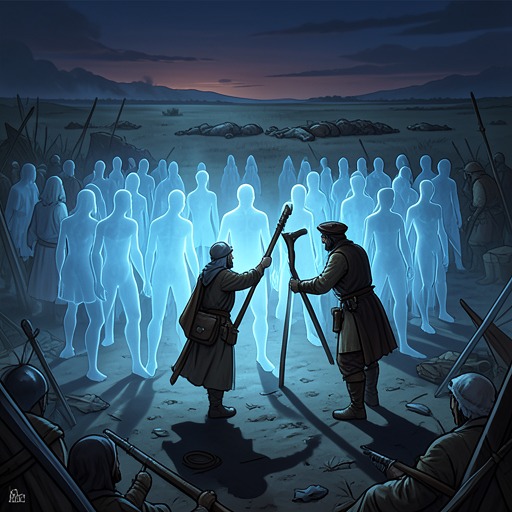
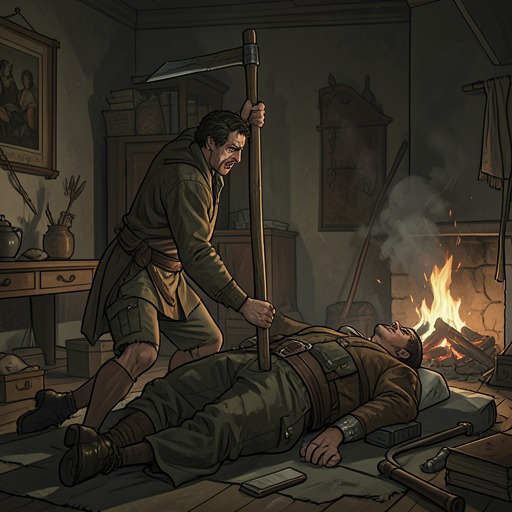
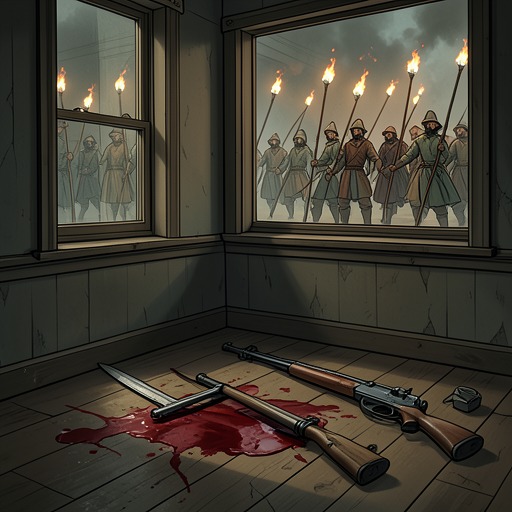
I Am LegendRobert Neville's execution is not merely the killing of the last human investigator of vampirism; it is the moment when the defeated minority's account of normality is replaced by the majority's judgment. Wounded and confined in his own house, Neville learns that the people gathered outside are waiting for his execution. Ruth offers him a packet of pills, and, after seeing the crowd's fear, he accepts death as the least violent conclusion available to him. His final insight completes the reversal: to the new society, he is the scourge, superstition, and terror that must be destroyed.\n## Causes and Background\nThe execution grows out of the collapse of the old legal and social order. During the plague, ordinary funeral practices have been suspended: bodies must be taken to the fires immediately, and the law is defended as a means of preventing the bacteria from spreading. Neville has already resisted that emergency logic when he refuses to surrender Virginia Neville's body to the flames. He buries her himself, sewing her into a blanket before carrying her away, even though a man insists that the burning is required by law. His resistance establishes the pattern that later governs his own fate: institutions claim necessity, while Neville preserves a private obligation to the dead.\n\nHis isolation also makes the final confrontation inseparable from accumulated grief. He dreams about Virginia Neville and cries out in sleep; later, a remembered vision returns him to the fire in which Kathy Neville was taken from his arms. He drinks, works, searches, and repeatedly tries to replace impossible losses with acts of care. When he finds a surviving dog, he treats it as the highest expression of life left on the planet, soothing it until it licks his palm, only for the dog to die within a week. These losses leave him emotionally exposed when Ruth enters his life. He tells her that Virginia Neville returned from the grave and became something that wanted to drink his blood, a memory that makes intimacy at once consoling and terrifying. Their brief embrace gives the impending execution a personal dimension: Ruth is both the person who reaches him and a representative of the society that will kill him.\n## Capture and Sentence\nRuth tells Neville that it is too late for him to leave. The people outside are not waiting for his death in an abstract sense; they are waiting for his execution. She explains that they are terrified of him, hate him, and want his life, and that their fear makes the sentence compulsory even though he is already wounded. The language of necessity echoes the earlier law requiring the incineration of plague victims. In both cases, collective survival is invoked to turn violence into procedure.\n\nRuth cannot defeat the crowd or cancel its decision. Instead, she unbuttons her blouse, takes a tiny packet from beneath her brassiere, and presses it into Neville's right palm. She says that the packet is all she can do to make the end easier and reminds him that she warned him to leave. Her action is simultaneously an act of loyalty, an admission of helplessness, and a practical concession to the new order's power. Neville understands that he cannot fight so many people. When Ruth leaves, the door is locked behind her, converting the house from a refuge into a temporary cell.\n## Final Confrontation with the Crowd\nAfter saying farewell to Ruth and to everything that remains of his former life, Neville forces himself upright despite the pain exploding through his chest. He nearly falls, catches his balance, and reaches the window on legs that scarcely respond. Outside, the street is filled with people moving through the gray morning. Their voices first rise in startled agitation when someone sees him, then fall into sudden silence. The crowd's stillness makes the window a boundary between two incompatible worlds: Neville is visible at last, but visibility no longer gives him power.\n\nLooking down at the white faces turned toward him, Neville realizes that he is now the abnormal one. Normality has become a majority concept, determined by the many rather than by the solitary survivor. The people see him as an invisible scourge whose existence is proved by the bloodless bodies of their loved ones. Their awe, fear, and shrinking horror are not incomprehensible to him. He recognizes that they feel toward him what he once felt toward the vampires, and this recognition prevents him from hating them even as they prepare to kill him. The execution therefore rests on reciprocal historical perception: each side has named the other monstrous, and each believes destruction is a form of protection.\n## Death and Immediate Consequence\nNeville's last choice is designed to prevent spectacle and further violence. Holding the packet Ruth has given him, he hopes that the end will not become a butchery before the crowd's eyes. He swallows the pills while leaning against the wall, and lethargy begins to spread through his limbs. The act is neither a victory over the new society nor an escape into reconciliation. It is a controlled surrender that preserves the final measure of agency available to a wounded captive.\n\nAs the drugs take effect, Neville understands the historical consequence of his death. He is not going to belong to the people outside, just as he believes he no longer belongs to the world that existed before the plague. To the new people of the earth, he is anathema and a black terror comparable to the vampires he spent years studying and killing. His execution will therefore do more than remove a dangerous enemy. It will supply the new society with the founding image of its own fear: a dead figure whose story can be transformed into superstition.\n## Narrative Significance\nThe execution completes the novel's circular structure. Neville began as a solitary man attempting to make sense of an apparently supernatural catastrophe through observation, experiment, and repeated acts of defense. He has buried the dead against the law, mourned Virginia Neville's return, cared for the doomed dog, and tried to approach Ruth as another human being. Yet none of these private meanings can survive the public reclassification imposed by the majority. His scientific and moral self-understanding becomes irrelevant once the new society defines him as its monster.\n\nHis final thought, “I am legend,” names the transformation produced by the execution. He becomes legendary not because he defeats the vampires, but because his death marks the birth of a new normality and a new superstition. The phrase also exposes the historical irony of his position: the world he called monstrous will remember him as the monster, while the society that kills him will appear to itself as ordinary and legitimate. Execution is thus both an ending and an origin—the end of Robert Neville's life and the beginning of the myth through which the new society explains its terror.