Robert Neville's house
I Am LegendRobert Neville's house is the principal refuge, workshop, listening post, and emotional enclosure of the novel. Its walls separate Robert Neville from the nocturnal vampires, but they also preserve his isolation, making the house less a home than a maintained perimeter between one surviving man and a transformed society.
Definition and Physical Defense
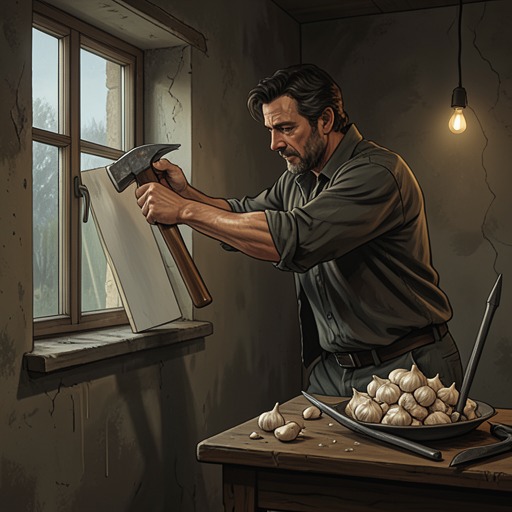
The house is presented as a place that must be inspected and repaired rather than simply inhabited. On cloudy days, Robert Neville remains close to it because he cannot judge sunset accurately and may otherwise be caught in the streets when the vampires arrive. He walks around the building in the gray afternoon, checking every window for loosened boards after the night’s attacks. A single loose plank represents a continuing pattern: the house survives only through repeated labor.
The rear of the property contains a hothouse and a water tank, both essential parts of its practical independence. The vampires sometimes weaken the tank’s structure, bend or break its rain catchers, throw rocks over the fence, or tear through the hothouse’s overhead netting and break panes. On one inspection both structures remain undamaged, but Robert Neville still goes inside for a hammer and nails. Maintenance is not optional upkeep; it is the daily condition of continued life.
The house’s interior is altered by the same defensive logic. Robert Neville fastens a cracked mirror to the front door, knowing that its jagged silver-backed pieces will soon fall away, and decides that garlic will replace it because garlic remains effective. He prepares roughly twenty-five necklaces by cutting garlic cloves in half, punching holes through them with an icepick, and stringing them on wire. Once hung over the windows, the necklaces provoke attacks from a distance: rocks break the panes, forcing him to cover them with plywood and eventually replace the exposed windows with even rows of planks. The result is a gloomy, almost sepulchral enclosure, moderated only by three air-conditioning units.
A Daily Stronghold
Robert Neville's house is sustained by repetitive work that contrasts sharply with his emotional exhaustion. He carries out repairs, gathers garlic in the hothouse, and disposes of household waste, yet he sometimes cannot bring himself to burn paper plates, clean the furniture, wash the sinks and bathroom fixtures, or change the bedclothes. His neglect is connected to his solitude: ordinary domestic order has lost its importance to a man living alone under siege. The house therefore records both discipline and collapse, with carefully maintained defenses surrounding a life that no longer possesses ordinary social purpose.
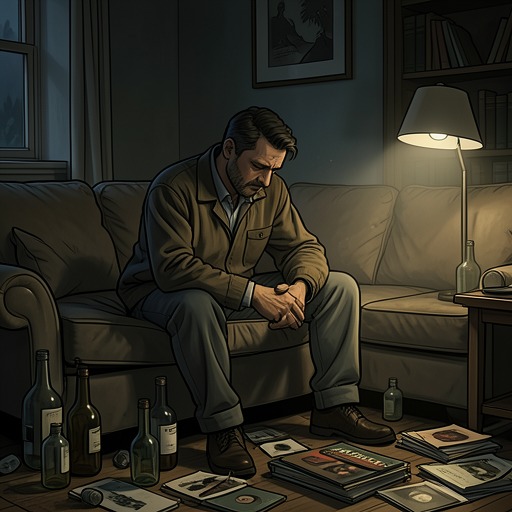
At night the house becomes an acoustic as well as a physical barrier. Before the walls are soundproofed, Robert Neville must listen to the vampires outside, including the women who strike obscene postures in the hope of luring him out. He once watches them through a peephole, but stops after they notice him and turn their bodies into deliberate instruments of provocation. He continues to read and listen to music, refusing to block his ears because doing so would mean allowing the vampires to force him completely into a shell. Yet the sounds repeatedly awaken a bodily craving he cannot master. He paces, drinks, raises the music, or turns to the movie projector, while the books around him fail to extinguish what he experiences as a wordless demand of the flesh.
The house thus protects Robert Neville from immediate physical contact while exposing him to psychological pressure. Its rooms contain books, music, alcohol, tools, food, and scientific activity, but none of these resources restores companionship. The structure becomes a controlled environment in which survival is possible and normal human life is not.
Violence at the Threshold
The boundary of the house is repeatedly tested by direct assault. During one attack, Robert Neville reaches the door while several vampires rush the porch. He drives one attacker into another, gets inside, and forces the door shut against an arm thrust through the opening. He applies his full strength until bones snap, pushes the broken arm outside, and drops the bar into place. The house saves him, but only after its threshold becomes a site of intimate, exhausting violence.
Afterward, Robert Neville collapses on the floor in darkness while the vampires howl, curse, and shout his name outside. They pound the door and throw bricks and rocks against the walls. He lies listening to the impact until he can struggle upright and pour himself whisky; the alcohol gradually steadies his breathing and stops his shaking. The assault demonstrates the house’s double function: it is a successful defense, but every successful defense leaves Robert Neville physically and emotionally depleted.
The house also contains the moral violence of his daytime work. When Robert Neville stakes infected women, the action is difficult precisely because they are alive and because their presence awakens a sexual response he regards as irrational and uncontrollable. He must persuade himself that the killing is necessary before carrying it out. The house is consequently not only where he repels external enemies; it is where he confronts the conflict between his bodily impulses, his scientific judgment, and the violence required by survival.
From Refuge to Prison
The house’s meaning changes as Robert Neville’s losses accumulate. He approaches the crypt containing Virginia Neville with fierce protective urgency, fearing that the vampires have disturbed her, and the discovery that the casket remains untouched briefly relieves him. Later, he refuses to let Virginia Neville be burned under the plague-body incineration law. He sews a blanket over her inert body, covering her face, and then carries her from the bedroom. The house therefore holds the last private claims of marriage against a public law that treats plague victims as dangerous bodies rather than beloved people.
The same rooms register the loss of the dog Robert Neville briefly discovers. After the dog disappears, he searches the neighborhood for an hour, calling for it, then returns in hopeless dejection. The house, which had seemed to guarantee solitude’s safety, becomes the place where the loss of the first possible companion is fully felt. When the dog later lies sick inside, Robert Neville talks quietly until it permits his hand on its neck; he promises that it will recover, and the dog licks his palm as tears run down his face. The dog dies a week later, turning the house into a repository of another failed attachment.
Robert Neville's encounters with other survivors also expose the limits of the refuge. Ruth recounts that her husband was killed, her two children died in the plague, and she has spent a week hiding, starving, and sleeping only a few hours before Robert Neville chased and dragged her to the house, pushed garlic before her face, and declared her infected. Her account reveals that the house is not experienced by every occupant as sanctuary. For Ruth, it is also a place of capture and interrogation, where Robert Neville’s defensive practices can resemble coercion.
Soundproofing and Final Siege
By March 1976 the house is described as livable again, more so than before, because Robert Neville has spent three days soundproofing its walls. He especially values no longer hearing Ben Cortman. Soundproofing appears to complete the transformation of the house into a sealed defensive system: the vampires may scream and howl outside, but their voices no longer enter with the same force. The improvement is practical, yet it also deepens the house’s separation from the world beyond it.
That apparent security ends in January 1979. The new vampire society arrives at night in dark cars carrying spotlights, guns, axes, and pikes. Their lights sweep around the boulevard corner toward Cimarron Street, and Robert Neville sees the vampire faces whirl away from the glare. Even through the soundproofing, he hears the motors. Sitting at the peephole, he considers the pistols in his bureau and the sub-machine gun on his workbench, then confronts the possibility of defending the house against an organized force.
The final siege reverses the house’s earlier spatial logic. Robert Neville had used its windows, boards, garlic, doors, soundproofing, and peephole to observe and repel the vampires; now an armed society identifies, surrounds, and approaches him. The house remains the place from which he sees the danger, but it no longer guarantees control over visibility or violence. Its decisive significance lies in that reversal: the refuge that enabled Robert Neville to survive the old world becomes the enclosure from which the new world comes to claim him.