Robert Neville's investigation of vampirism
I Am LegendRobert Neville's investigation of vampirism is the decisive intellectual action of his solitary life: it turns the vampire from a figure of superstition into a biological problem, while exposing the limits of his methods and assumptions. His inquiry begins with practical contradictions in the rules he has been following, advances through observation, reading, and microscopy, and culminates in the discovery of a visible bacillus. Yet the investigation does not deliver final mastery. Its last major insight—that bacteria can mutate—forces Robert Neville to understand that the plague is not a fixed phenomenon but an evolving one.
From Ritual to Questions
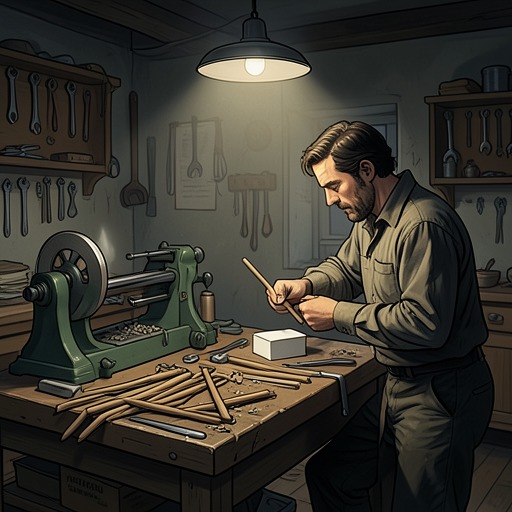
Robert Neville initially acts according to rules whose origins he barely understands. While driving to Sears after killing vampires, he begins to wonder why only wooden stakes work and how he repeatedly manages to strike the heart despite having no anatomical knowledge. The questions expose the gap between successful practice and rational explanation: he can perform the act, but cannot yet explain its mechanism.
A daylight death provides the first sharp experimental breakthrough. He finds a vampire dead even though its heart has not been touched and no garlic is present. The rapid change in the corpse’s appearance and smell leads him to infer that daylight killed it. He immediately connects this observation with the other traditional protections and vulnerabilities—garlic, the cross, the mirror, the stake, daylight, and the earth in which some vampires sleep—and asks whether they might all bear a relation to blood. The moment is both discovery and self-reproach: he has known for five months that the vampires remain indoors during the day, yet only now has he connected their behavior with the sun.
Establishing a Scientific Method
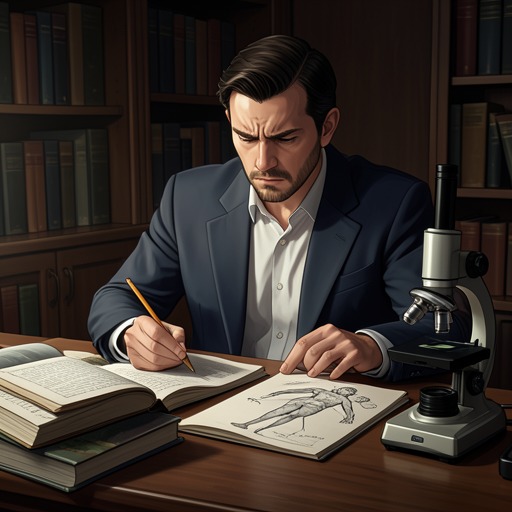
The new hypothesis gives Robert Neville a reason to abandon isolated experiments. After days marked by drinking, disgust, and desultory investigation, he recognizes that scattered tests are producing nothing and that a rational answer requires careful research. On April 7, 1976, he goes to the Los Angeles Public Library and begins with blood as the provisional basis of his inquiry. The library’s science room becomes the institutional counterpart to his improvised defenses at home: instead of relying solely on inherited rules, he seeks an ordered body of knowledge.
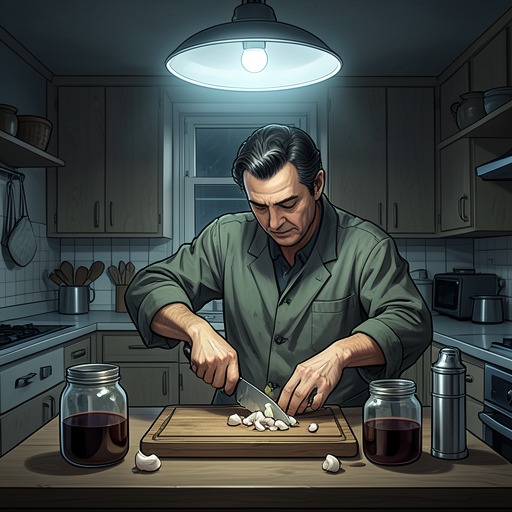
His reasoning proceeds by elimination, but it is also burdened by hesitation. Sitting over a text on garlic, he considers whether the answer might lie in water, protein, fat, carbohydrates, fiber, or ash before focusing on the essential oil responsible for garlic’s characteristic odor and flavor. The technical detail does not immediately solve the problem, but it shifts his attention from symbolic objects to material composition. Garlic ceases to be merely a ritual defense and becomes evidence of a chemical process.
Robert Neville also struggles to admit that germs might be involved. He contrasts germs, bacteria, and viruses with vampires and wonders whether his resistance arises from stubbornness or from the intimidating scale of the task. Rather than choosing outright between supernatural and scientific explanations, he adopts a temporary compromise: bacteria might provide the answer to the vampire. This is an important methodological change, because it allows him to preserve observations associated with folklore while seeking a different causal account of them.
Discovery of the Vampiris Bacillus
The investigation reaches its central discovery through painstaking laboratory work. It takes Robert Neville days to mount a few drops of blood correctly, center the cell on the slide, and adjust the microscope. On the thirty-seventh slide, the effort succeeds. The organism is not a virus, which could not be seen in this manner, but a germ visibly moving across the prepared blood. He names it vampiris in the instant of recognition.
Consultation of bacteriology texts gives the discovery a formal biological description. The organism is a cylindrical bacillus, a tiny rod of protoplasm that moves through the blood by means of threadlike flagella projecting from its cell envelope. Their movement propels the bacillus through the fluid medium. For Robert Neville, the microscope collapses centuries of fearful superstition into a material cause: the vampire is no longer inexplicable folklore but the visible effect of an organism inhabiting blood.
The discovery also changes the status of his earlier observations. Wooden stakes, garlic, sunlight, and related vampire rules are no longer isolated supernatural laws; they become phenomena requiring physiological explanation. The investigation therefore does not simply replace one vocabulary with another. It translates customary signs into questions about blood, infection, bodily change, and the conditions under which the infected body can survive.
Testing the Biological Model
Robert Neville’s later observations extend the investigation beyond the initial discovery. Experiments on dead vampires show that the bacilli produce a powerful body glue capable of sealing bullet openings as soon as they are made. The bullets become enclosed almost immediately, and the body’s germ-activated system prevents penetration beyond a few fractions of an inch. This accounts for the vampires’ resistance to ordinary gunfire: shooting them is effectively like throwing pebbles into tar.
The finding illustrates the strength and incompleteness of his approach. A physical effect that might once have seemed a supernatural immunity becomes a consequence of infected physiology. At the same time, the investigation remains shaped by the pressures of survival. Robert Neville’s questions arise from killing, examining, and defending himself; knowledge is never detached from danger, and every explanation matters because it may determine whether he lives through the next night.
His solitude also affects the process. He is alone, exhausted, drinking, grieving, and often driven by bodily pressures he cannot easily control. He neglects domestic work because, as a man by himself, he regards such tasks as unimportant, while at night an intense physical craving makes reading and music inadequate distractions. These conditions do not invalidate his observations, but they show that the investigation is carried out by a damaged and isolated investigator rather than by an impersonal laboratory. The same man who seeks order under the microscope must also manage grief, fear, sexual frustration, and the repeated demands of survival.
Mutation and the Limits of Explanation
The investigation’s most consequential revision comes when Robert Neville recognizes that bacteria can mutate. The realization occurs after he reads Ruth’s letter and looks again through the microscope. He understands that the statement, encountered perhaps hundreds or thousands of times, has acquired a new force: the bacillus need not remain identical across all infected bodies or across time.
This insight changes his entire world because it undermines any static account of vampirism. The rules he has catalogued may describe one stage, strain, or expression of infection without defining the plague permanently. His earlier confidence in a single explanatory model gives way to a more difficult understanding of variation and adaptation. The bacillus explains the vampire, but mutation explains why the vampire may change beyond the reach of his established conclusions.
The investigation thus carries an irony at its center. Robert Neville defeats superstition by discovering a germ, yet the germ itself refuses to become a final, stable answer. Scientific reasoning gives him a clearer account of the plague, but it also reveals why no fixed list of rules can secure him against it. His research is both an achievement of knowledge and a lesson in the provisional nature of knowledge: each successful explanation opens a further problem, and the organism he names continues to exceed the boundaries of the theory built around it.