Ruth
I Am LegendRuth is the most consequential human connection Robert Neville forms after the plague, and her importance lies in the unstable boundary she occupies between victim, infiltrator, witness, and successor. She first appears as a woman standing in the sunlight, an image so unexpected that Robert Neville doubts his own sight. Her name briefly restores his emotional responsiveness, but the encounter gradually exposes a deeper reversal: she is infected, has been sent to observe him, and belongs to the population that is beginning to replace the old human order. Yet Ruth does not become a simple villain. Her personal losses, divided loyalties, scientific testimony, warning, and final attempt to ease Robert Neville’s execution make her the character through whom the novel most clearly imagines moral recognition across an evolutionary and social divide.
Identity and Introduction
Ruth enters the narrative as a startling interruption to Robert Neville’s routine of isolation and defense. When he sees a woman outside in daylight, he is so shocked that his pipe falls from his mouth; he closes and reopens his eyes, but she remains there. The scene makes her appearance more than a new character introduction. It challenges the assumptions on which Robert Neville has organized his survival, especially the belief that the infected are confined to the nocturnal behavior he has studied and resisted.
Her name, when she finally gives it, is “Ruth.” The faltering sound of her voice loosens the tension in Robert Neville and nearly brings him to tears. At this stage he responds to her less as an object of investigation than as the first possible human presence in a world where solitude has become habitual. His reaction also reveals how severely isolation has narrowed his emotional life: a name and a voice can momentarily dissolve the questions that have governed his existence.
Ruth presents herself as a traumatized survivor. She says that her husband was torn to pieces in front of her, that the plague killed her two children, and that she spent a week wandering, hiding at night, eating almost nothing, and sleeping only in brief intervals because of fear. Her account explains her physical weakness and terror while also placing her within the same catastrophe that destroyed Robert Neville’s family. It establishes a genuine history of bereavement before the later disclosure that her account has been strategically incomplete.
Encounter, Suspicion, and Exposure
Robert Neville’s treatment of Ruth is shaped by his investigative habits and by the bodily strain of his solitary existence. He subjects her to garlic, watches her reaction, and interprets her sickness as evidence. When she retches, he tells her quietly that she is one of the infected. The moment is both diagnostic and accusatory: the experiment confirms his suspicion, but it also turns a desperate survivor into a suspected enemy inside his house.
Ruth’s anger forces Robert Neville to confront the violence of his method. She recounts that he chased her across a field, struck her, dragged her to his house, and then shoved a plate of reeking garlic in her face before declaring her infected. Her testimony does not disprove his diagnosis, but it changes the moral meaning of his conduct. Robert Neville has understood himself as a rational investigator defending humanity; Ruth shows how that defense appears from the position of someone already dispossessed, frightened, hungry, and grieving.
She asks Robert Neville about the disease, claiming that she wants to understand the illness that killed her daughters and husband. He explains that the pathogen is a cylindrical bacterium that alters the blood, slows its circulation, activates bodily functions, lives on fresh blood, and either produces self-killing bacteriophages or forms spores when deprived of blood. He further explains that the spores leave a decomposing host, seek new hosts, germinate, and infect another system. Ruth’s blank expression shows the distance between his technical vocabulary and her apparent understanding, but the conversation also gives her access to the knowledge by which he has defined the enemy.
When Robert Neville asks whether she thinks his conclusions are wrong, Ruth refuses to answer directly. Her hesitation becomes retrospectively significant. She is not simply ignorant of his theory; she is concealing her position while measuring how much he knows. The repeated invocation of her name marks Robert Neville’s attempt to recover personal trust at precisely the moment when the conversation is becoming an interrogation.
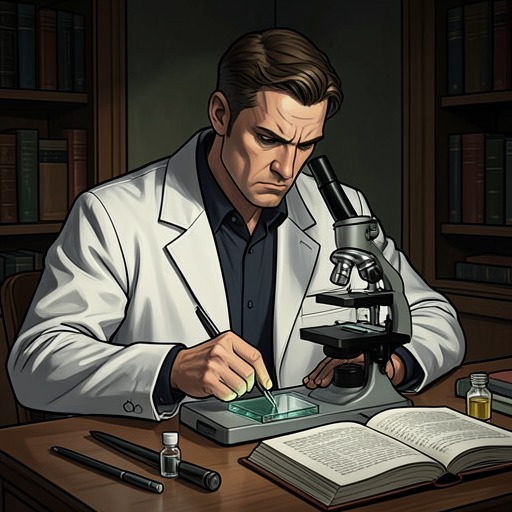
The decisive exposure occurs when Ruth strikes Robert Neville with a wooden mallet. The blow comes after he has already realized what she is, and her frightened face confirms that the apparent intimacy between them has been part of an operation. She overturns the microscope as she attacks him, physically interrupting the scientific work that has allowed him to interpret vampirism. Her violence is therefore personal, strategic, and symbolically directed at the instrument of Robert Neville’s authority.
Infiltration and Divided Loyalty
Ruth’s written confession makes her role explicit. She admits that she was spying on Robert Neville and that almost everything she told him was a lie. She also explains that her original hostility was personal: she had a husband, and Robert Neville killed him. This fact gives her infiltration a motive beyond abstract allegiance to the infected community. Robert Neville’s campaign of extermination has entered her life as the murder of someone she loved.
The confession nevertheless refuses to leave her within a simple revenge plot. Ruth tells him that she now understands he was forced into his situation just as her people were forced into theirs. She identifies herself and the others as infected, but insists that they have found a way to remain alive and are rebuilding society. Their objective is not merely to survive as scattered nocturnal predators; they intend to eliminate those whom death has deprived of ordinary life and to establish a new social order.
Ruth warns Robert Neville that this new society may decide to kill him and others like him. The warning changes the scale of the conflict. He is no longer facing an undifferentiated mass of creatures outside his house. He is confronting an organized population with collective decisions, emerging institutions, and a historical claim to survival. Ruth’s message also reveals that her side regards Robert Neville as a dangerous remnant of the former order rather than as an unquestioned representative of humanity.
She tries to delay an attack by telling the others that Robert Neville is too well armed. At the same time, she urges him to leave his house, go into the mountains, and save himself while only a small number of them remain. Her warning is practical rather than sentimental: she knows that organization will eventually make resistance impossible. She also tells him that the infected can now tolerate sunlight for short periods and that her tan was makeup, exposing the manufactured appearance by which she gained his trust.
Ruth leaves one of her pills as evidence of her claims. The pill confirms that her letter is not wholly an appeal for belief; it is accompanied by a material sign of the altered condition she describes. Robert Neville eventually recognizes that the remainder of the letter is truthful even without relying on the pill. His scientific insight that bacteria can mutate gives Ruth’s testimony its larger explanatory setting: the infected population is not simply preserving an old disease state but changing with it.
Relationship with Robert Neville
The relationship between Ruth and Robert Neville develops through alternating attraction, examination, mistrust, and reluctant recognition. Her arrival offers him companionship, but his response remains entangled with the compulsions that solitude has intensified. His isolation has produced a bodily craving that he tries to suppress through alcohol, loud music, reading, and restless movement. The same difficulty appears when he approaches infected women with a stake and mallet: he experiences desire and revulsion together, then forces the desire down as irrational.
Ruth therefore occupies a dangerous position in Robert Neville’s imagination. She is a possible companion, a possible patient, and a possible target. He wants her to be proof that human contact remains possible, yet he tests her as he tests blood under the microscope. The emotional promise of the encounter is repeatedly undermined by his need to classify her, while her concealed mission makes his trust both understandable and exploitable.
Their connection also joins private loss to public conflict. Ruth’s husband was killed by Robert Neville; Robert Neville’s family was destroyed by the plague and by the infected world that followed. Neither character stands outside the catastrophe as a neutral observer. Each carries a history in which the other side’s survival has appeared as personal devastation. Their eventual recognition of one another’s coercion does not erase responsibility, but it prevents the conflict from settling into a clean division between innocent human and inhuman enemy.
Change and Ending
Ruth’s outward presentation changes as her position is revealed. When Robert Neville later sees her, she appears clean-cut and self-possessed, with reddish hair drawn tightly back. The composed appearance contrasts with the frightened, weakened woman first encountered and signals that the vulnerable survivor was also a constructed identity. Her physical presentation has become part of the new society’s capacity to move through the remnants of the old one.
Despite helping to expose Robert Neville and enabling his capture, Ruth remains sympathetic to him. She tells him that the people outside intend to execute him, even though he is wounded, because they fear and hate him. The execution is presented not as an isolated act of revenge but as a collective necessity within the new order: Robert Neville has become too threatening to leave alive.
Her final gesture is clandestine and limited. Ruth unbuttons her blouse, removes a tiny packet from beneath her brassiere, and presses it into Robert Neville’s palm, saying that it is all she can do to make things easier. She had warned him to flee, and now, after that warning has failed, she offers the last practical assistance still available to her. The gesture cannot save him from the society she serves, but it demonstrates that betrayal and compassion coexist within her.
Ruth’s final position is consequently unresolved rather than reconciled. She does not abandon the new society, and she cannot undo her role in Robert Neville’s capture. Nor does she accept the emotional logic by which he must be treated as nothing but a monster. Her significance lies in that divided allegiance: she is both an agent of historical replacement and a witness capable of seeing the doomed individual inside the enemy.
Narrative and Thematic Significance
Ruth gives the novel its clearest human form of the conflict between scientific explanation and inherited moral categories. Robert Neville discovers a bacillus and studies its effects, but Ruth embodies the consequence of that discovery: infection does not freeze its hosts into a single condition. The statement that bacteria can mutate reframes her apparent deception and the infected community’s new abilities as stages in biological and social transformation.
She also exposes the limits of Robert Neville’s claim to normality. He has treated the infected as aberrations while preserving his own identity through defense, experiment, labor, and violence. Ruth’s testimony shows that his actions have made him a murderer from another community’s point of view. When the infected organize and define him as a threat, the old human survivor becomes the abnormal figure within a new majority.
As a character, Ruth is therefore more than a betrayer or romantic possibility. Her scenes convert the book’s central mystery into a historical reversal. She enters as evidence that Robert Neville may not be alone, becomes proof that his categories are incomplete, and ends as the compromised representative of a future that can pity him without making room for him. Through her, the novel’s question is no longer only how Robert Neville will survive the infected world, but whether survival itself has already changed the meaning of being human.