Vampire
I Am LegendVampires are the central creature and governing problem of the novel: nocturnal beings who threaten Robert Neville’s house, compel his daily defenses, and become the object of his sustained investigation. Their decisive significance lies in the reversal they produce. Neville begins by treating them as supernatural enemies to be killed or kept away, but discovers a bacterial cause behind their condition; by the end, the surviving vampires belong to an organized society that captures him, making the former hunter appear to them as the terrifying remnant of an extinct human order.
Appearance, Behavior, and Threat
Vampires are associated with the nightly return of violence to Neville’s home. As daylight fades, they gather outside and wait for the hour when they can approach, while Neville measures the afternoon against their expected arrival. He knows that they are inside during the day and active after dark, and the silence of empty streets does not mean that they are absent. Their presence is registered through voices, movement, engines, and the pressure of being watched from beyond the walls.
Their behavior combines physical danger with deliberate provocation. Neville once watched them through a peephole, but stopped when women among them saw him and struck obscene poses to entice him outside. The women’s gestures turn the house’s window into a contested surface: Neville observes, is observed in return, and must retreat from a spectacle designed to exploit both his fear and his sexual vulnerability. The recurring disturbance becomes so oppressive that he considers soundproofing the house, yet refuses to shut out his music because doing so would mean allowing the vampires to force him completely into isolation.
The threat is also inward. Their nightly presence awakens in Neville a bodily craving he cannot simply reason away. Heat knots deep in his body, his abdominal muscles tighten, and he paces with bloodless fists, trying to suppress the sexual impulse that the women provoke. He turns to alcohol, food, the movie projector, books, or deafening music as forms of emergency self-control. The vampires therefore attack the boundaries of his house and the boundaries of his disciplined identity at the same time; the danger is not only that they may enter, but that they expose desires Neville experiences as alien and uncontrollable.
From Superstition to Biology
At first, vampires appear to confirm the established folklore. Neville lists their daytime confinement, avoidance of garlic, vulnerability to a stake, supposed fear of crosses, and alleged dread of mirrors. Yet observation steadily separates fact from legend. He knows that the claim that vampires are invisible in mirrors is false, as is the belief that they transform into bats or wolves. Vampire dogs exist, but they remain dogs rather than transformed wolves. The creature is thus assembled from recognizable evidence and rejected superstition rather than accepted wholesale as a supernatural category.
The scientific turning point comes when Neville abandons the opposition between germs and vampires. Reading that flies and mosquitoes can mechanically disseminate bacterial diseases, he considers whether bacteria might explain the speed with which the plague spread. He begins to treat the supernatural account and the germ theory as potentially compatible, concluding that bacteria could be the answer to the vampire. This shift changes his work from defensive folklore into investigation.
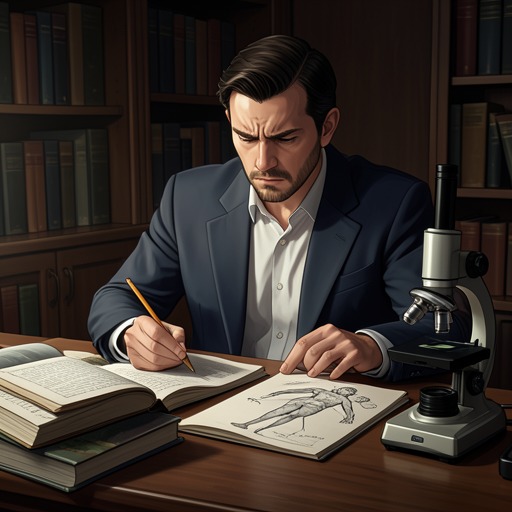
After repeated attempts to prepare blood samples, Neville examines his thirty-seventh slide and sees a moving organism. The discovery establishes that the condition is not caused by a virus but by a visible germ, which he names vampiris. Consulting bacteriology texts, he identifies the organism as a bacillus: a cylindrical rod of protoplasm propelled through blood by threadlike flagella. The microscope collapses centuries of fearful superstition into a material explanation. Vampires remain terrifying, but their terror now has a mechanism that can be studied, compared, and potentially understood.
Infection, Animals, and Unstable Boundaries
The vampire condition does not belong exclusively to human beings. Neville sees a thin, limping dog wandering into daylight, an encounter that momentarily breaks the sealed pattern of his existence. The animal is frightened of him and flees, but its appearance raises the possibility that infection and survival operate differently across species. Neville leaves milk and hamburger outside, surrounding the food with garlic in the hope that vampires will not reach it. He then realizes that the garlic may repel the dog as well if the animal carries the germ.
The dog’s uncertain condition makes the biological theory ethically immediate. Neville wonders how an infected animal could move outdoors in daylight, whether it has received only a small dose of bacilli, and how it survived nocturnal attacks. When the dog finally returns, he waits without moving until it reaches the food, then seizes it despite its snapping jaws and terrified whines. The encounter shifts the vampire problem from an abstract enemy to a vulnerable living body that might be saved. The dog’s possible infection links vampires to a wider ecology of mosquitoes, flies, bacteria, animals, and humans, while Neville’s desperate care reveals how profoundly his isolation has redirected his need for companionship.
Psychology, Faith, and the Living Infected
The biological explanation does not erase the psychological forms taken by vampirism. Neville proposes that some apparent supernatural traits may arise from the infected mind. A person forced to accept that a once-revered object can repel him might develop a dread of the cross; self-hatred could then create a mental block against seeing his own hated image. In this account, the vampire’s loneliness, nocturnal existence, and attachment to the soil of a native land emerge from damaged belief and the need for communion rather than from magical transformation.
Neville applies the same logic to the living vampires who come to his house at night. He believes that many are deranged people who think themselves true vampires while actually suffering from dementia or other mental disturbance. Their irrationality explains why they do not take the obvious step of burning his house. A man who climbed a lamppost and leaped into space while waving his arms becomes, in Neville’s retrospective interpretation, someone who believed himself to be a bat. The vampire is consequently both a medical condition and a cultural role: infection supplies the bodily crisis, while belief supplies the form in which the crisis is acted out.
Society, Reversal, and Meaning
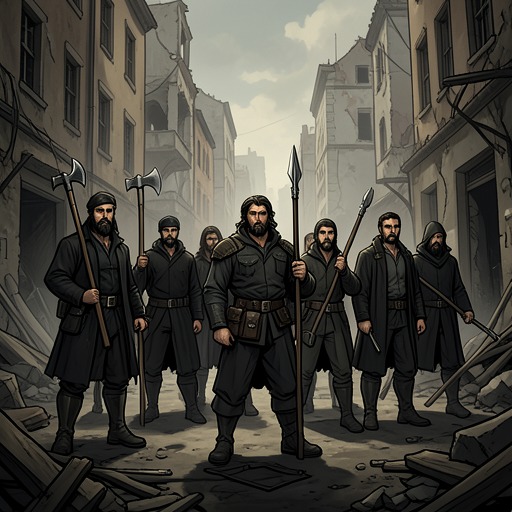
The vampires’ organization eventually surpasses the isolated attacks of the early plot. They arrive in dark cars equipped with spotlights, guns, axes, and pikes, approaching Cimarron Street as a coordinated force. The scene reverses Neville’s earlier position at the peephole. He had watched individual vampires from the protected interior of his house; now a collective power illuminates, surrounds, and targets him. The house that once served as his observatory becomes a trap, and the defensive weapons in his bureau and on his workbench cannot restore his former control.
The new social order also clarifies the scale of Neville’s earlier violence. He tells Ruth that he has killed most of the vampires, though a few remain ahead of him. His statement presents the extermination campaign as practical survival, but it also reveals that he has become a singular predator within the infected population. What seemed to him a lonely human defense can be seen from the other side as systematic persecution.
When Neville awakens after the attack in a small cubicle with barred windows, he remembers the dark men and understands that he has been captured. His wound, the expanding bloodstain on his bandage, and the sound of the outside world confirm that the invasion has ended his long residence in the house. The vampires’ final importance is therefore social and historical rather than merely physical. They have become the majority, the organized norm, and the agents capable of defining Neville as abnormal. Their power culminates in the principle that the monster is not determined by ancient legend or private conviction, but by which society survives to name whom it fears.