Vampire Dog
I Am LegendVampire dogs are the canine form of the plague’s terrifying reach, but the novel treats them less as fantastic shapeshifters than as animals caught inside an infection ecology. Robert Neville has seen and heard them outside his house at night, and his observations help separate genuine physiological effects from inherited vampire superstition. Their most important appearance is a scrawny, limping dog that briefly offers him companionship, purpose, and the possibility of saving another living creature before dying within a week.
Definition and Relation to Vampire Lore
Robert Neville distinguishes vampire dogs from the legends that surround vampirism. The creatures are dogs, not animals that have transformed from human beings or acquired the power to become wolves. He rejects the belief that vampires can turn into bats and understands the supposed mirror-blindness of vampires as false, while accepting that dogs can be infected and behave as vampire creatures. This distinction makes the vampire dog a product of observation rather than folklore: its strangeness lies in disease, not in magical transformation.
The dog’s condition also belongs to the larger pattern of infection. Robert Neville studies the ways bacterial disease can be disseminated mechanically by flies and mosquitoes, and the infected dog occupies a comparable position in the plague’s network of bodies and possible vectors. Yet the evidence does not reduce the animal to a mere carrier. Its physical suffering—limping, a bony and almost hairless body, dulled eyes, and fearful whines—makes the creature a living victim of the same catastrophe that has isolated Robert Neville from humanity.
Appearance and Encounter
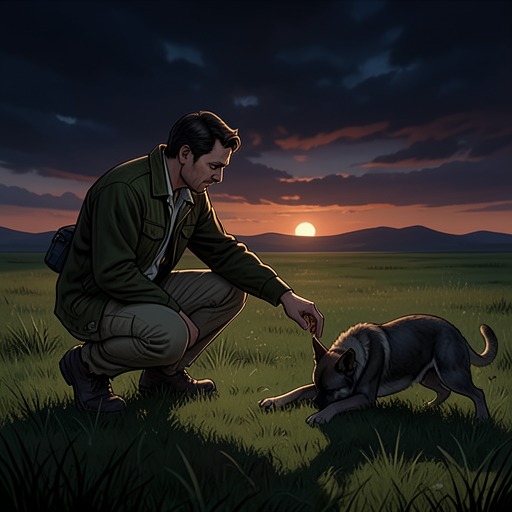
The decisive encounter begins when Robert Neville sees a dog roving on the lawn in daylight. The animal stops snuffling over the grass as soon as it hears the front door, jerks its head up in fright, and bounds away with its tail drawn between its legs. Its fear and weakness shock him into stillness. After months of solitude and nightly attacks, the sight of a living animal becomes a miracle, not because the dog is powerful, but because it is vulnerable and still alive.
Robert Neville searches for it through the surrounding streets and houses, calling to it repeatedly and promising that he will not hurt it. When the dog does not immediately return, he leaves milk and hamburger outside, placing a ring of garlic bulbs around the food in the hope that the vampires will not touch it. He then realizes that the garlic may repel the dog as well if it carries the germ. The practical safeguard therefore becomes an obstacle to rescue, revealing how completely the plague has entangled ordinary acts of care with the rules of vampirism.
The dog’s daytime presence creates a further biological puzzle. Robert Neville wonders how an infected animal can roam outdoors while sunlight remains dangerous to vampires. He considers whether the dog has received only a small dose of bacilli and is not yet fully affected, but cannot explain how it has survived repeated nightly attacks. His uncertainty is important: the dog does not confirm a neat scientific rule but exposes an intermediate condition in which infection, resistance, and vulnerability cannot yet be clearly separated.
Rescue and Failed Care
Fearful that the vampires will kill the dog during the night, Robert Neville spends a sleepless night worrying that its death might be his responsibility. He returns to the house where it has been hiding, waits on the porch without eating breakfast or lunch, and forces himself to remain motionless until the dog finally limps out between the houses and reaches the food. Only then does he seize it.
The rescue is physically difficult and emotionally charged. The dog tries to snap at him, so Robert Neville grips its jaws shut while its lean body struggles feebly in his grasp. Its terror is not aggression in any simple sense; it is the panic of a sick animal being handled by a stranger. Robert Neville repeatedly reassures it that everything will be all right, and the promise carries an importance beyond the immediate scene because the dog gives him a role he has almost lost: protector, caretaker, and companion to another living being.
For a brief period he believes the dog may recover. He tells it that it will soon be better, while the animal looks at him with dulled, sick eyes. When it licks his palm, the small gesture breaks through his restraint and brings tears to his face. The contact is reciprocal but fragile: the dog cannot understand his promise, and he cannot cure the disease. His care therefore becomes an ethical act whose value does not depend on success, even though the failure is devastating.
Death and Psychological Consequences
The dog dies within a week. Its death repeats the structure of Robert Neville’s earlier losses, but with a different emotional charge. Virginia Neville and Kathy Neville belong to his family history and to the trauma that defines his isolation; the dog is a newly encountered creature, yet Robert Neville invests it with the hope that something living can still be approached, sheltered, and saved. Its death proves that even an act of rescue cannot guarantee a future in the plague-stricken world.
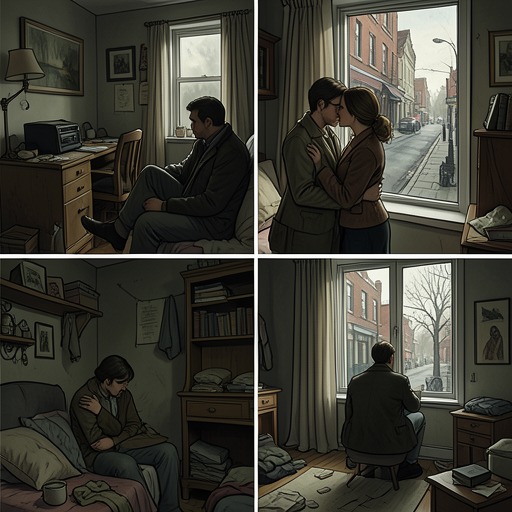
The loss follows a period in which grief already intrudes through dreams and involuntary recollection. Robert Neville dreams about Virginia Neville and cries out in his sleep, while memories of Kathy Neville being taken from him and of Virginia Neville’s burial return with overwhelming physical force. After burying Virginia Neville, he lies drunk in the darkness, listening to the whisky spill across the floor. Against that history, the dog’s death is not an isolated disappointment; it reopens the pattern of attachment followed by helpless separation.
At the same time, the failed rescue marks a turning point. Robert Neville does not simply collapse into another prolonged debauch. He recognizes that his last drunkenness had brought him to the lowest point of despair and concludes that, unless he destroys himself, he can only begin to move upward. The dog’s death thus intensifies his mourning while also contributing to a change in his conduct: suffering becomes a reason to continue rather than a proof that continuation is pointless.
Narrative Significance
Vampire dogs complicate the novel’s opposition between human survivor and vampire enemy. They are neither purely monstrous antagonists nor fully separable from the natural world. Robert Neville first knows them as nocturnal presences outside the house, grouped with the other dangers surrounding him; later, a single dog appears as a frightened, starving, and dying individual. The change from category to creature exposes the emotional cost of treating infected beings only as threats.
The dog also tests Robert Neville’s confidence in classification. He can distinguish dogs from supernatural transformations, identify signs of infection, and reason about bacilli, sunlight, garlic, and exposure. But scientific observation cannot resolve the dog’s moral claim on him. The animal’s status shifts from possible danger to object of care without the disease itself becoming intelligible, and the unanswered biological questions remain inseparable from the helplessness of the rescue.
Finally, the vampire dog serves as a compressed image of Robert Neville’s own condition. Like him, it exists between categories: alive but marked by the plague, outside ordinary society, exposed to nightly violence, and unable to return to a former normality. Its brief presence gives him companionship without speech and hope without security. Its death confirms the loneliness from which he had momentarily escaped, while the tenderness of the encounter prevents that loneliness from being understood as mere physical solitude.