Vampire garlic aversion
I Am LegendVampire garlic aversion is the rule that garlic repels or sickens beings infected with the vampiris bacillus, and it is the central practical principle behind Robert Neville’s domestic defense. At first, Robert Neville knows only that garlic works. He gradually converts that uncertain observation into a repeated procedure, then into a physiological explanation. The rule therefore stands between folklore and science: it resembles a traditional vampire taboo, but its operation is eventually treated as an effect of infection, sensitized tissue, and abnormal bodily reaction.
Definition and First-Line Use
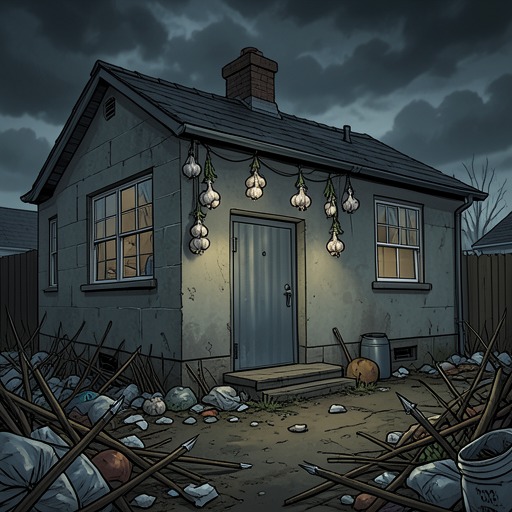
Robert Neville keeps garlic at the house as a functional barrier against nightly attacks. When a cracked mirror finally begins to fail, he decides that garlic will replace it because garlic always works. The statement is less a superstition than a conclusion drawn from prolonged survival. His house has become a defended enclosure, and garlic marks its vulnerable boundaries with a smell that the vampires cannot tolerate.
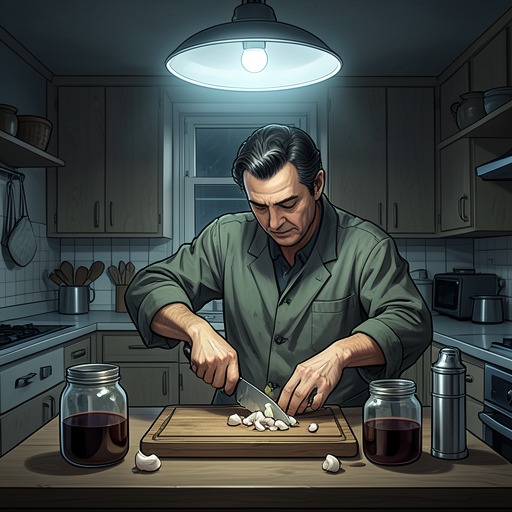
The defense is labor-intensive. Robert Neville grows and gathers garlic in the hothouse, separates the bulbs into cloves, cuts each pink, leathery clove in half, punches holes through the pieces with an icepick, and strings them into roughly twenty-five necklaces. He hangs these necklaces over the boarded windows, replacing the old strings when their smell has weakened. The procedure must be repeated twice a week. Until a better method is found, garlic remains his first line of defense, even though the boarded windows and the repeated work make the house resemble a gloomy sepulcher.
The arrangement also reveals the cost of relying on the rule. Garlic fills the house, the furniture, and Robert Neville’s clothes; at times he imagines that its odor has entered his flesh. He eats food that seems to taste of garlic and lives inside an atmosphere shaped by the defensive measure. The house is protected, but protection has become a form of enclosure in which ordinary domestic life has been subordinated to the management of infection and attack.
From Observation to Investigation
For months Robert Neville can describe the effect without explaining it. He observes that the vampires remain indoors by day, avoid garlic, die from a wooden stake, and are reputed to fear crosses and mirrors. Garlic is the most immediate of these facts because it repeatedly determines whether the vampires approach the house, yet its mechanism remains obscure. He suspects that smell drives them away and asks why, but postpones a systematic investigation while other dangers occupy him.
His questions arise from practical contradictions. Wooden stakes work, although he does not initially understand why; garlic repels the vampires, although he does not know whether the effect lies in the plant, its odor, or some associated belief. The rule thus becomes part of Robert Neville’s larger attempt to replace vampire legend with evidence. He rejects claims that vampires become bats or wolves, distinguishing vampire dogs from any supernatural transformation, while treating the garlic response as an observed fact requiring explanation.
After finding a reference work describing garlic as a plant containing water, protein, fat, carbohydrates, fiber, ash, and several allyl compounds, Robert Neville tests the listed components mentally. Water, protein, fat, carbohydrates, fiber, and ash cannot account for the effect in any distinctive way. The essential oil, however, is identified as the source of garlic’s characteristic odor and flavor and as consisting mainly of allyl sulphide and allyl isothiocyanate. The chemical detail gives him a possible route from household observation to bacteriological reasoning, even though the explanation is initially incomplete.
Physiological Mechanism
The decisive explanation is that garlic acts as an allergen in a system infected with the vampiris bacillus. Robert Neville understands the reaction as one in which exposure stimulates already sensitized tissues, producing an abnormal response to later contact with garlic. This account explains why the odor matters: the vampire need not consume garlic for the reaction to occur. Directly putting garlic into the veins has accomplished little, whereas exposure to the smell reaches the relevant sensitized system.
The rule therefore has a precise operational form. Garlic does not function merely as a symbolic charm, and the effect is not presented as universal poisoning by ingestion. Its odor provokes sickness or repulsion in an infected body whose tissues have been altered by the bacillus. The practical necklaces outside Robert Neville’s windows are consequently a crude but effective delivery system: they keep the active smell at the threshold where the vampires would otherwise enter.
The scientific model remains vulnerable to revision. Robert Neville later recognizes that bacteria can mutate, a realization that changes his entire understanding of the disease. The garlic rule remains valid as a major observed pattern, but it can no longer guarantee that every infected body will respond identically or that the existing explanation exhausts the biology. A defense learned from the past may become unreliable when the pathogen changes.
Testing the Rule on Ruth
Robert Neville applies the rule most dramatically when he tests Ruth. After suspecting that she may be infected, he takes garlic cloves from a cabinet, tears them apart, mashes them into a pulp, and pushes the dish close to her face. Ruth turns away, cries that the smell makes her sick, retches, and runs into the bathroom. To Robert Neville, the reaction appears to confirm infection. He has learned to read garlic aversion as a bodily sign rather than as a voluntary response.
The scene also shows the danger of converting a defensive rule into an interrogation method. Ruth explains that she has a weak stomach, has watched her husband be killed, has lost two children to the plague, and has spent a week wandering, hiding at night, eating almost nothing, and sleeping little. Exhaustion and starvation could make a large amount of garlic provoke vomiting even without the interpretation Robert Neville immediately assigns to it. The same physical response can therefore support more than one explanation.
Robert Neville’s certainty is further complicated by his emotional condition. He has spent his feeling on loss and now finds compassion difficult to summon, leaving him hollow while Ruth suffers. Garlic becomes an instrument through which he classifies her before he can recognize her as a person with a competing account of her experience. The rule protects him against genuine infection, but its use also reproduces the logic of suspicion that governs his isolated life.
Narrative and Thematic Significance
Garlic aversion connects the intimate body to the defended house. Its odor crosses the boundary between inside and outside, while the infected body is defined by its altered reaction to an ordinary plant. The rule makes contamination perceptible through smell and turns domestic labor into a repeated ritual of classification: garlic is gathered, cut, pierced, strung, hung, and renewed according to the rhythm of nightly threat.
The rule also gives material form to Robert Neville’s conflict between reason and inherited belief. At first he relies on what resembles vampire folklore, but he eventually asks what chemical property produces the effect and how the bacillus changes human tissue. His scientific inquiry does not abolish fear; it makes fear more exact. Each necklace is both a folk defense and an improvised experiment, while each failed or ambiguous reaction reminds him that observation must be interpreted rather than merely repeated.
Finally, garlic aversion exposes the limits of solitary knowledge. Robert Neville’s most dependable rule is learned through survival, yet he initially understands neither its cause nor its boundaries. Its effectiveness enables him to remain alive, but its smell saturates his existence, and its application to Ruth reveals how easily a useful biological generalization can become a tool of coercion. The rule is thus simultaneously a shield, a scientific clue, a sign of bodily difference, and a warning that survival depends not only on knowing what works but on knowing when the evidence does not yet justify certainty.