Vampire legend
I Am LegendVampire legend is the traditional framework through which the night creatures are understood, feared, and resisted. Its decisive importance lies in its double movement: it begins as an apparently obsolete collection of folklore, yet several of its rules correspond to real effects of infection; later, Robert Neville’s investigations separate physiological facts from inherited superstition. By the ending, the legend has not vanished. It has changed owners, becoming the story the new society tells about Robert Neville himself.
Traditional Beliefs and Their Limits
Vampire legend gathers a set of supposed characteristics: the creatures remain indoors by day, avoid garlic, die when stabbed with a stake, fear crosses, and are believed to dread mirrors. Robert Neville treats these facts unevenly. His daily defenses show that garlic has practical force: he replaces its fading necklaces over the boarded windows twice a week, after earlier strings had been hung over the glass and attacks had forced him to cover the windows with plywood and then solid planks. The house becomes a gloomy, fortified enclosure, but garlic remains his first line of defense.
Other elements collapse under observation. The claim that vampires are invisible in mirrors proves false when Robert Neville sees his own distorted reflection in the cracked mirror fastened to the door and recognizes that the traditional account cannot be accepted wholesale. The supposed transformations into bats or wolves are equally rejected. He has seen and heard vampire dogs outside his house, but they remain dogs rather than transformed supernatural beasts. The legend therefore contains observations mixed with imaginative additions, and Robert Neville’s method is to separate the two rather than accept or dismiss the whole tradition at once.
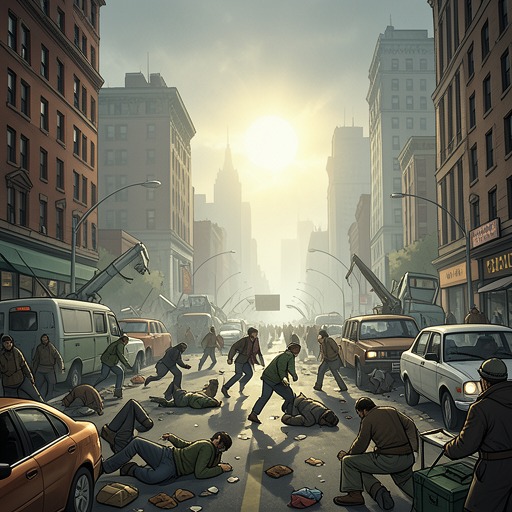
The cultural power of the legend is itself part of the problem. Robert Neville recognizes the force of the proposition that no one will fight a vampire if no one believes such a being exists. To him, the vampire had been reduced by modern culture to medieval superstition, literary melodrama, encyclopedia material, pulp fiction, and film imagery. That dismissal allowed the plague to arrive without an adequate conceptual framework. The legend was treated as too fictional to be useful, even though the reality it named had returned.
From Folklore to Biological Inquiry
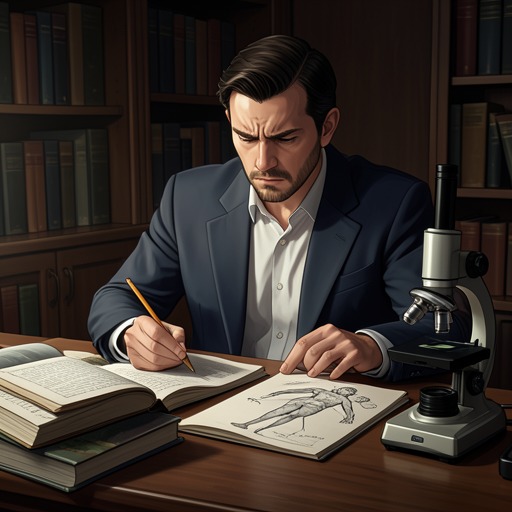
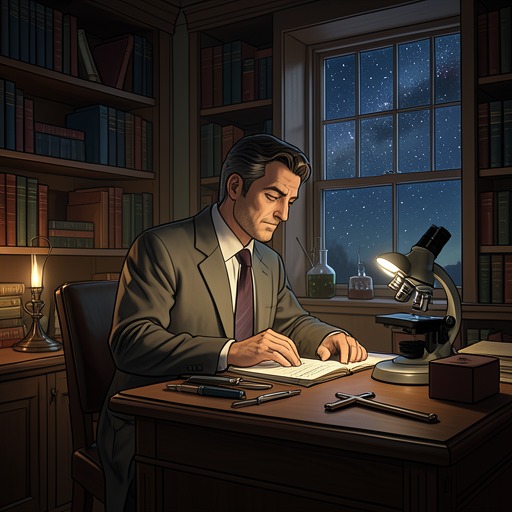
Robert Neville’s investigation begins when a dead vampire’s exposure to sunlight suggests that the rays have altered the creature’s blood. He starts asking whether garlic, the cross, the mirror, the stake, daylight, and the earth associated with burial might all be related through the blood. This question turns the legend into a research program. The old symbols are no longer merely ritual objects; they become clues whose effects require explanation.
The stake, once understood as a weapon that stops the heart, receives a specifically biological explanation. Robert Neville concludes that driving it into the body lets air enter and keeps the flesh open, preventing the body’s “body glue” from sealing the wound. The heart is not the essential target. He therefore changes his own practice, cutting the wrists deeply enough to prevent the infected tissue from closing, and understands why a long-dead woman dissolved rapidly when air reached her system. The traditional action survives, but its meaning shifts from ritual execution to the mechanical exposure of a vulnerable biological process.
The same revision applies to the cross. Robert Neville explains that its power does not arise from an inherent supernatural force. Since the legend became especially established in predominantly Catholic Europe, the cross became a culturally recognized defense against darkness. Its effectiveness depends on the vampire’s mental and religious associations rather than on the object alone. When a Jewish person confronts the threat with a Torah, the cross loses the universal authority assigned to it by popular legend. The rule is thus psychological and culturally conditioned, not a fixed law of nature.
Robert Neville’s account of the living vampires extends the same naturalizing logic. He believes that the people who come to his house at night are not supernatural beings but deranged sufferers who have adopted the belief that they are true vampires. Their irrational behavior becomes intelligible as mental disturbance: one man climbs a light post and leaps while waving his arms because he thinks he is a bat. In this interpretation, vampirism is both infection and belief, a condition in which physical alteration and inherited imagery reinforce each other.
Legend as Psychological and Social Structure
Robert Neville’s explanation of the cross, mirror, and other taboos does not simply replace superstition with biology; it shows how legend can shape damaged minds. He imagines the resurrected dead awakening beneath the soil, discovering that death has brought no rest, and suffering a traumatic shock when their old religious dread is confirmed. The cross becomes an object of renewed terror. Self-hatred and mental collapse could then produce blindness to the vampire’s own hated image, making the mirror taboo a psychological block rather than an optical impossibility.
This model also gives the vampire legend a social function. The infected are not merely bodies governed by a germ. They are people whose fears, religious symbols, memories, and explanations have been reorganized by catastrophe. The old stories provide forms for experiences that the sufferers cannot otherwise understand. Witch lore and vampire lore overlap around fears of water, soil, darkness, and forbidden thresholds, illustrating how legends borrow from one another and preserve older cultural patterns even after their original meanings have been lost.
The house itself materializes this struggle between folklore and explanation. Garlic necklaces, nailed boards, the cracked mirror, and the sealed crypt all mark boundaries between infected and uninfected, interior and exterior, living blood and dead blood. Yet the boundaries are never purely magical. Garlic repels; sunlight destroys; air changes the germ; fire is believed capable of destroying the plague bacteria. Ritual defenses and scientific procedures occupy the same threatened world, and Robert Neville gradually converts inherited precautions into testable knowledge.
The Reversal of Normality
The final transformation of vampire legend occurs when the new society captures Robert Neville. Ruth calls him “the last of the old race” and explains that, as far as the society knows, he is unique among them. His uniqueness does not make him heroic in their eyes. It makes him an anomaly destined to disappear when the new social order is complete.
Looking down at the people outside, Robert Neville realizes that normality is determined by the majority rather than by the isolated individual. The white faces below regard him with awe, fear, and horror. To them he is the scourge who has left bloodless bodies behind, an invisible terror known through the evidence of his violence. He understands their fear and does not hate them, even while recognizing that he does not belong to their world and will be destroyed as anathema.
His death completes the legend’s reversal. The pills he carries end his life before the new society can turn his execution into a spectacle of butchery, but his final insight is not that the vampires were simply right or that he was simply wrong. Instead, a new superstition is born around him. The man who once hunted vampires as abnormal creatures becomes, to the majority that survives, the legendary monster. Vampire legend therefore proves adaptable enough to survive the disappearance of its original human center: it moves from medieval tale, to plague explanation, to psychological structure, and finally to the official myth by which a new society justifies eliminating the last representative of the old one.