Vampire psychological mechanisms
I Am LegendThe psychological mechanisms of vampirism are the mental processes Robert Neville uses to explain the parts of vampirism that cannot be reduced to infection. His theory distinguishes physical effects caused by the bacillus from psychological effects produced by terror, religious expectation, trauma, self-hatred, and collective belief. It also provides the conceptual bridge to the novel’s final reversal, in which Robert Neville’s understanding of abnormality is transformed from a private judgment into the verdict of a new majority.
From Germ Theory to a Mixed Explanation
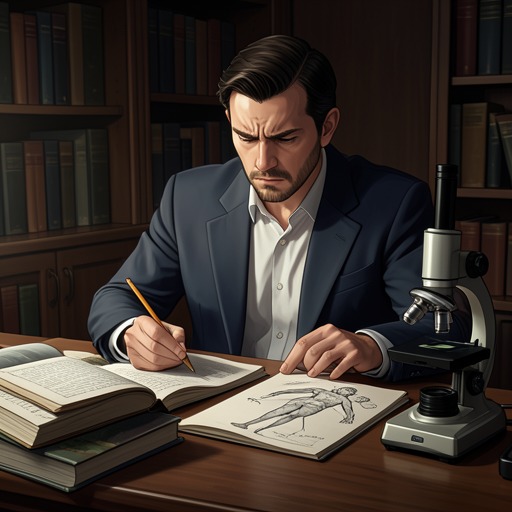
Robert Neville begins by treating vampire phenomena as consequences of the germ. Whenever an observed trait fails to fit the behavior of bacilli, however, he is inclined either to dismiss it as superstition or to regard the entire tradition as irrational. His new approach develops when a psychology text recalls the condition known as hysterical blindness, which can be partial or complete and may affect one object, several objects, or every object. The example releases him from his earlier insistence that one physical cause must explain everything. He now accepts that some vampire characteristics may be physically produced while others are psychological, an explanation that appears obvious only after his previous assumptions have been abandoned.
This revision does not reject science; it makes scientific inquiry more flexible. The body remains subject to infection, and physical symptoms remain real, but the mind interprets and intensifies the experience of disease. Robert Neville’s theory therefore occupies the unstable ground between scientific investigation and the supernatural language inherited from vampire legend. The phenomena are not simply magical, yet neither are they exhausted by laboratory description. Psychological vampirism names the residue that remains when a purely biological account has reached its limit.
Trauma, Dread, and the Cross
The central psychological cause is traumatic shock. People who survived the plague, Robert Neville reasons, may have awakened beneath heavy soil after believing death would bring rest, only to discover that death had confirmed their worst fears. Their bodies would then be driven by a strange need, while their minds, already damaged by terror, struggled to comprehend what had happened. Such trauma could undo what remained of the mind and make otherwise inexplicable behaviors intelligible.
The cross becomes the clearest example. If a vampire was forced to accept that an object once revered as sacred really could repel him, the shock would validate the dread surrounding the object. The cross would then become not merely a physical barrier but a psychological trigger. The vampire’s fear of it would arise from the collapse of an old religious expectation into terrifying personal proof. In this account, the object’s power depends on the victim’s mental history and religious conditioning rather than on a universal supernatural law.
The same traumatic process could produce a vampire’s hatred of his own image. Robert Neville proposes that self-loathing, intensified by the vampire’s weakened mind, might establish a psychological block that makes the creature blind to the hated reflection. The vampire’s inability to see himself thus becomes an outward sign of inward repudiation. The consequence is not only visual blindness but a wider condition of isolation: the vampire becomes a lonely, spiritually lost creature of the night, afraid to approach others and sometimes seeking the soil of his native land as a substitute for communion.
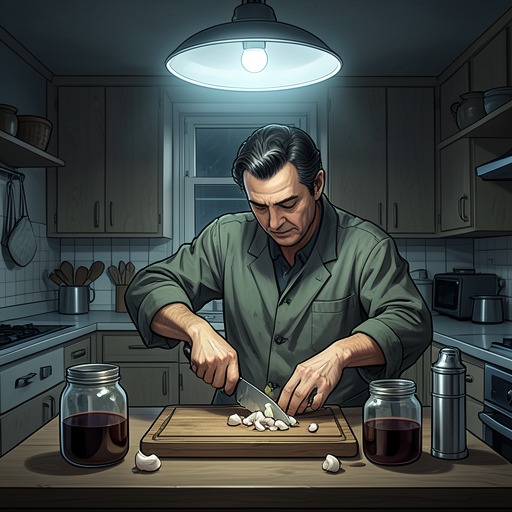
Other elements of traditional legend receive a less generous explanation. Robert Neville accepts the fear of running water as superstition, a survival of older stories about witches and their inability to cross streams. The apparent continuity between witches and vampires shows how legends can overlap, transferring old fears into new circumstances. Psychological mechanisms therefore operate not in isolation but through inherited symbols, rituals, and stories that shape how infected people understand their altered condition.
Living Vampires and Delusion
The living vampires present a different psychological problem from those who have died and returned. Robert Neville concludes that the living people who visit his house at night are deranged sufferers who have adopted vampirism as an identity. They believe themselves to be genuine vampires even though they remain alive, and their behavior is governed by that conviction. Their apparent supernatural nature is therefore partly a performance produced by illness, fear, and self-identification.
This theory explains their irrational tactics. They repeatedly besiege Robert Neville’s house but fail to take the obvious logical step of burning it. Their failure is not evidence of a mysterious rule protecting the house; it is evidence, in his view, that they cannot reason normally. One man climbed a light post and leaped into space while flailing his arms, a behavior Robert Neville later interprets as the action of someone who believed he was a bat. The image is grotesque, but it also reveals the force of an adopted fantasy: the deluded person’s body obeys a symbolic identity that has replaced ordinary judgment.
The women outside the house demonstrate another form of psychological pressure. Early in his isolation, Robert Neville watches them through a peephole, but they notice him and begin striking obscene poses to entice him outside. He eventually refuses to look at them, yet the sounds and knowledge of their repeated provocation continue to work upon him. He listens to them while trying to preserve the music playing through his loudspeaker, unwilling to seal himself completely inside silence merely because his enemies are trying to force him into a shell. The psychological attack is therefore conducted through visibility, desire, and sound as much as through physical threat.
Perception, Majority, and the Reversal of Normality
The psychological mechanisms of vampirism culminate in a reversal of the relationship between observer and observed. Robert Neville spends years treating the infected and the living vampires as abnormal objects of investigation. He watches them through the peephole, studies their behavior, and kills most of them while trying to understand the disease. Even his encounter with Ben Cortman is organized around this observational structure: Ben Cortman appears on the lawn, calls for Robert Neville to come out, and remains a figure watched from behind the barrier of the house.
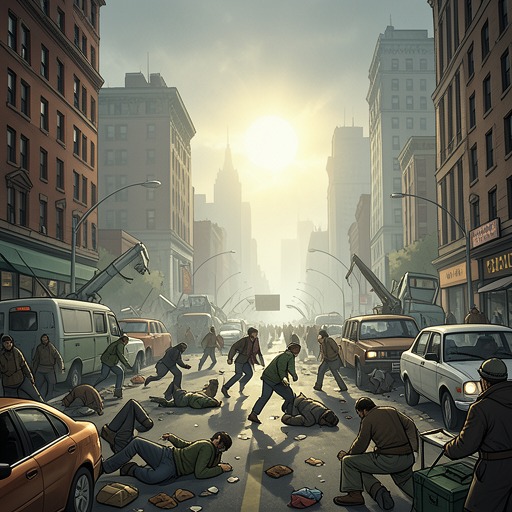
The new society eventually reverses that arrangement. Its members arrive at night in dark cars carrying spotlights, guns, axes, and pikes, surrounding Robert Neville’s house and transforming the familiar boulevard into a field of coordinated surveillance and attack. After the assault, Robert Neville awakens injured in a barred cubicle and remembers the dark men attacking his house. The physical confinement makes visible the social judgment already being prepared: the isolated investigator has become the captured specimen.
The reversal is completed when Robert Neville sees the people outside and realizes that normality is a majority concept. What he once understood as the normal human position is now occupied by the new society, while he alone represents the obsolete condition. The faces looking up at him show awe, fear, and horror because they understand him as a scourge whose existence is proved by the bloodless bodies of their loved ones. Their fear does not depend on an accurate account of his motives; it depends on the social meaning attached to him.
Robert Neville therefore recognizes that he is now, to them, what the vampires had been to him: anathema, black terror, and an object marked for destruction. The new society’s label does not merely describe him; it authorizes his isolation and execution. The psychological mechanism that once helped him explain vampiric fear has become a mechanism of collective identity, with the majority defining the solitary remnant as monstrous.
Narrative Significance
The theory of psychological vampirism joins the novel’s scientific and social arguments. It explains why the cross, the mirror, religious belief, irrational conduct, and inherited legend cannot all be treated as simple biological symptoms. At the same time, it exposes the danger of assuming that one observer possesses the permanent authority to define reality. Robert Neville’s explanations become more sophisticated as he separates physical infection from mental response, but his final insight shows that even rationality is socially situated.
The ending gives the concept its fullest force. Robert Neville understands that the new people fear him as a terrible unknown and does not hate them for that fear. He swallows the pills he has been holding, and, as lethargy overtakes him, recognizes that history has come full circle: a new terror is being born in his death, and a new superstition is entering the supposedly unassailable future. Psychological vampirism thus describes both the minds of those Robert Neville studies and the collective mind that finally studies and condemns him. It is the mechanism through which disease becomes identity, identity becomes stigma, and stigma becomes the accepted definition of the normal.