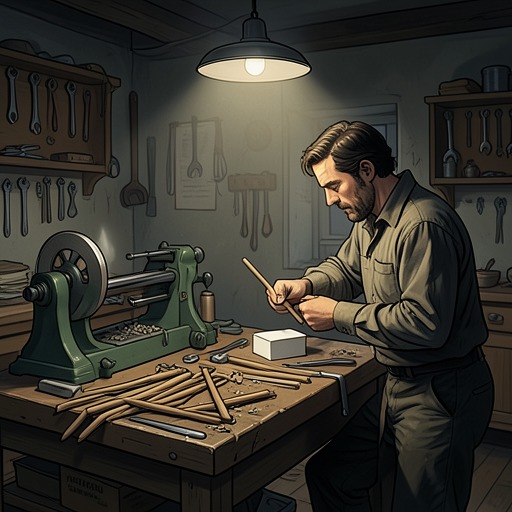
Vampire staking rule
I Am LegendThe Vampire staking rule is a central example of how Robert Neville replaces folklore with laboratory explanation. At first, the rule seems to say that a wooden stake must pierce a vampire's heart. Neville follows that belief while killing the infected, but his later experiments show that the heart is irrelevant: any deep opening that lets air into the body can trigger the same lethal biological process. The rule therefore survives in practice while its traditional meaning collapses.
The Traditional Rule and Neville's Doubt
The rule belongs to the cluster of strange facts surrounding the vampire: its confinement indoors during daylight, avoidance of garlic, reputed fear of crosses, and supposed dread of mirrors. Neville initially accepts the stake as part of this inherited system. While driving to Sears, however, he begins to question why only wooden stakes should work and why he always manages to strike the heart despite having no anatomical knowledge. The fact that his actions succeed becomes the reason for doubt rather than proof of the legend.
His uncertainty is intensified by observation. Neville knows that vampires are not invisible in mirrors and that they do not transform into bats or wolves; vampire dogs are, in his view, infected dogs rather than transformed supernatural creatures. The stake thus becomes one more apparent supernatural rule awaiting a material account. His determination to collect the questions and answer them in a scientific way marks a shift from surviving the nightly attacks to investigating the system that makes them possible.
Experiments That Break the Heart Theory
Neville's research proceeds through repeated, difficult experimentation. After obtaining a woman's blood specimen, he spends days preparing slides and finally examines his thirty-seventh mount under the microscope. He discovers that the causative agent is not a virus but a visible germ, which he names the vampiris bacillus. This discovery gives the staking rule a biological context: the vampire's condition is produced by an organism whose behavior can be studied rather than by a curse whose effects must simply be accepted.
His later explanation of the stake begins with a direct test of the accepted belief. Neville tells Ruth that he once thought the stake had to hit the heart because he believed the legend. He then placed stakes in different parts of vampire bodies, and the victims died regardless of where the stakes entered. That result first suggests hemorrhage, but the rapid decomposition of a woman under observation disproves that explanation as well. The rule remains effective, yet each experiment removes another part of its traditional interpretation.
The Biological Mechanism
Neville concludes that air is the crucial factor. Under ordinary conditions, the vampiris bacillus is symbiotic with its host, but when air enters, the situation changes instantaneously: the germ becomes aerobic and virulently parasitic. It begins to consume the host. The stake is effective because it creates and maintains an opening, allowing air to enter while preventing the body's sealing substance from closing the wound; the heart is not the target.
This mechanism also explains why the infected body can dissolve so quickly. Neville tells Ruth that the woman he observed had been dead for so long that, once air reached her system, the germs caused spontaneous dissolution. The body's collapse is therefore not the result of a wooden object possessing a special occult property. The stake is a crude instrument that exposes the conditions under which the bacillus destroys the vampire's tissues.
The same investigation connects staking to Neville's broader theory of the disease. When no blood enters the vampire's system, the bacilli metabolize abnormally, absorb water, swell, and ultimately explode, destroying the cells. In another protective response, the germ sporulates and the vampire sinks into a coma until favorable conditions return. These findings place the apparent rule within a larger cycle of infection, blood dependence, dormancy, and cellular destruction rather than within vampire mythology alone.
Practical Use and Narrative Significance
Although Neville has not yet solved the rule when he begins his investigation, he refuses to continue killing mechanically. His frustration over lacking mustard oil, potassium sulphide, and proper equipment briefly threatens to become despair, but he decides that he will either find an answer or abandon the entire struggle. The preparation of his first chemical sample gives him his first genuine sense of accomplishment since forced isolation began. Scientific method becomes not an academic luxury but a means of resisting psychological collapse.
The rule also organizes the novel's recurring opposition between observation and visibility. Neville watches the vampires through a peephole, while they gather outside and try to entice him into the open. Later, Ben Cortman approaches the lawn and echoes Neville's command to come out; much later, dark cars, spotlights, guns, axes, and pikes converge on Cimarron Street and turn the house into a besieged site of observation. The same man who once studied bodies and tested wounds is eventually captured and wakes in a barred cubicle, badly wounded after the attack. The staking rule consequently acquires an ironic reversal: a technique Neville understood as rational self-defense becomes part of the violent logic by which the new society defines and destroys him.
The rule's decisive significance lies in this reversal of knowledge. Neville does not merely learn a better way to kill vampires; he demonstrates that a supposedly sacred rule can be reproduced by ordinary physical conditions. The wooden stake loses its mystical status, while the real threat is revealed as microbial, metabolic, and dependent on the interaction between infected tissue and air. That movement from legend to mechanism embodies the book's larger conflict between scientific inquiry and superstition, even as the weapon remains one of the most recognizable signs of the vampire world.