Virginia Neville
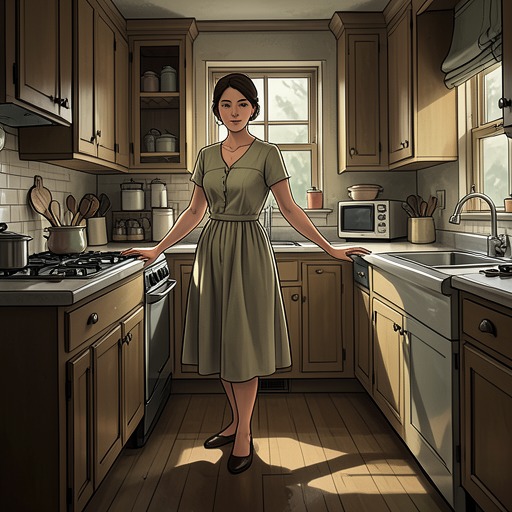
I Am LegendVirginia Neville is the absent presence at the center of Robert Neville’s ruined life. As his wife, she belongs to the world of marriage, domestic intimacy, and shared history that the plague has destroyed; as a returned vampire, she becomes the intimate enemy who makes that destruction impossible to deny. Her death separates Robert Neville from ordinary human attachment, while her reappearance converts private mourning into a horrifying encounter with the biological reality of vampirism.
Identity and Place in Robert Neville’s Life
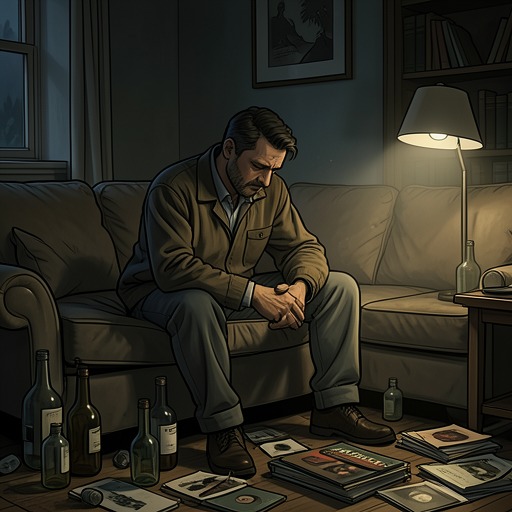
Virginia Neville is remembered not as a minor casualty but as the person whose loss organizes Robert Neville’s existence. He continues to measure the catastrophe through the disappearance of domestic life: the house, the bedroom, the marriage, and the family that once occupied them. Even while he is alone and surrounded by practical work, garlic, weapons, alcohol, and unfinished household tasks, his emotional life remains fixed on what has been taken from him. The narration’s observation that he is a man alone and therefore considers ordinary domestic maintenance unimportant shows how thoroughly bereavement has stripped routine of meaning.
His attachment to Virginia is inseparable from his grief over Kathy Neville. At the cemetery, Robert Neville wishes that Kathy could lie across from her mother, imagining the two of them together even after death. His sorrow is therefore familial as well as marital: Virginia’s grave becomes the surviving location of a destroyed household, and the absence of Kathy intensifies the sense that Robert Neville has been excluded from his own family’s final resting place.
Death, Burial, and the Refusal of Erasure
Virginia Neville’s heart stops during the plague’s aftermath. Robert Neville sits beside her white face, holding and stroking her fingers while his own body becomes rigid and nearly motionless. The shock is represented as a disturbance of the brain rather than as an immediately articulated emotion; his mind cannot process the fact that the woman beside him is dead. The event is followed by a returning vision of Kathy being taken from him during the great fire, binding the deaths of daughter and mother into one continuous traumatic wound.
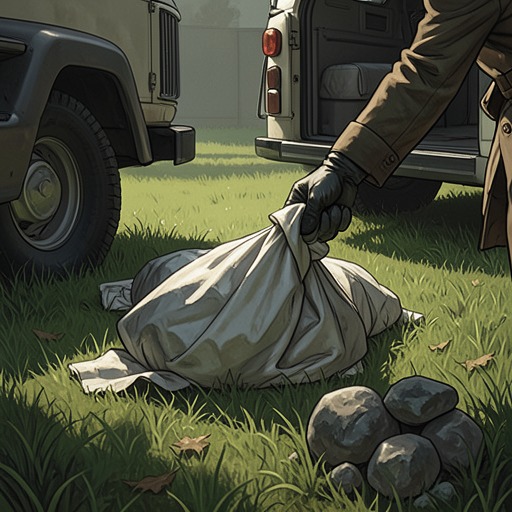
The law requires plague victims’ bodies to be incinerated, but Robert Neville refuses to submit Virginia Neville to that fate. He knows the rule and understands the public logic behind it, yet he cannot accept the thought of husbands burning their wives or parents burning their children. After an hour of indecision, he uses needle and thread to sew a blanket around Virginia Neville’s body until only her face remains visible, then closes the fabric over her mouth, nose, and eyes. The act is both practical and intimate: it prepares her body for burial while preserving a final form of personal care against the impersonal machinery of the plague law.
He carries her outside and buries her himself. The burial is accompanied by the recognition that eleven years of marriage have ended in a filled-in trench, a formulation that turns the grave into the physical measure of lost time and shared life. Afterward, Robert Neville lies fully clothed on his bed, half drunk, staring at the black ceiling. Two days after the burial, he listens to the whisky spilling across the floor and watches the clock at two in the morning. His drinking does not relieve the loss; it merely occupies the stillness in which the loss continues to return.
Return as a Vampire
Virginia Neville’s burial does not end her role in the narrative. One night Robert Neville hears someone on the porch and opens the door to the moonlight. He cannot scream when he sees Virginia Neville standing there. She addresses him by name, reducing the impossible apparition to a painfully recognizable marital encounter. Her return is terrifying precisely because it preserves enough of her identity to reactivate Robert Neville’s love while exposing the body’s transformation into something predatory.
Robert Neville later explains to Ruth that he had buried his wife, but that she came back in the form of an outline or shadow. He tried to keep her with him, yet she was no longer the same. Her return is defined by a new appetite: his own wife has come back to drink his blood. The scene collapses the boundary between beloved and threat. Virginia Neville is not merely a vampire encountered in the street; she is the proof that the plague can take the person closest to Robert Neville and return her as the agent of his death.
His refusal to burn her body earlier therefore carries a tragic irony. The burial was an attempt to protect Virginia Neville’s dignity and preserve the marriage’s final bond, but the grave cannot keep her separated from the plague’s altered world. Her reappearance makes mourning unstable: the dead are not securely dead, and the act of remembrance can become an invitation to renewed danger.
Grief, Substitution, and Intimacy
Virginia Neville’s return continues to govern Robert Neville’s relations with the living. When Ruth is in his house, he suddenly realizes that he does not want her to leave because he does not want to be alone. He tells Ruth that he mistook her for his wife when he woke, then recounts Virginia Neville’s return and the horror of watching his own wife come back for blood. The confession identifies the emotional mechanism beneath his attachment to Ruth: Ruth is present not as a simple replacement for Virginia Neville, but as a living person whose presence briefly interrupts the loneliness created by Virginia Neville’s death and transformation.
Robert Neville’s physical embrace of Ruth follows this disclosure. The two hold each other tightly in the night, and the contact offers temporary shelter from the isolation that Virginia Neville’s loss has made nearly absolute. Yet the scene is shadowed by the earlier return. Robert Neville’s need for closeness is inseparable from his fear that intimacy can expose him to betrayal, infection, or the return of the dead in an altered form.
The same pattern appears in his response to the stray dog. After finding a living companion, Robert Neville searches the neighborhood when it disappears, calling repeatedly for it and returning home in hopeless dejection. He regards the dog as more than an animal, calling it the peak of a planet’s evolution in his grief-stricken estimation. When the dog finally allows him to touch its neck and licks his palm, he promises that it will soon be better; the dog dies a week later. The failed rescue repeats the structure of Virginia Neville’s loss: a vulnerable living being awakens Robert Neville’s capacity for care, only for illness to carry it away again.
Narrative and Thematic Significance
Virginia Neville’s character is constructed through recurrence rather than sustained present-tense action. She appears in dreams, memories, the crypt, the bedroom, and Robert Neville’s explanations to Ruth. He dreams of her and cries out in his sleep; later, an intrusive memory of Kathy’s death returns when Virginia Neville’s heart stops. These repetitions show grief as an experience that does not remain in the past. Virginia Neville is continually reintroduced into the narrative through the body, the house, the grave, and the night.
Her death also exposes the limits of Robert Neville’s masculine self-control. He uses work, alcohol, scientific investigation, weapons, and ritualized defense to maintain a functioning identity, but Virginia Neville’s loss repeatedly breaks through those defenses. He can force down emotion while staking infected women or maintaining the house, yet he cannot make the intellectual world of books extinguish the bodily craving, fear, and grief that plague him. His response to Virginia Neville is consequently not a linear passage from mourning to acceptance but an oscillation between numbness, recollection, rage, tenderness, and terror.
Most importantly, Virginia Neville’s transformation helps move Robert Neville from supernatural explanation toward biological understanding. The discovery that bacteria can mutate changes his entire conception of the plague: the condition is not governed simply by inherited folklore but by a changing organism capable of producing new forms. Virginia Neville’s return embodies that discovery in personal terms. She is the beloved wife who becomes a vampire, the private wound through which Robert Neville learns that the old categories of life and death, love and danger, and human and monstrous have been biologically disrupted.