Virginia Neville's burial and resurrection
I Am LegendVirginia Neville's burial and resurrection is the decisive loss that reshapes Robert Neville's existence. He first protects her body from the state's compulsory cremation, carrying out a clandestine burial when conventional funerals and guarded cemeteries are unavailable. Her later return does not restore the marriage he remembers: she comes back as a vampire, forcing Robert Neville to recognize that the woman he loved has become a threat and that his attachment can survive only as grief, guilt, and traumatic memory.
Death and the Refusal of Cremation
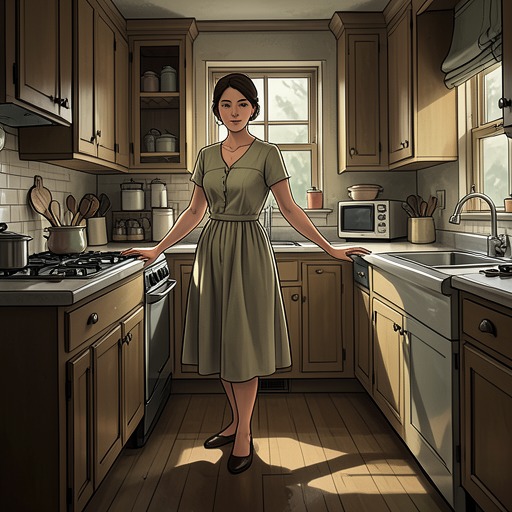
Virginia Neville remains in the bedroom after her death, lying on her back with her arms at her sides and her slightly curled fingers making her appear to be asleep. Robert Neville turns away from her and confronts the practical question of what can be done with the dead during the plague. The law requires every body to be transported immediately to the fires because only flames can destroy the bacteria responsible for the disease. Funeral parlors are closed, healthy morticians are prevented from working, and cemeteries are locked and watched; people attempting to bury relatives have even been shot.
Robert Neville knows the law but refuses to surrender Virginia Neville to it. His decision is not presented as ignorance of the danger. He understands the public rationale for incineration, yet cannot accept the emotional act of placing the woman who shared his life and love onto a communal fire. The conflict therefore joins epidemiological necessity to intimate resistance: the same body is at once a possible source of infection and the remains of a marriage. His refusal becomes a vow that, if anything still exists in the world, Virginia Neville will not be burned.
The Secret Burial
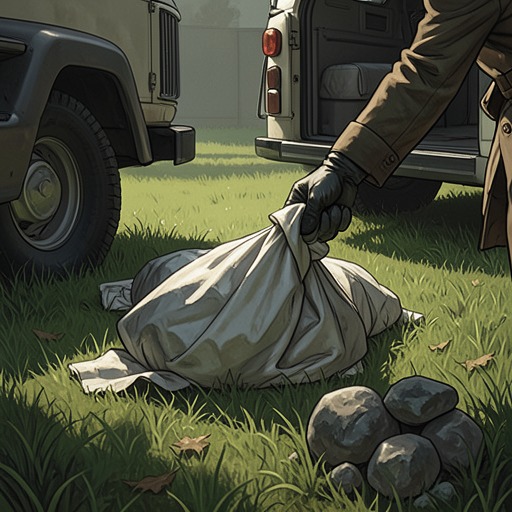
After an hour of indecision, Robert Neville chooses concealment and physical labor. He takes needle and thread and sews Virginia Neville into a blanket, covering her mouth, nose, and eyes until only her face is visible. The procedure is careful but violently final, turning the recognizable body of his wife into something that can be transported without being seen. He then drinks whisky, finds that it does not affect him, and carries her from the bedroom on faltering legs.
He drives through deserted streets, turns at Compton Boulevard, and avoids the watched cemeteries. In a quiet street ending at a large, high-weeded lot, he cuts the motor and lets the car roll so that no one will hear it. No one sees him carry Virginia Neville from the car or take her deep into the lot. Kneeling in an open patch of ground, he digs beneath the direct heat of the sun, with sweat running down his face and newly turned earth filling his nostrils. The burial is hidden from society but not from his own consciousness: the physical work delays the moment when he must release her.
At the grave, Robert Neville understands the burial as the end of eleven years of shared life. He tries to suppress his trembling because there is no time for grief, but the world shimmers through tears as he presses the earth back over her body. Two days later he lies fully clothed on his bed, half drunk, watching the clock mark two in the morning. The overturned whisky bottle and the silent room externalize the collapse that follows the burial: the act has preserved Virginia Neville from the public fire, but it has not made her loss bearable.
The Return from the Grave
The resurrection begins as an intrusion into the sealed house. Robert Neville hears someone mumbling on the porch, braces himself, and opens the door to the moonlight. He cannot scream when he sees Virginia Neville standing before him. She is not merely remembered or imagined in that moment; she appears as a returning figure whose presence revives the burial instead of undoing it. Her attempt to speak his name makes the recognition more devastating, because the familiar identity remains perceptible within an altered, dangerous body.
Robert Neville later explains that he initially tried to keep Virginia Neville with him. He describes her return as resembling an outline or shadow and emphasizes that she was dead even while she had come back. The contradiction is the emotional core of the episode: resurrection offers the shape of reunion without restoring the person or relationship that existed before death. Virginia Neville wants blood, and Robert Neville must confront his own wife as one of the creatures from whom he has spent years defending himself.
The return also explains why Robert Neville's grief cannot settle into ordinary mourning. Burial had seemed to establish a boundary between the living and the dead, but Virginia Neville crosses it. Her reappearance converts remembrance into vigilance, and love into a source of physical danger. The house, once a refuge for Robert Neville, becomes the place where the past itself arrives at night.
The Second Burial and the Stake
Robert Neville ultimately puts Virginia Neville away again. He has to do to her what he has done to the other vampires: drive a stake into her. He presents the act as the only method he knows, but its emotional meaning is unlike the routine disposal of anonymous bodies. The stake is a survival measure applied to his wife, and the repeated phrase that she is his own wife marks the unbearable collision between intimacy and violence.
This second removal is more than a return to the first burial. The first burial attempted to preserve Virginia Neville's dignity and marital identity against the plague law. The staking acknowledges that the dead woman has become an active danger and that Robert Neville's attachment cannot suspend the biological condition governing her return. His action therefore closes the path to reunion while leaving the wound open; he survives, but survival requires him to destroy the figure through whom he most desperately sought companionship.
Traumatic Afterlife and Narrative Significance
Virginia Neville's death and return continue to govern Robert Neville's behavior long after the immediate events. He dreams about her intensely enough to cry out in sleep and grip the sheets with frenzied fingers. Later, when he encounters Ruth, the possibility of human closeness activates the memory of Virginia Neville rather than replacing it. He mistakes Ruth for his wife upon waking and then confesses the entire sequence: the burial, the return, the attempted reunion, the blood-feeding, and the stake.
The episode also illuminates Robert Neville's responses to later losses. When he finds a dog and then loses it within a week, the animal's death reopens the same structure of attachment and deprivation. Robert Neville regards the dog as the peak of a planet's evolution, not as a trivial consolation, and its loss leaves him unable to eat, drink, or sleep. His gentle promise to the sick animal that it will soon be better, followed by tears when it licks his hand, reveals how strongly the earlier loss has made companionship both necessary and perilous.
Virginia Neville's resurrection thus functions as the novel's most intimate demonstration that the plague has destroyed more than bodies. It has abolished the ordinary rituals by which the living separate from the dead, made affection a possible avenue of infection, and forced Robert Neville to treat a beloved person as an enemy. The burial preserves his last act of marital loyalty; the resurrection exposes the limits of that loyalty; and the second burial establishes the traumatic knowledge that love cannot bring the past back without also bringing back the disease.