Willys station wagon
I Am LegendThe Willys station wagon is Robert Neville’s principal vehicle and one of the practical foundations of his solitary life after the plague. It enables him to move through deserted Los Angeles, dispose of vampire bodies, obtain supplies, and maintain the routines by which he resists the surrounding vampire population. Its eventual destruction turns an ordinary tool into a conspicuous sign of Neville’s material vulnerability, forcing him to rebuild the conditions of survival almost from nothing.
Function in Neville’s Routine
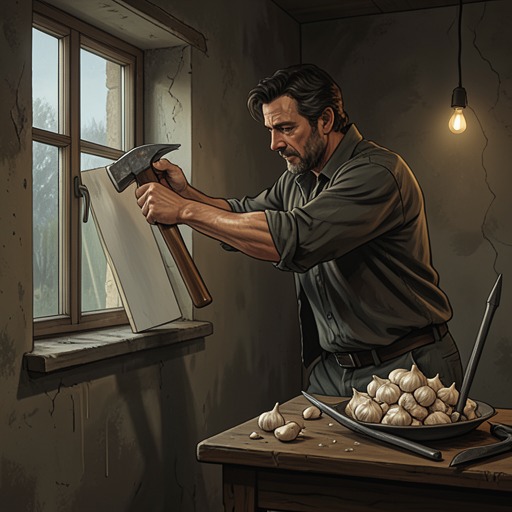
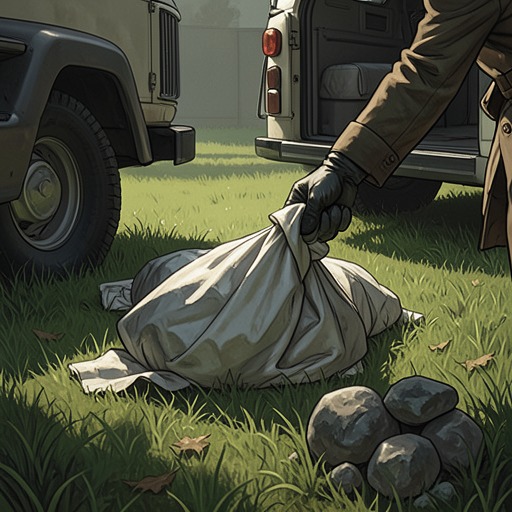
Neville uses the Willys station wagon as part of a carefully ordered morning operation. After unlocking the garage, he backs it into the early-morning air, loads two dead women onto a canvas tarpaulin, and gathers stones and bricks into a cloth sack. He then prepares lunch, takes his bag of stakes and mallet, locks the house, and checks his list. The first item is a lathe at Sears, but only after the bodies have been dumped. The station wagon therefore joins domestic preparation, personal weaponry, supply acquisition, and corpse disposal in a single chain of labor.
The vehicle also makes possible his movement through a city that has lost its ordinary social function. He drives from his house toward Compton Boulevard, turns east, and passes silent houses and empty, dead cars parked along the curbs. When the fuel gauge shows half a tank, he stops on Western Avenue to siphon gasoline into the tank rather than use the reserve stored in the garage. The station wagon is not merely transportation: it is part of Neville’s system of rationing, planning, and preserving options in a city where every usable resource has become finite.
The Vehicle at the Corpse-Burning Pit
The Willys station wagon carries the bodies to the corpse-burning pit, where the fire is always burning. Approaching the site, Neville puts on heavy gloves and a gas mask and watches the sooty pall of smoke above the excavated field. The pit, already made into one gigantic excavation in June 1975, is the destination toward which the vehicle’s cargo has been directed from the beginning of the morning.
At the pit, Neville parks, opens the rear gate, drags out a body, stands it on its feet, and shoves it down the steep incline onto the smoldering ashes. The station wagon thus occupies an unsettling position between machine and ritual instrument. It performs the logistical work required by the plague’s aftermath, carrying human remains toward compulsory destruction, while Neville’s gloves, mask, and physical effort reveal that the supposedly impersonal process still depends on one exhausted survivor.
Destruction During the Attack
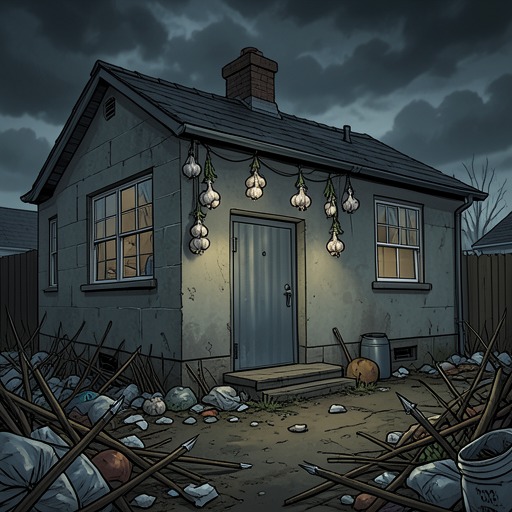
The station wagon becomes a focal point when Neville returns to Gardena and discovers that the vampires are waiting in front of his house. He has misjudged the time spent at the cemetery and during the other errands, and by the time he reaches the neighborhood they have gathered around his home. Their presence transforms the vehicle’s return journey from routine transit into a desperate attempt to reach shelter before night fully closes around him.
After Neville gets inside, a great crash announces the attack. From the peephole he sees the station wagon lying on its side while the attackers smash the windshield with bricks and stones, tear open the hood, and strike the engine and frame with clubs. The destruction is both practical and psychological. The vampires are not only damaging a car; they are dismantling the means by which Neville travels, works, and brings necessities back to the house. His rage at the sight of the blows is intensified when the electricity fails, the refrigerator and freezer go dead, and the house becomes what he recognizes as a dead house.
Replacement and Material Dependence
The loss of the station wagon creates a difficult recovery task. Neville needs a new car but cannot simply walk to Santa Monica, where he knows the only Willys store. The many cars abandoned around the neighborhood are mostly unusable because of dead batteries, clogged fuel pumps, empty tanks, or flat tires. His dependence on the same type of vehicle is deliberate: the Willys station wagons are the only cars with which he has experience, and he does not consider this a suitable time to experiment with an unfamiliar model.
Eventually, he finds a functioning car in a garage about a mile from the house, drives it to Santa Monica, and obtains another station wagon. He installs a new battery, fills the tank with gasoline, loads gasoline drums into the back, and drives home, arriving about an hour before sunset. The replacement restores mobility, but it also confirms the precariousness of Neville’s independence. Survival requires not only courage and scientific investigation but knowledge of engines, fuel, batteries, pumps, tires, stores, distance, and daylight.
The vehicle’s continued use is also protected indirectly by the generator. The attackers fail to understand the generator’s importance, leaving it damaged only by a torn wire and a few cudgel blows; Neville repairs it the morning after the attack and saves his frozen food from spoiling. The contrast is revealing: the vampires destroy the visible vehicle that carries Neville through the city, while the less obvious machine that sustains his house remains available. His survival depends on this network of vulnerable objects rather than on any single heroic action.
Narrative Significance
As an object, the Willys station wagon moves from transparent utility to exposed material presence. At first it is simply something Neville backs out of the garage, fuels, loads, and drives. Its importance becomes visible only when it is overturned and beaten apart. The attack makes the vehicle’s physical dependence on fuel, electrical power, and mechanical integrity impossible to ignore, showing that Neville’s apparently controlled routine rests on a fragile assemblage of machines, supplies, tools, and timing.
The station wagon also gives shape to the novel’s contrast between ordinary life and post-plague existence. A shopping list, a trip to Sears, a fuel stop, and a familiar automobile belong to the world of everyday maintenance; the bodies in the rear, the gas mask at the corpse-burning pit, and the vampires waiting at the house belong to a world in which those same routines have become survival procedures. The Willys station wagon binds these worlds together. It is a domestic and commercial artifact repurposed as a vehicle of resistance, and its destruction briefly proves how easily the remnants of normality can be overturned.