Xin Shehui
I Am LegendThe new society is the organized community of infected survivors that begins rebuilding social life after the plague. It has discovered a way to remain alive with the germ, to endure brief periods in sunlight, and to prevent the infection from multiplying through a pill made from defebrinated blood and an unidentified drug. Its emergence transforms the novel’s central conflict: Robert Neville’s solitary campaign against vampires is recast as resistance by an obsolete minority against a new majority that considers him a dangerous abnormality.
Formation and Biological Adaptation
The new society arises from people who are infected but no longer condemned to die or remain wholly governed by the disease. Ruth explains that its members have found a way to stay alive and intend to establish society again gradually. Their adaptation is not a cure in the ordinary sense. The germ remains part of their condition, but the pill they take combines defebrinated blood, which feeds the germs, with a drug that prevents their multiplication. This discovery saves them from dying and makes collective reconstruction possible.
The group’s altered physiology also weakens the boundaries that Robert Neville had treated as absolute. Its members can live in the sun for short periods, and Ruth’s apparent tan is revealed as make-up rather than the mark of ordinary health. These changes make the new society difficult for Neville to recognize through the older folklore of vampirism. Daylight, infection, and human appearance no longer divide the world as cleanly as they once did; medical management has produced a population that occupies an intermediate state between the healthy humans of the past and the night-bound vampires Neville has hunted.
Political Aims and Methods
The new society’s stated aim is restoration: its members want to set up society again slowly and surely. Yet restoration depends on exclusion. Ruth tells Neville that they intend to eliminate the creatures whom death has cheated, treating the old, impaired vampires as beings whose continued existence cannot be permitted beside the living. The organization therefore defines reconstruction through population management, deciding which infected bodies can be incorporated and which must be destroyed.
Its political method is openly coercive. Ruth compares the group to a revolutionary movement repossessing society through violence and describes violence as inevitable. When Neville protests that he killed only to survive, she answers that survival is precisely the justification used by the new society. From its perspective, Neville’s repeated killings are not evidence of heroic resistance but proof that he belongs to the same violent history. The new order does not abolish the logic of extermination that shaped Neville’s lonely war; it inherits and institutionalizes that logic.
This principle explains the organization’s decision to capture Neville rather than simply ignore him. Ruth says that the attackers had orders to bring him in unharmed, although his gunfire provoked a more damaging assault. The distinction between authorized force and uncontrolled violence is important to the new society’s self-image: it presents itself as a governing authority with procedures, even while its agents arrive armed and prepared to destroy a person judged too dangerous to leave alive.
Surveillance, Assault, and Capture
For most of the narrative, visibility belongs to Neville. From his house he watches the infected outside through a peephole, while they surround the building, call to him, and attempt to lure him into the night. He eventually stops looking at the women because they perform obscene postures in the hope of enticing him outside, but the refusal to look does not end the contest over visibility. The house remains a fortified point from which Neville observes and repels the surrounding population.
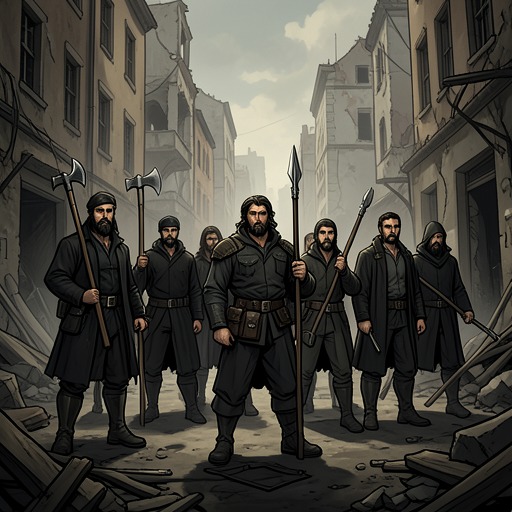
The new society reverses that arrangement. Its members come at night in dark cars carrying spotlights, guns, axes, and pikes. The lights sweep around the corner of Cimarron Street and expose the vampire faces gathered outside Neville’s house. He sees the assault forming through the peephole, considers the pistols in his bureau and the sub-machine gun on his workbench, and prepares to defend the building. The scene turns the familiar instruments of his survival into signs of an older order under siege: the observer at the window is suddenly the watched and targeted inhabitant.
The attack succeeds. Neville is wounded in the chest and wakes in a tiny cubicle with barred windows, remembering the dark men and the assault on his house before fully understanding where he is. The barred room converts his former domestic fortress into a prison, completing the organization’s seizure of control over space, movement, and sight. After more than three years alone in the house, Neville is no longer an isolated investigator choosing when to observe the outside world; he is a captured specimen held within the new society’s institutions.
Relationship with Robert Neville
The organization’s relationship with Robert Neville is shaped by both fear and historical judgment. Ruth identifies him as the last of the old race and says that, within the society known to her, no one else is like him. His uniqueness does not grant him authority. Instead, it makes him an intolerable remainder of a superseded population, someone whose continued existence preserves the threat of the old world.
When Neville asks whether the people outside are human, the organization’s perspective is embodied in the people who look up at him. At first they appear to him as a crowd gathered below; then, when they see him, they respond with awe, fear, and shrinking horror. Neville realizes that they regard him as a scourge worse than the disease they have learned to live with, because they associate him with the bloodless bodies of their loved ones. Their fear is not irrational within their historical experience. He has spent years killing members of the infected population, and the evidence of his existence is, for them, the bodies he leaves behind.
The reversal reaches its clearest formulation when Neville sees the new people of the earth and understands that he does not belong to them. Like the vampires he once condemned, he has become anathema and a black terror to be destroyed. Normality is no longer the condition of one man measured against a diseased majority; it is the standard established by the majority itself. The organization’s power is therefore biological, political, and interpretive at once: it survives the plague, controls the future, and supplies the meaning by which Neville is classified.
Ruth and the Organization’s Internal Voice
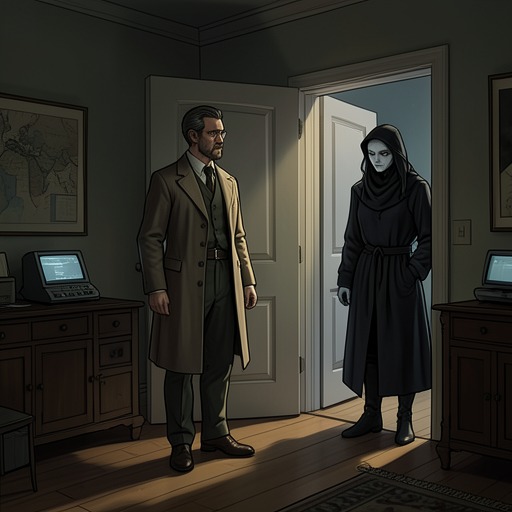
Ruth provides Neville with the clearest account of the new society’s structure and intentions. Earlier, she had entered his life as a vulnerable apparent survivor, but her later message reveals that she was assigned to spy on him. She explains that she initially felt no concern for his life because he had killed her husband, yet her understanding changed when she recognized that both sides had been forced into their situations by infection and social collapse.
Her warning shows that the organization is not presented as a perfectly unified machine. Ruth tries to save Neville by telling him that the group is currently too small and insufficiently armed to attack his house effectively. She urges him to use the time to flee into the mountains, while warning that the society will eventually become organized enough for the others to destroy him regardless of her objections. Her attempt to intervene suggests conflict between personal recognition and collective survival, but it does not undo her commitment to the new order.
After Neville is captured, her manner has changed. She speaks dispassionately about the revolutionary violence of the new society and calmly defends its policy of destroying the dead. Her altered expression confirms that she now speaks from within the organization’s emergent political identity rather than from the uncertain position of an infiltrator. The society can absorb sympathy, fear, and individual hesitation into a larger program whose basic premise remains that incompatible populations cannot coexist.
Historical and Thematic Significance
The new society completes the novel’s reversal of the vampire story. Neville believes himself to be the last normal man investigating a supernatural plague, but the organization demonstrates that the supernatural has become ordinary through adaptation, medicine, and collective power. The former monster population becomes the founding population of the future, while the solitary healthy man becomes the legendary terror remembered by that future.
Its authority rests on a majority concept of normality. When the crowd falls silent before Neville, he understands that normalcy belongs to the many rather than the one. The organization’s members need not share the folklore that once made them monsters; by surviving, organizing, and reproducing social rules, they make their own condition the basis of reality. Neville’s final recognition of himself as a new terror born in death marks the organization’s ultimate victory: it has not merely captured him but displaced the interpretive world in which his actions once made sense.
The new society thus preserves the violence of the old world while changing its direction. It uses medicine to stabilize infection, institutions to regulate survival, armed agents to eliminate threats, and collective judgment to define the abnormal. Its rise does not produce a simple moral replacement of evil by good. It produces a new historical normality in which the people Neville called vampires become the inheritors of the earth, and Neville becomes the legend that explains why they fear what came before.