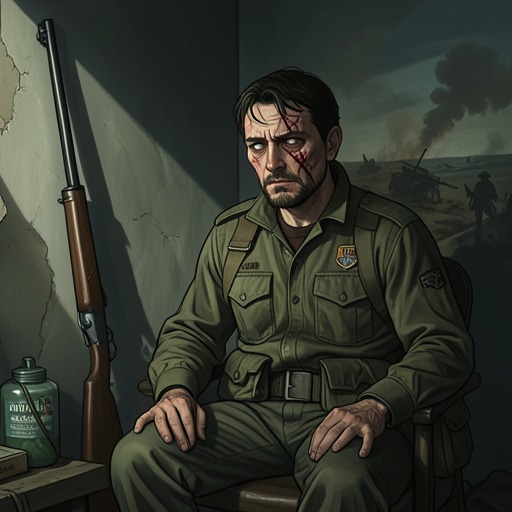
Allied invasion of Sicily
I Heard You Paint HousesThe Allied invasion of Sicily enters the book through Frank Sheeran’s recollections as an infantryman in the 45th Infantry Division. Rather than recounting the campaign’s operational course, his account follows the division’s preparation, Patton’s effort to define its character, and the killing of unarmed prisoners after the battle for Biscari airfield. The contrast is central: a celebrated fighting force could be praised for its success even as its conduct toward prisoners came under scrutiny.
Preparing the 45th Division
In the fall of 1942, while the 45th Infantry Division was still training in the United States, General George S. Patton addressed its men at a theater in Fort Devens, Massachusetts. Sheeran remembered an audience of young soldiers, many away from home for the first time and facing the prospect of being sent overseas to fight and die. Patton told them that he had a special role for the division in the war. His speech did more than describe a military assignment: it supplied the men with an identity and a standard of conduct before they had entered combat.
Sheeran sailed for Casablanca on July 14, 1943, assigned to the division as an infantry rifleman. He had requested a place in the company where his friend Diggsy served and was assigned not only to that company but to the same platoon and eight-man squad. The details give the campaign a personal scale. The division was a large military formation, but the fighting Sheeran recalls was also a matter of the same small group of men going forward together.
Patton told the division that it would probably see more combat than any other American division and wanted the Germans to know it as the “Killer Division.” The label turned anticipated exposure to combat into a collective identity. In a further speech in Algiers on June 27, Patton urged the men to keep killing, argued that taking prisoners meant feeding more men, and discouraged them from accepting surrender. A division officer also reported that Patton said civilians who remained near the battle and were considered enemies should be killed and removed. The book presents these remarks as a command climate in which restraint toward people encountered in battle was sharply devalued.
Biscari and the treatment of prisoners
Sheeran’s recollection of Sicily includes reports he heard from Diggsy after digging his foxhole. Both sides, he said, hated snipers, and the men believed that a captured sniper could be killed on the spot. After American soldiers had been hit by sniping near Biscari airfield, about forty Italian soldiers surrendered. Because the Americans could not determine which prisoners had been responsible for the sniping, they lined them up and shot them. In a separate incident, a sergeant took about thirty prisoners behind the line and machine-gunned them. Sheeran recalled that the reports made him think twice about surrendering if he were ever captured.
The account distinguishes what Sheeran says he witnessed from what he says he learned from Diggsy. The executions are related as events reported to him, not as actions he claims to have seen. That distinction matters: the episode reaches the reader through a soldier’s recollection of what fellow soldiers said, while still conveying how such accounts shaped his understanding of the dangers of surrender.
The narrative also records that two members of the division faced courts-martial for murder after the battle to take Biscari airfield. Captain John T. Compton had ordered a firing squad to shoot approximately forty unarmed prisoners of war, including two civilians; Sergeant Horace T. West had machine-gunned thirty-six unarmed prisoners. These cases give specific form to the broader stories of killings Sheeran recalls. The book sets Patton’s reported calls for ruthless killing beside the proceedings against the two soldiers, without reducing the incidents to a single command or suggesting that the speeches alone establish the circumstances of each crime.
Praise after combat
In August 1943, after the division’s combat success in Sicily, Patton addressed its men and officers outdoors. He praised it as one of the best divisions in the history of American arms. The speech made the campaign’s success and the division’s reputation the subject of public approval. In the book’s sequence, that commendation follows the account of the prisoners killed at Biscari and the court-martial cases. The contrast is not resolved: the same division could be celebrated for battlefield performance while members of it faced murder proceedings for killing unarmed prisoners.
The invasion is therefore presented less as a map of movements than as a formative experience in Sheeran’s military recollection. The unit’s close-knit structure, Patton’s forceful rhetoric, and the violence reported around Biscari shape his account of what combat meant and what a soldier might fear even after surrender. The campaign’s significance in this narrative lies in that collision between military praise and the treatment of the vulnerable, an early example of the violence through which Sheeran remembers his wartime years.