Andrew Jackson Hotel
I Heard You Paint HousesThe Andrew Jackson Hotel was Jimmy Hoffa’s headquarters during the Nashville jury-tampering trial: a base for his legal team and supporters, but also a setting entangled with the government’s surveillance of the defense operation. Its rooms linked the visible work of preparing a case to the concealed flow of information that would shape the trial’s outcome.
Headquarters During the Nashville Trial
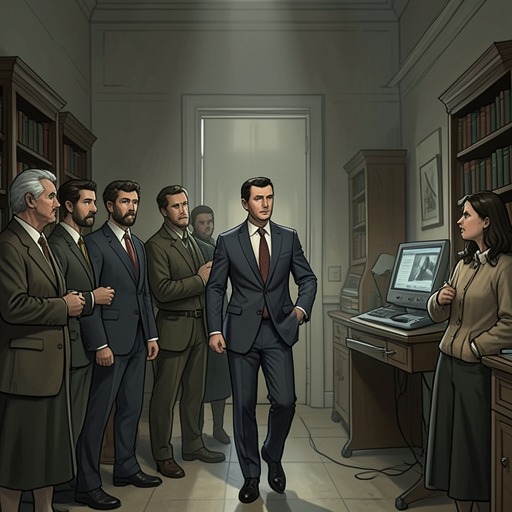
Hoffa established his base at the plush Andrew Jackson Hotel, a short distance from the federal courthouse. Lawyers worked both in court and back at the hotel, where a legal brain trust advised and researched for the defense. Around them gathered union allies and other supporters, including Hoffa’s foster son, Chuckie O’Brien, and Allen Dorfman, who managed the pension fund. Some members of the entourage came from Nashville and were expected to provide information about prospective jurors during selection, in an era before professional jury advisers.
The hotel therefore served more than a convenient lodging function. It concentrated legal preparation, personal loyalty, union connections, and efforts to understand the jury in one place. The account also suggests that the gathering did not have a single purpose: Hoffa’s supporters were present to advance several causes, not merely the trial defense.
The Trial’s Hidden Drama
The hotel’s importance becomes clearer against the trial’s two simultaneous narratives. Courtroom procedure—witnesses, cross-examinations, arguments, objections, motions, and rulings—was only one drama. The other was the jury tampering taking place alongside it, while Edward Grady Partin supplied the Get Hoffa Squad with details of events as they unfolded. Partin’s access to Hoffa’s circle made the hotel’s informal network consequential: the defense’s gathering place was also penetrated by a source reporting to Walter Sheridan.
Sheeran recalled staying at the hotel while insisting that he was not part of the jury operation. He remembered seeing Partin in the restaurant seated with Frank Ragano, who, Sheeran said, did not know that Partin was an informant. Sheeran also described the hotel room used by the lawyers as the place where Partin was present among them. The recollection captures the imbalance at the heart of the episode: people within the defense circle could believe they were sharing plans among allies while information was moving outside their control.
Sheeran’s Recollection and the Hotel’s Significance
Sheeran’s account gives the hotel an everyday surface as well as a strategic one. Alongside the legal entourage and the FBI presence, he remembered the restaurant’s Southern-fried chicken and seeing familiar associates there. That ordinary detail makes the reported intrusion more striking: Partin’s presence was not in a distant government office but in the hotel’s shared social space, among the people Hoffa had gathered around himself.
The hotel was not the courtroom, and the decisive testimony against Hoffa came later in court. But it formed part of the environment in which the jury-tampering case was carried out and observed. When Partin appeared as the government’s final witness after months of proceedings, the dispute over whether he had been planted inside the defense camp made the earlier hotel access newly significant. In the book’s account, the Andrew Jackson Hotel stands as a physical hinge between Hoffa’s confidence in his network and the hidden reporting that helped unravel it.