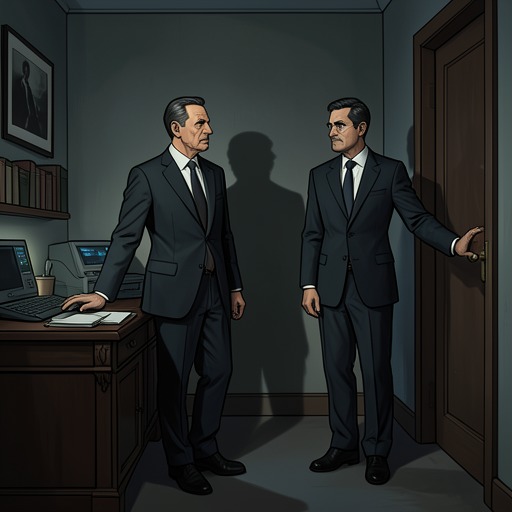
Arrangement for Hoffa and Tony Provenzano to meet and reconcile
I Heard You Paint HousesThe proposed meeting between Jimmy Hoffa and Anthony Provenzano was a last-minute opening in a dangerous feud: Anthony Giacalone arranged a public sit-down, Hoffa agreed to try to settle the dispute, and Frank Sheeran was asked to provide backup. The arrangement mattered not because the account confirms a reconciliation, but because it captures the uncertain interval in which peace was still being proposed and violence was already imaginable.
A renewed attempt after earlier refusals
Hoffa told Sheeran that a meeting had been set for Wednesday afternoon “with the little guy,” meaning Provenzano. Sheeran was surprised enough to ask what had changed Hoffa’s mind. Hoffa’s answer, “What have I got to lose?”, made the decision sound less like confidence in an agreement than a willingness to make one last attempt. He also referred to the expectation that he should try to settle his own dispute first, before Sheeran came out to the lake on Saturday. The planned sit-down was therefore placed within a short sequence of unresolved business, not presented as a settled return to friendship.
The change was striking against the earlier history recounted in the passage. For a long time, people had said that Anthony Giacalone was trying to arrange another meeting between Hoffa and Provenzano after the fiasco in Miami. Hoffa had rejected the idea. Now he was agreeing to meet the same man who, according to the narrator, had threatened to rip Hoffa’s guts out with his bare hands. That reversal gives the arrangement its tension: the meeting was framed as an attempt at accommodation, but it brought together men whose conflict had already reached the level of explicit threats.
Venue, timing, and the backup plan
Hoffa emphasized that the meeting would take place at the Machus Red Fox Restaurant on Telegraph, a public restaurant. He identified Anthony Giacalone as the person who had set it up and assured Sheeran that he did not need a weapon or bodyguard. Sheeran nevertheless urged Hoffa to take what he called a “little brother”—his euphemism for a gun. Hoffa refused the suggestion, while Sheeran treated the public setting as reassuring but not sufficient to remove his concern.
The timing was specific. Hoffa asked Sheeran to meet him at the restaurant on Wednesday at 2:00; the others were expected at 2:30. Sheeran agreed to go there and repeated that he would bring his “little brother,” describing it as a good negotiator. The exchange made his role clear: he was not being asked to negotiate the feud or attend as one of its principals, but to stay close enough to act as protection if the meeting turned dangerous. The half-hour difference between his arrival and the other men’s expected arrival also belongs to the arrangement as narrated; the account does not explain what was meant to happen during that interval.
Anthony Giacalone’s position between the men
The choice of intermediary carried its own complication. Anthony Giacalone belonged to the Detroit outfit and was very close to Hoffa, his wife, and his children. But he was not connected only to Hoffa: Giacalone’s wife was a first cousin of Provenzano. The narrator presents that family tie as significant within Italian relationships, making Giacalone a figure with personal connections on both sides rather than a detached arranger.
Sheeran says he understood why Hoffa trusted Giacalone and describes him as very good people. He also notes that Giacalone died in jail in February 2001, and that a newspaper headline said the reputed mobster had taken the Hoffa secret to the grave. This later observation does not establish what Giacalone knew or what happened at the planned meeting. Instead, it emphasizes the limits of what the narrator can verify: the trusted intermediary who arranged the sit-down could, in Sheeran’s view, have told things that remained undisclosed.
Sheeran’s retrospective suspicion
At the time, Sheeran responded to the public venue with guarded optimism. He joked that perhaps a wedding was bringing everyone together and described the hoped-for mood as one of smoking a peace pipe and burying old hatchets. But his reassurance was qualified immediately: he would have felt more comfortable if he had been present as backup. Hoffa’s answer, “All right, Irishman,” turned that concern into a concrete invitation to attend.
The narrator’s later reading is darker and explicitly speculative. Looking back, he wonders whether Hoffa himself might have been setting Provenzano up to be killed by relying on Provenzano to behave as he usually did. In this imagined scenario, Giacalone would witness Hoffa acting reasonably and Provenzano acting abusively; Hoffa could then tell Russell Bufalino at the lake on Saturday that he had exhausted every effort to settle matters and that Provenzano had to go. Sheeran does not present this as something he knew at the time or as a proven motive. Its importance lies in the retrospective uncertainty it introduces: even the apparent peacemaking could, in his later account, have been part of a case for escalation.
The arrangement and its limits
Sheeran says he immediately called Russell Bufalino with the encouraging news that Hoffa would meet Giacalone and Provenzano, and told him that he himself would be there as backup. He then says he cannot recall Bufalino saying anything. That silence remains a gap in the account, not evidence of approval, objection, or foreknowledge. The arrangement thus reaches Russell through Sheeran, but the passage supplies no response from him that would resolve what he thought of the plan.
The account establishes a proposal, its intermediary, its public location, its scheduled times, and Sheeran’s intended protective role. It does not establish that the Wednesday meeting took place, what was said there, or whether either man genuinely intended reconciliation. The distinction matters: Hoffa’s willingness to make one last attempt is reported directly, while the possible trap and its imagined audience belong to Sheeran’s hindsight. The scene leaves peace and danger side by side, with the restaurant chosen as a public safeguard and a gun still treated as prudent backup.