Battle of Anzio
I Heard You Paint HousesThe Battle of Anzio was an Allied amphibious landing intended to open a second front against German forces in Italy and help break the deadlock at Monte Cassino. Its opening brought surprise and prisoners; a delay in advancing gave the Germans time to reinforce and fortify the ground above the beachhead. For Frank Sheeran and the 45th Infantry Division, the intended flanking maneuver became four months of bombardment, confinement, and survival by turns of watch and rest.
From Monte Cassino to the Beachhead
By November 1943, the 45th Infantry Division had advanced north from Naples toward Rome and reached the foothills around Monte Cassino. German forces held the mountains above them and shelled their positions. The division endured more than seventy days of continuous combat under cold, wet conditions and near-constant artillery and mortar fire. Repeated Allied assaults against the German line failed, and the monastery at Monte Cassino, used by German observers, became the focus of a costly struggle. Bombing it did not solve the problem: the rubble offered the Germans further protection.
The division was withdrawn to a rest area at Casserta, near Naples, where it had about ten days away from the front. The respite ended with the move in landing craft to Anzio, a coastal town north of the German line at Monte Cassino and south of Rome. The plan was to attack the German flank and give the main Allied force a chance to break through at Monte Cassino. The transfer therefore offered a change of battlefield, not an escape from combat.
Surprise Lost
The Allies took the Germans by surprise at the Anzio beach and captured a couple of hundred prisoners. The first twenty-four hours were quiet as troops moved inland from the beach. But the general in command feared that the apparent opening might be a trap and chose to wait for tanks and artillery to land rather than press forward. That caution changed the operation’s prospects: the delay gave the Germans time to bring their own tanks and artillery into position above the Allies and dig in, helping them pin the beachhead down and impede the arrival of Allied heavy equipment.
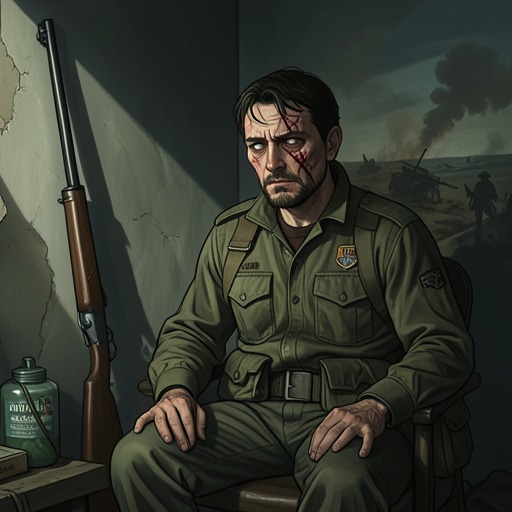
German artillery and aircraft then subjected the position to sustained attack. Ordinary foxholes offered too little protection, so the soldiers dug shelters roughly eight feet deep with shovels. Foot ladders allowed them to climb in and out; boards and branches laid overhead helped shield them from rain and absorb shrapnel. A landing meant to create room for a rapid advance had become a defensive struggle in which the exposed ground beyond the shelters was dangerous even by day.
Four Months Under Fire
The division remained under attack for four solid months. During daylight, leaving a dugout could invite German fire, while night offered the limited opportunity to emerge, take a turn on the perimeter, or relieve oneself. Sheeran’s account describes men eating canned K-rations because cooked food could not be brought to them; German attacks on supply ships further interrupted deliveries. They passed the confined hours playing cards and talking about what they would do after the war, while prayer became part of the routine of enduring the bombardment.
The worst shelling came at night from a German heavy gun nicknamed the Anzio Express. Camouflaged during daylight, it was kept on a railroad track outside Rome and brought into position after dark, when Allied aircraft were on the ground. Its shells made the night itself a warning: the incoming sound was compared to a freight car overhead, and the bombardment could leave no bodies to send home. Soldiers also took turns serving as outposts about a hundred yards beyond the perimeter so that others might sleep. There was little rest; conventional shelling continued by day, and night duty brought its own danger.
The Germans advanced twice in attempts to drive the Allies off the beachhead, but the 45th held its position. The Combat Report described the division as tearing apart the effort to erase the beachhead. Holding the ground, however, did not mean that the siege was over: the repulse was followed by long months of waiting under constant bombardment, during which more than 6,000 Allied lives were lost.
Relief and Significance
In May, the main Allied force broke through the German line at Monte Cassino. By the end of the month, 150,000 weary but relieved soldiers moved out of their Anzio dugouts and joined the force advancing north from the south toward Rome. The landing’s immediate promise of a quick opening had not been fulfilled; its eventual contribution was a beachhead held through months of attack until the wider advance could link up with it. On June 6, as the Italian campaign continued, Allied forces also landed in Normandy and opened another front.
The episode is presented through Sheeran’s recollection alongside the division’s reported conditions and the campaign’s military course. Its sharpest reversal lies between the first quiet day, when the landing force had taken the Germans by surprise, and the months of entrenchment that followed the decision to wait. In the account, the Battle of Anzio is not simply a landing or a successful defense: it is the prolonged cost of holding exposed ground after the chance to advance had narrowed.