Battle of Salerno
I Heard You Paint HousesThe Battle of Salerno was a costly Allied landing in September 1943 and, in Frank Sheeran’s recollection, the worst of the three invasion landings he made. German shells exploded around the landing craft as the soldiers entered the Mediterranean and struggled ashore. The immediate objective was to push roughly 1,000 yards inland and secure a beachhead; each man carried a shovel, and the troops began digging in under fire.
Landing and Beachhead
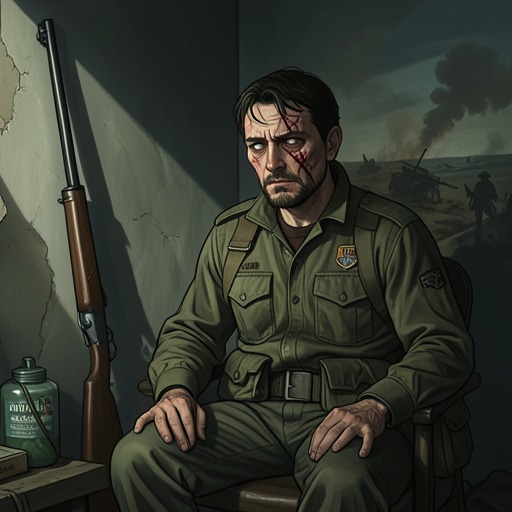
The landing placed the soldiers in a exposed, precarious position. German artillery pounded their positions, while German planes strafed them. Sheeran remembered shooting at advancing German soldiers, but not the first time he fired on an enemy. His account sets the physical urgency of the landing against the uncertainty of memory: he could recall being there and firing, but not the moment when that act first began.
The troops came close to being pushed off the beach. A Combat Report cited a general from another division who credited the 45th Infantry Division with preventing the Germans from driving the Allied invaders into the sea. The beachhead’s survival was therefore not an assured outcome but the result of resistance under pressure.
The Turn Inland
Heavy fire from the Navy forced the Germans to retreat beyond the range of its guns. That change gave the Allied troops an opportunity to move forward: they advanced off the beach and joined other divisions for a push north. The sequence—landing under bombardment, nearly losing the shore, then advancing behind naval fire—makes Salerno a struggle first to hold ground and then to convert that foothold into movement inland.
Sheeran recalled that fear was shared among the soldiers, whether or not they admitted it. The danger did not depend on how anyone described it; the men still had to remain in position and continue the fight. His recollection presents endurance as collective and practical rather than heroic in the abstract.
Personal Loss and Recollection
Salerno also remained linked in Sheeran’s memory to Alex Siegel, a tough soldier from Brooklyn’s Jewish section who had been his first new friend in the squad. The two had their photograph taken together in Sicily, with Sheeran’s arm resting on Siegel’s shoulder. About a month later, Siegel was killed in a strafing on the Salerno beachhead. The photograph preserves their friendship before the loss, while the interval between meeting and death gives the battle a personal consequence beyond its military result.
In Sheeran’s account, the landing’s significance lies both in its narrow military outcome and in what it cost the men who held the shore. The 45th Infantry Division’s stand helped keep the Allied force from being driven back into the sea, and naval artillery opened the way north. Yet the advance did not erase the fear, the broken recollection of combat, or the death of a friend at the beachhead.