Bobby Kennedy
I Heard You Paint HousesBobby Kennedy emerges as the central federal antagonist in the book’s account of the government’s campaign against Jimmy Hoffa: first as the forceful interrogator who brought organized crime into millions of living rooms, then as the figure Hoffa’s lawyers invoked while resisting prosecution. His influence is often felt through hearings, investigators, witnesses, and courtroom arguments rather than through his physical presence. The resulting conflict joined public exposure of labor racketeering to an enduring dispute over how far the government could go to prove it.
Identity and Public Role
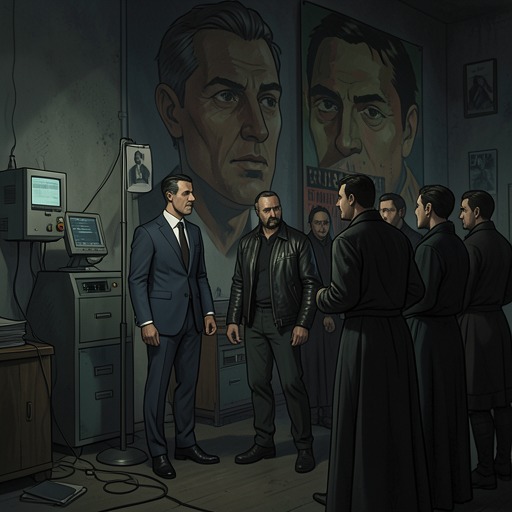
In 1957, Bobby Kennedy served as chief counsel and principal interrogator for the Senate’s McClellan Committee hearings on organized crime. The televised proceedings offered viewers an unusually direct view of mobsters and their lawyers facing senators and declining to answer questions under the Fifth Amendment. The ritualized refusals, delivered in gruff voices and often following questions about grave crimes, became part of the decade’s public culture; viewers commonly took the silence as an admission of guilt.
The hearings followed a highly visible attack on Victor Riesel, an investigative reporter who had featured anti-Hoffa Teamsters on his radio program. After Riesel was blinded in an acid attack, his continuing appearances on television to advocate labor reform intensified public outrage. The Senate’s televised inquiry gave that outrage an institutional forum. Bobby Kennedy’s aggressive work there established him as a formidable opponent of racketeering and, in the book’s account, made him Hoffa’s mortal enemy.
The Hoffa Investigation
Hoffa could not simply refuse to answer committee questions without risking his union position. When confronted with recordings of conversations with Johnny Dio, he responded with evasions and claims of faulty memory, including a carefully qualified assertion that he could not remember asking Dio for favors. The contrast between Dio’s repeated invocation of the Fifth Amendment and Hoffa’s strained denials helped make the hearings a public contest over what could be proved and what a powerful union leader would admit.
The conflict continued in the Test Fleet case, a prosecution concerning a car-hauling company placed in the names of Hoffa’s wife and the late Owen Bert Brennan. The government alleged that the enterprise followed a strike Hoffa had settled favorably for an employer who would then do business with it. The case also carried a tactical purpose: the underlying charge was a misdemeanor, but evidence of jury tampering could raise the stakes to a felony. After three earlier jury trials engineered by Bobby Kennedy had failed to convict Hoffa, suspected jury interference had become a central concern for investigators.
For the Nashville trial, the Get Hoffa Squad encouraged Edward Grady Partin to join Hoffa’s entourage and serve as a guard outside Hoffa’s suite. Walter Sheridan acknowledged that Partin was given a recording device and instructed to watch for efforts to bribe jurors. Bobby Kennedy was not in Nashville during jury selection: as the Cuban Missile Crisis brought the world close to nuclear war, he was needed beside his brother, JFK. The prosecution, however, continued to pursue the case through Sheridan, the investigators, and the trial team.
Jury Tampering and Partin’s Testimony
The danger the investigators were watching for appeared during jury selection. An insurance broker on the panel reported that a neighbor had offered him $10,000 in hundred-dollar bills to vote for acquittal if selected. The judge excused him after requiring him to identify the neighbor. Other prospective jurors said that a supposed Nashville Banner reporter named Allen had questioned them about their views of Hoffa, although the newspaper had no reporter by that name; the tainted candidates were dismissed. These incidents turned jury selection itself into evidence of an effort to shape the verdict.
Partin’s role became explosive only at the end of the later Chattanooga jury-tampering trial. After three months, when Hoffa appeared close to victory, the government called Partin as its final witness. The defense argued that prosecutors had planted him inside Hoffa’s camp and that his presence violated Hoffa’s constitutional right to counsel. The government maintained that Partin had volunteered, reported to Sheridan rather than to prosecutors, and had been assigned to watch for the ongoing crime of jury tampering—not to gather information about the Test Fleet defense.
The judge accepted the government’s account after a four-hour hearing and allowed Partin to testify. Hoffa glared at him from his chair; Partin was not intimidated. He recounted Hoffa’s boasts about attempts to bribe jurors, including efforts he said Hoffa had described before they happened or while they were underway. The government’s case thus turned on a witness whose proximity to the defense could be presented either as evidence of a constitutional violation or as the means by which an ongoing crime was exposed.
Courtroom Conflict and Constitutional Legacy
In closing, prosecutor James Neal characterized the events in Nashville as an extraordinary assault on the jury system and argued that Partin’s account was validated because the events he described had occurred. Hoffa’s lead attorney called the prosecution a frame-up and attacked Walter Sheridan as Bobby Kennedy’s instrument. The defense’s invocation of Kennedy made him a courtroom presence even when he was not a witness: his campaign against Hoffa became part of the argument over whether the prosecution was neutral law enforcement or a politically driven operation.
The Supreme Court appeal brought that dispute into a broader period of expanding criminal-rights protections, identified in the book as the criminal law revolution of 1961–1971. The question was whether Partin’s presence at the Andrew Jackson Hotel had violated Hoffa’s right to counsel. After argument, the prosecution team was uncertain how the justices would rule. A Teamsters official then threatened the brewery owned by Justice William Brennan’s brother in an effort to influence Brennan’s vote. The Court rejected Hoffa’s appeal on the merits; Brennan joined the majority opinion written by Justice Potter Stewart. Chief Justice Earl Warren dissented, calling the government’s clandestine use of Partin an affront to fair federal law enforcement.
Bobby Kennedy’s significance in this conflict therefore extends beyond the outcomes of individual cases. His committee work helped make organized crime and labor racketeering a nationally televised subject; his pursuit of Hoffa brought informants, jury manipulation, and constitutional rights into direct collision. The account neither reduces that collision to simple triumph nor resolves its moral tensions: the government sought to expose jury tampering, while the means used to place Partin near Hoffa became a lasting question about the limits of prosecution.