Chuckie O’Brien
I Heard You Paint HousesChuckie O’Brien was Jimmy Hoffa’s foster son, a member of his household who called him “Dad,” and, in Frank Sheeran’s account, an unwitting participant in the plan that brought Hoffa to his disappearance. His story turns on a painful division: O’Brien remained employed by the union as his ties to Hoffa weakened, then became a crucial link in the supposed trap, while investigators later treated him as a suspect and Sheeran continued to describe him as a dupe rather than a knowing accomplice.
Family Ties and a Widening Break
O’Brien grew up in Hoffa’s household as a foster son and called him “Dad.” That relationship did not disappear when the union’s political loyalties shifted, but it became increasingly strained. As Fitz moved against Hoffa, he fired Hoffa’s wife, Josephine, from her union position, costing her an annual income of $48,000, and ended James P. Hoffa’s $30,000-a-year legal retainer. O’Brien, by contrast, kept his Teamsters job. He also grew closer to Fitz and more estranged from Hoffa.
The book gives the division a personal dimension beyond union appointments. Hoffa was disappointed by O’Brien’s divorce and strongly disapproved of his gambling and spendthrift habits. He refused to support O’Brien for president of Teamsters Local 299, a refusal that widened the rift between them. O’Brien’s continued employment and growing association with Fitz thus stood alongside an intimate history in which Hoffa had helped raise him. The contrast makes his later role especially consequential: the foster son who had called Hoffa “Dad” was positioned to help draw him into a meeting, whether or not he understood what awaited him.
The Meeting and the Alleged Bait
Hoffa disappeared on July 30, 1975, after going to the Machus Red Fox Restaurant outside Detroit for a meeting arranged through Tony Giacalone. The stated purpose was to make peace between Hoffa and Anthony Provenzano, with Anthony Giacalone expected to attend. Hoffa was seen in the restaurant parking lot but never came home. In Sheeran’s later account, the argument over Provenzano’s million-dollar pension was a pretext to bring Hoffa out, and the expectation that the men would be in the Detroit area was strengthened by a wedding scheduled for August 1, two days after the disappearance.
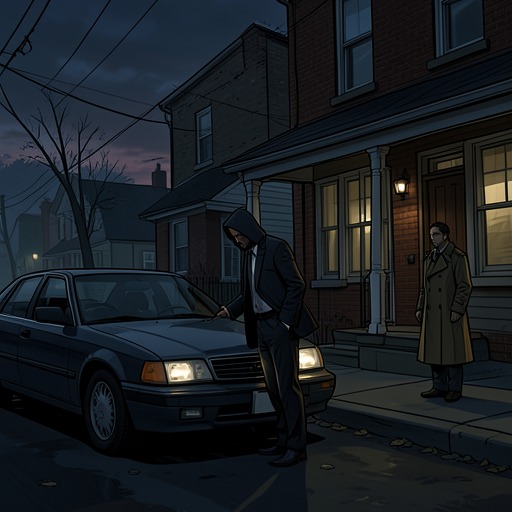
Sheeran describes O’Brien as part of the bait. According to his account, O’Brien and Sheeran were to help lure Hoffa into a car with Salvatore Briguglio, Provenzano’s right-hand man. Briguglio watched for O’Brien’s arrival, while Sheeran understood that his own presence was meant to keep Hoffa from becoming suspicious. The intended next step, as Sheeran tells it, was for Hoffa to feel safe in O’Brien’s car and enter a brown-shingled house with Sheeran beside him.
Sheeran’s account insists that O’Brien did not know the plan. He says O’Brien was expected simply to pick up Hoffa and drive the group to what O’Brien believed was an important meeting. The explanation rests partly on the role O’Brien played: his ease with Hoffa was valuable precisely because the two men had a father-and-son bond. Sheeran portrays him as boastful but too nervous and untrustworthy with secrets to be told the truth; if O’Brien had suspected the purpose, Sheeran argues, his unease would have alerted Hoffa. These are Sheeran’s retrospective claims, not independent proof of what O’Brien knew.
Suspect, Witness, and Limited Penalty
The Federal Bureau of Investigation included O’Brien among nine suspects named in its Hoffa investigation. Six weeks after the disappearance, all nine appeared before a Detroit federal grand jury and were represented by Bill Bufalino. O’Brien took the Fifth Amendment and did not answer questions. Bill Bufalino represented him despite having previously represented Hoffa, and explained that Hoffa would have wanted it that way. The grand-jury account presents O’Brien within a group under intense suspicion, but the invocation of the Fifth does not itself establish his knowledge or guilt.
The book distinguishes the suspicion surrounding O’Brien from the charges that could actually be proved against him. The most the Federal Bureau of Investigation obtained was evidence that he had received a car from a trucking company with a contract with his local and had falsified a bank-loan application. He served a ten-month sentence in 1978. The account does not identify those matters as proof that he knew of or participated knowingly in Hoffa’s killing; instead, it underscores the gap between investigators’ belief about the disappearance and the limited conduct for which O’Brien was punished.
That gap remained relevant decades later. After the Federal Bureau of Investigation transferred the Hoffa case to Oakland County on March 29, 2002, prosecutor David Gorcyca repeatedly sought portions of the agency’s seventy-volume, sixteen-thousand-page file relating to Sheeran, Briguglio, and the Andretta brothers. Gorcyca also asked federal authorities to convene a grand jury to question the last living participants identified by Sheeran, including O’Brien. The request was denied, and the requested file sections were not released to the prosecutor. O’Brien therefore remained a figure whose possible knowledge was central to the case’s unresolved story but was not newly tested through that proposed testimony.
The Car, the Confession, and the Unresolved Question
In Sheeran’s 1999 confession to Charles Brandt, he said that he had lured Hoffa into the rear passenger seat of a maroon Mercury, although Hoffa habitually insisted on riding in the front passenger seat. O’Brien denied that Hoffa had been in the car and passed a lie-detector test. The Federal Bureau of Investigation later announced that a hair recovered from the rear passenger-side headrest had been DNA-tested and was Hoffa’s. That finding corroborated Hoffa’s presence in the car, but it did not by itself establish what O’Brien knew about the trip or its purpose.
Sheeran also says that the Federal Bureau of Investigation had undermined O’Brien’s alibi. He interprets the weakness of that alibi not as evidence of a carefully planned deception, but as consistent with O’Brien’s innocence: if O’Brien believed he was merely driving Hoffa to a mob meeting, he would have had no reason to prepare a deliberate cover story. That interpretation aligns with Sheeran’s portrayal of him as an unwitting participant, but it remains an inference offered by the narrator rather than a conclusive finding.
O’Brien’s place in the book is therefore defined by two roles that cannot be cleanly reconciled: Hoffa’s foster son, whose familiarity could make the pickup seem safe, and a man named among the principal suspects after Hoffa vanished. The narrative preserves Sheeran’s claim that O’Brien was innocent of the plan’s real purpose, while also documenting the suspicion, denials, grand-jury silence, and unresolved request to question him. His closeness to Hoffa made him useful to the alleged scheme; the same closeness makes the question of his knowledge one of the disappearance’s most charged uncertainties.