FBI Laboratory
I Heard You Paint HousesThe FBI Laboratory became central to the forensic debate over Jimmy Hoffa’s disappearance because its findings pointed in different directions. DNA testing identified a hair from a car’s rear passenger seat as Hoffa’s, while testing of blood recovered from a house where Frank Sheeran said he shot Hoffa found human male blood that did not match Hoffa. The results strengthened one part of the account and left another unresolved, illustrating the difference between a trace that identifies a person and one that cannot establish who left it or when.
The hair from the Mercury
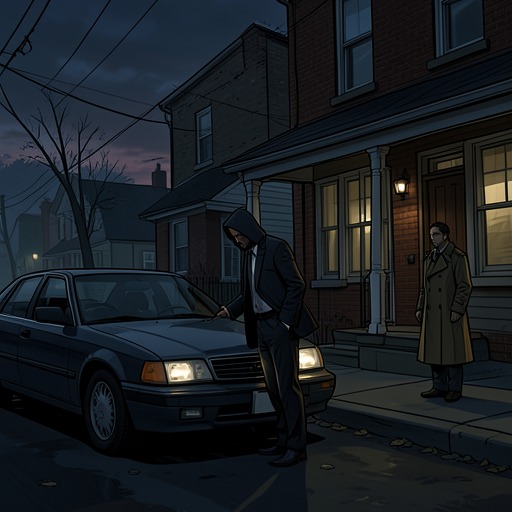
On September 7, 2001, the Federal Bureau of Investigation announced that a hair recovered from the headrest of the rear passenger-side seat of a maroon Mercury had been DNA-tested and was Hoffa’s. The hair had been preserved since the car was searched. Its location mattered because Sheeran had told Charles Brandt that he lured Hoffa into the Mercury’s rear seat, although Hoffa usually insisted on riding in the front passenger seat.
The account linked the hair to an already disputed car journey. Chuckie O’Brien, who drove the Mercury, denied that Hoffa had been in it and passed a lie-detector test. Sheeran described O’Brien as an unwitting participant who believed he was driving Hoffa to a meeting. The hair did not, by itself, establish who had placed Hoffa in the car or what happened afterward; in the book’s presentation, however, its identification gave the car evidence independent forensic weight alongside Sheeran’s account.
The Detroit house and the blood test
In February 2002, five months after the hair announcement, Sheeran and Charles Brandt found the Detroit house where Sheeran said he had shot Hoffa. The location and exterior matched Sheeran’s description. Later, details of the interior also appeared to fit: Sheeran described a back door at the end of the hallway, through the kitchen and toward the backyard. The homeowner said that a door in that location had been removed during a 1989 renovation and was still in his garage. These details were physical corroboration of the description, not laboratory findings.
Before the book’s first edition appeared, Fox News obtained permission from the current owners to have forensic specialists apply Luminol to the floorboards. The privately hired specialists found eight small indications of blood in a trail from the vestibule down the hallway toward the kitchen, matching the route described in Sheeran’s confession. That result detected traces of blood; it did not identify the blood as Hoffa’s. The account also noted reasons DNA testing might be difficult, including the small quantity, the nearly twenty-nine years that had passed, environmental exposure, cleaning, and the placement of linoleum on part of the floor.
What the FBI Laboratory established—and did not
The Bloomfield Township Police Department later removed sections of flooring and sent them to the FBI Laboratory. On February 15, 2005, police chief Jeffrey Werner announced that the laboratory had found human male blood on the flooring, but that its DNA did not match Hoffa’s. Oakland County Prosecutor David Gorcyca said the result did not corroborate Sheeran’s confession, but did not refute it either.
That distinction sets the limit of the laboratory’s conclusion. The test ruled out an identification of the sampled blood as Hoffa’s; it did not determine whose blood it was, when it was deposited, or whether it came from the killing Sheeran described. After nearly twenty-nine years, the blood could have had an unrelated source, or could have been connected to other activity in the house. The negative match therefore weakened a direct claim that the tested trace was Hoffa’s blood without resolving the larger question of whether Sheeran’s account was true.
Michael Baden, a former chief medical examiner of New York City, assessed the confession as credible and considered it supported by the forensic evidence. His assessment included the broader pattern of evidence, not a claim that the blood sample matched Hoffa. The contrast between that overall judgment and the laboratory’s specific negative DNA result is important: an expert’s evaluation of a body of evidence should not be mistaken for the finding of an individual test.
Forensic evidence in a contested investigation
The two principal laboratory episodes served different functions. The Mercury hair was identified as Hoffa’s and connected him to a particular seat in a car; the floor sample was identified as human male blood but not as Hoffa’s. The first finding supported a detail of Sheeran’s account, while the second supplied no positive identification of the victim. Neither test alone established the full sequence of events alleged in the confession.
The narrative also places these scientific findings beside evidence that was not produced by the FBI Laboratory: the privately commissioned Luminol examination, the house’s matching layout, and the door detail recalled by Sheeran. Keeping those forms of evidence separate avoids treating every point of consistency as a laboratory confirmation. The laboratory’s contribution was narrower but consequential: it authenticated the hair as Hoffa’s and established that blood was present in sampled flooring, while leaving the blood’s source—and the ultimate truth of Sheeran’s confession—unsettled.