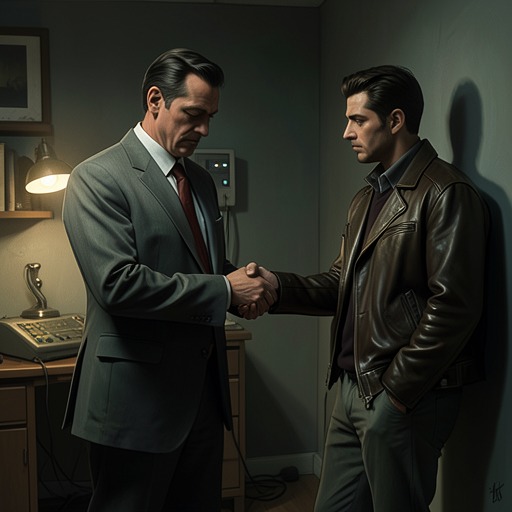
Frank Sheeran and Russell Bufalino: Longstanding Trust and Assigned Work
I Heard You Paint HousesFrank Sheeran and Russell Bufalino’s relationship was both intimate and instrumental: friendship gave their criminal partnership a personal language, while repeated assignments and acts of protection made loyalty a practical obligation. The book’s opening image condenses that entanglement into two names, “Russ & Frank,” penciled on Jimmy Hoffa’s yellow pad. Hoffa’s family feared that only someone trusted enough to get close to him could have harmed him; the notation therefore turns a private bond into an early clue and a source of suspicion.
From acquaintance to trusted companion
Sheeran’s account traces the relationship through the work of driving. Bufalino would call from upstate and ask him to collect him or take him between places where he had business. Sheeran says he enjoyed Bufalino’s company and did not ask for money. The arrangement nevertheless carried an unspoken benefit: being seen with Bufalino helped Sheeran, though he says he did not initially understand how much.
That became clear in November 1957, when Bufalino asked Sheeran to drive him to Apalachin. Bufalino said he would continue afterward to Erie and Buffalo with other transportation arranged; Sheeran dropped him at a house and noticed nothing unusual. The following day, police arrests of about fifty men from around the country made the meeting front-page news. Sheeran then understood the scale of the organization and why Bufalino traveled to conduct business in person and in cash. The episode marks a change in the relationship as Sheeran tells it: he had not merely been helping a friend get around, but had been trusted with access to the movements of a powerful criminal figure.
The friendship was not confined to errands. Sheeran describes drinking wine with Bufalino, talking Italian with him, bringing him prosciutto bread and sausages, and receiving gallons of homemade red wine in return. Bufalino knew Sheeran’s wife, Mary, asked after his children, and sometimes arranged Wednesday dinners for the couples with his wife, Carrie. Their shared meals and family familiarity made the association look like an ordinary friendship even as the surrounding work placed it inside a criminal network.
Protection and reciprocal obligation
Bufalino’s loyalty appeared in personal matters as well as professional ones. When Sheeran’s brother was dying of cancer and a Veterans Administration doctor would not provide morphine, Bufalino called Meyer Lansky from prison; Lansky arranged for a doctor to help ease the brother’s pain. The intervention reached beyond the two men, but it strengthened the sense that Bufalino could mobilize powerful connections on Sheeran’s behalf.
The relationship also ran in the other direction. After Bufalino’s arrests brought deportation proceedings, Sheeran recommended a lawyer when Bufalino had lost his final appeal and had packed his bags and bought tickets. In Sheeran’s telling, the lawyer worked through the Italian government until it refused to take Bufalino, leaving the United States obliged to keep him. Bufalino was grateful. The episode shows Sheeran moving from driver and companion to a person able to intervene in a grave personal crisis for his patron.
Sheeran later described Bufalino as having repeatedly saved his life. He said he had seven contracts out on him over the years and that Bufalino had been able to settle each dispute. This account presents protection not as a single favor but as a continuing feature of their bond—and as the basis for a debt that could be called in. Sheeran also recalls that Bufalino sometimes summoned him with little explanation. After one such call, Sheeran says, he understood only that Bufalino needed a favor; the people arranging an attack, he explains, relied on surveillance and timing to find a target exposed on the street. The episode makes the relationship’s darker terms plain: trust meant being available before all the circumstances were disclosed.
Shared work and the wider network
Bufalino’s business drew Sheeran into meetings that connected figures from different regions. Sheeran says he often drove with Bufalino to Joe Sonken’s Gold Coast Lounge in Hollywood, Florida, where people from around the country met. Bufalino met there with Santo Trafficante and Carlos Marcello; Sheeran also encountered lawyers and associates in that setting. The long drives and repeated visits made him a companion within a network, not merely a local chauffeur.
The connection to John Francis further illustrates how assignments were organized. Sheeran describes Francis as Bufalino’s driver and as his own reliable driver on matters he handled for Bufalino. In one account of a killing, Sheeran says Francis made sure there was no tail, changed cars, and then disposed of the weapons in a river. Sheeran later heard that Francis had implicated him in multiple killings, including the killing of Joey Gallo, but he treats the report as uncertain and says Francis was dying, in pain, and medicated. His mixed response—questioning whether Francis had talked, yet refusing to blame a dying man for wanting to make peace—shows the personal loyalty and criminal secrecy operating together.
Sheeran also recalls supporting Bufalino during a three-week extortion trial in upstate New York. He sat in the front row each day, even as the prosecution concerned alleged pressure on two business owners who had rejected a proposed arrangement with Bufalino’s associates. At the same time, Sheeran says Bufalino supported Jimmy Hoffa against Tony Provenzano’s campaign and had promised to introduce Sheeran to Provenzano’s boss after his own trial. Their alliance therefore crossed personal, legal, and labor-political territory, linking attendance at court with influence over union disputes.
Hoffa’s disappearance and the bond under suspicion
The relationship’s most consequential turn comes after Hoffa disappeared. Sheeran’s account of the plot presents Bufalino as someone who understood the danger and the obligation involved. Sheeran says Bufalino believed that participating would demonstrate that Sheeran had not intended to betray the group by siding with Hoffa against Provenzano. He also says that, had Bufalino’s side decided not to use him, Hoffa would still have been killed and Sheeran himself would likely have been killed as well. These are Sheeran’s retrospective claims, not independent proof of every detail, but they reveal how he understood the choice: his survival and his loyalty had become inseparable.
Five days after the disappearance, the FBI noted a meeting at the Vesuvio Restaurant attended by Bufalino, Sheeran, Provenzano, Anthony Salerno, and Salvatore Briguglio. Sheeran later characterized the gathering as a report to Salerno about how the killing had been carried out and whether any loose ends remained. He recounts a confrontation with Provenzano over accusations that Sheeran had said Provenzano could kill Hoffa. Bufalino told Sheeran, “Deny it.” Sheeran says Bufalino then reassured Salerno that he had not meant to kill a made Mafia member for Hoffa, and arranged for Provenzano to be told there was nothing to the allegation. Once again, the protector intervened to contain a threat to his associate, though the meeting itself also situates both men amid the aftermath of the disappearance.
The FBI’s HOFFEX file identified Sheeran and Bufalino among a small group of suspects believed to have abducted and killed Hoffa. Its list placed them alongside Provenzano and several other men; the book’s opening reference to “Russ & Frank” gives that suspicion an intimate counterpart in Hoffa’s own notes. The relationship thus ends in a double image: a trusted friendship that, in Sheeran’s telling, was built through shared meals, favors, and protection, and a partnership that made both men objects of intense suspicion after Hoffa vanished. The book preserves the bond’s emotional force while leaving its decisive claims embedded in Sheeran’s account rather than resolving the case independently.