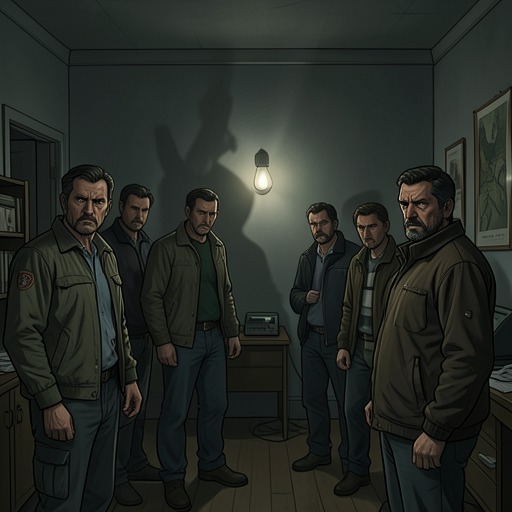
Frank Sheeran's 1980 RICO trial
I Heard You Paint HousesFrank Sheeran’s 1980 RICO trial brought an unusually sharp contradiction into view: the government portrayed him as a participant in a web of organized crime, yet the jury acquitted him on every charge. The verdict ended the federal case in his favor, but it did not erase the threats surrounding the trial or the separate Delaware convictions that ultimately sent him to prison. The episode is therefore both a courtroom reversal and a reminder that acquittal in one prosecution was not the end of Sheeran’s legal troubles.
The indictment and the danger around the case
The indictment named about twenty unindicted coconspirators, including Russell Bufalino and Angelo. Angelo had already been killed by the time the case reached trial. Sheeran recalled that other people named in the indictment had reason to fear what might happen if he were convicted and decided to cooperate with the government: they, too, might become targets of prosecution. The case carried consequences beyond the defendant’s own fate.
On the first day of trial, in February 1980, the FBI warned Sheeran’s attorney, F. Emmett Fitzpatrick, that a source had reported a contract on Sheeran. The alleged concern was that a conviction would prompt him to turn against the people implicated alongside him. Sheeran’s response was characteristically defiant: he told Fitzpatrick to ask who had ordered the killing, so he could try to shoot first if the person appeared. The threat remained an allegation reported to the defense, not an attack carried out in the courtroom, but it made the trial’s danger feel immediate.
The murder allegations and courtroom defense
One of the murder accusations involved the shooting of Fred Gawronski. Charlie Allen claimed that Sheeran had ordered the killing because Gawronski spilled wine on him; Sheeran noted that Tommy Barker had already beaten the shooting charge on a self-defense theory. At trial, Fitzpatrick cross-examined Allen forcefully, and Sheeran described the lawyer as having dismantled Allen’s account under questioning. The allegation thus depended on testimony that the defense directly attacked, rather than on a story left unanswered before the jury.
Sheeran said he believed in testifying and meeting jurors’ eyes, particularly when prosecutors presented him as someone who would order a man killed over spilled wine. His account emphasized the performance of that encounter: rather than avoid the jurors’ scrutiny, he looked at them while the government made its case. The Philadelphia Bulletin’s headline after the verdict announced, “Jury Acquits Sheeran on All Charges.” The result was an acquittal on all charges in this federal case, not a finding that every accusation made against him in other proceedings was false.
The jury’s verdict and its limits
The acquittal resolved the federal RICO charges against Sheeran, but his own retrospective account distinguished the verdict from two other problems that followed. In a Delaware state case, prosecutors used a recording Allen had made while working with the FBI. The tape captured Sheeran ordering that a crane-company manager’s legs be broken after the manager had fired two shop stewards and would not negotiate. The FBI staged the manager’s appearance at a grievance hearing with a fake cast and crutches; Sheeran said he was convicted in state court for that episode.
A further Delaware conviction arose from dynamite taken from Medico Industries, a Pennsylvania ammunition manufacturer with major government contracts. Russell Bufalino was a silent partner in the company, and Sheeran said the dynamite was intended to blow up the office of the company employing the manager with the fake broken leg. The two state matters brought Sheeran a total of fourteen years. They form a separate legal track from the RICO jury’s verdict: he could be acquitted of every charge in the federal trial and still be convicted and imprisoned for offenses prosecuted elsewhere.
Aftermath and retrospective meaning
The trial’s outcome later sat beside Sheeran’s public account of his criminal past rather than resolving it. In 1999, as he grew physically disabled, his daughters arranged for him to meet Monsignor Heldufor at St. Dorothy’s Church in Philadelphia; the monsignor forgave his sins, a matter Sheeran connected to his hope of burial in a Catholic cemetery. Years later, during his final illness, Sheeran said that he had confessed and received communion. Six weeks before his death, on December 14, 2003, he recorded a final interview and publicly stood behind the book’s account, including his claimed role in what happened to James R. Hoffa on July 30, 1975.
That later confession did not alter the 1980 jury’s verdict, and the verdict did not settle the truth of every claim Sheeran would make afterward. The trial’s specific legal conclusion remains clear: the jury acquitted him on all federal charges. Its broader significance lies in the contrast between that courtroom result, the separate state convictions, and the later confessional account through which Sheeran presented his life for judgment.