Frank Sheeran–Jimmy Hoffa relationship
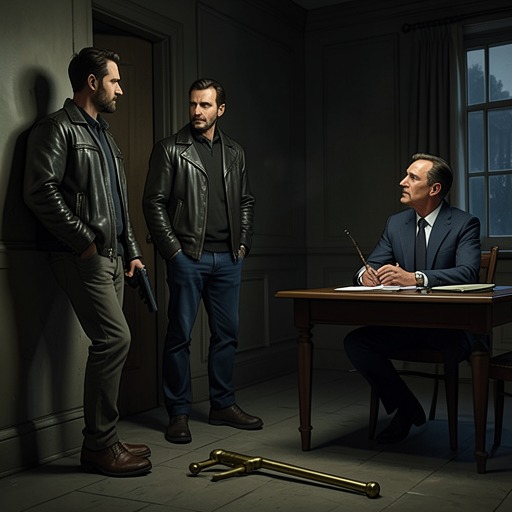
I Heard You Paint HousesThe Frank Sheeran–Jimmy Hoffa relationship began as a union connection and developed into a close personal alliance, with Sheeran presenting himself as Hoffa’s loyal friend, protégé, and trusted associate. Its decisive reversal comes in Sheeran’s later account: he said that he shot Hoffa after the union leader disappeared. The book frames the relationship through both that claimed betrayal and the long process by which Sheeran recounted, approved, and finally publicly stood behind his story.
First Contact and Recruitment
Sheeran’s introduction to Hoffa came through Russell Bufalino, who called Hoffa while sitting with Sheeran and passed him the telephone. Bufalino introduced Sheeran as a good union man and asked Hoffa to judge him. Hoffa opened with the phrase that gives the book its title, then asked whether Sheeran was a fellow union brother. The exchange joined two parts of Sheeran’s life that had previously been distinct: his reputation as a gunman and his aspiration to advance in the labor movement.
Hoffa asked whether Sheeran wanted to take part in the union’s history and whether he could start the next day in Detroit. Sheeran agreed and was directed to report to Bill Isabel and Sam Portwine at the International Brotherhood of Teamsters. The invitation was more than a one-time assignment. For Sheeran, it offered entry into Hoffa’s organization and a chance to learn directly from a leader he regarded as the most powerful figure in his working life.
A Union Protégé and Ally
In Detroit, Sheeran reported to Teamsters Local 299 on Trumbull Avenue, Hoffa’s home local, where he joined an organizing drive aimed at the city’s cab drivers. He described himself as happy to be an organizer and hoped that, if he succeeded, the experience might lead to a position at Teamsters Local 107 in Philadelphia. His ambitions reached further: he wanted to become an International organizer, a post that would have taken him across the country and given him greater influence within the union. He later said that, had nothing happened to Hoffa, he believed he would have reached that position.
Isabel and Portwine evaluated Sheeran’s work and recommended that Hoffa keep him with them so he could continue learning. Sheeran’s account therefore presents his advancement as a sequence of personal sponsorship and practical work: Hoffa recruited him, assigned him to experienced organizers, and retained him after their assessment. The relationship connected loyalty to opportunity. Sheeran saw Hoffa as the leader who could open the union’s highest levels to him, while the organizing assignment gave him a place within Hoffa’s network.
Sheeran’s recollections also emphasize that the bond was personal, not merely institutional. When Hoffa later met him in Chicago, he was personable and asked about Sheeran’s daughters. Sheeran portrays him as a man under intense legal and political pressure who could nevertheless make those around him feel at ease. Their association included arguments about union politics and Hoffa’s conflicts with Bobby Kennedy, but in Sheeran’s telling, Hoffa remained someone he would have wanted beside him in a foxhole.
Friendship, Trust, and Public Loyalty
Bufalino remained an important intermediary in the relationship. Sheeran regularly drove him to meetings and business appointments across Pennsylvania, New York, and New Jersey. In November 1957, he drove Bufalino to Apalachin, not understanding the significance of the trip until police arrested gangsters from around the country after the gathering. Sheeran later described himself as Bufalino’s friend: the men knew each other’s wives and families, shared food and homemade wine, and spoke Italian together. That preexisting closeness helps explain how Sheeran became known to Hoffa and how union ties overlapped with relationships in organized crime.
Sheeran also recalled driving with Bufalino to the Joe Sonken’s Gold Coast Lounge in Hollywood, Florida, where figures from different regions met. He described Bufalino meeting there with Santo Trafficante and Carlos Marcello, and said that Trafficante’s lawyer, Frank Ragano, was lent to Hoffa to assist with his trials. These episodes place Sheeran near the wider network surrounding Hoffa, but the account distinguishes proximity and association from proof of every operation discussed. The relationship’s significance lies partly in Sheeran’s position as a connector: he belonged to Hoffa’s union world while maintaining close ties to Bufalino and people who moved through the same wider network.
A public episode in Philadelphia shows Sheeran acting as Hoffa’s escort as well as his subordinate. At a rally held during a contested election at Teamsters Local 107, police wanted to bring Hoffa in through a back entrance to avoid the hostile crowd. Hoffa refused and asked to walk down the aisle with Sheeran beside him. Sheeran accompanied him; although there were boos farther back, the aisle remained calm. Hoffa spoke in support of union solidarity and his record, and the local won the election by a few hundred votes. The scene makes Sheeran’s role visible: he was close enough to accompany Hoffa into a potentially volatile gathering, while Hoffa trusted his presence and rejected a police escort.
Disappearance and the Reversal of Loyalty
After Hoffa disappeared, the relationship became part of the investigation’s central mystery. In a cottage where members of Hoffa’s family were anxiously gathered, investigators found a yellow pad kept beside Hoffa’s telephone. On it, Hoffa had written Russ & Frank. The book identifies those names as Bufalino and Sheeran, whom it describes as close friends and staunch allies of Hoffa. To the family, the note sharpened a frightening possibility: someone trusted enough to approach a cautious Hoffa might also have been able to harm him. Sheeran and Bufalino consequently became leading suspects in the disappearance.
The Federal Bureau of Investigation’s HOFFEX file listed Sheeran among seven men identified early in the investigation; with Tony Provenzano, the Andretta brothers, the Briguglios, and Bufalino named, the file’s list included people drawn from overlapping relationships and locations. Sheeran’s later account also places him at a meeting at the Vesuvio Restaurant five days after Hoffa disappeared, alongside Bufalino, Tony Provenzano, Sal Briguglio, and others. He described the meeting as a report to Anthony Salerno about how the killing had been carried out. These are claims presented through Sheeran’s account, not a substitute for an independently established account of the disappearance.
The starkest contradiction between the earlier friendship and the later confession emerges in the interview history. Sheeran’s first interview with Charles Brandt took place in 1991, but he ended it after admitting more than he was comfortable with. After receiving religious absolution in 1999, he contacted Brandt and agreed to resume questioning; the interviews continued for four years. Sheeran read and approved each chapter and then the complete manuscript. About two years into the interviews, he told Brandt he had been the shooter, and at a later meeting with Eric Shawn he publicly said that he had shot Hoffa twice in the back of the head.
During his final illness, Sheeran chose to appear on video and stand behind the book’s account, including its account of what happened to Hoffa on July 30, 1975. Without the protective legal language used during earlier interviews, he confirmed that the material about Hoffa came from what he had told Brandt and said that he stood behind what was written. The relationship thus ends in the book not with reconciliation or a settled public resolution, but with Sheeran’s claimed confession set against the record of recruitment, friendship, and trust that preceded it. His testimony makes the bond both the means by which he gained access to Hoffa and the defining measure of the betrayal he claimed.