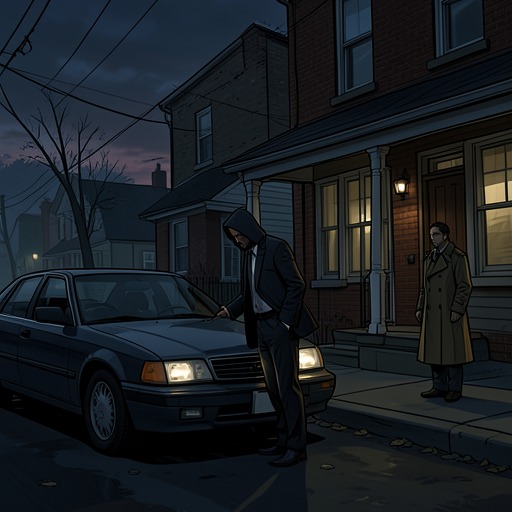
Hoffa murder house
I Heard You Paint HousesThe Hoffa murder house is the Detroit residence that Frank Sheeran identified as the place where he shot James R. Hoffa. Its significance lies not only in Sheeran’s alleged confession but in the way the house’s exterior, interior, former back door, and flooring were tested against details he had given. Those details produced striking corroboration, but not a definitive forensic identification of Hoffa’s blood or proof of every person’s role. The house becomes both a physical setting for the claimed killing and a focal point where testimony, investigation, and uncertainty meet.
Identification and location
In February 2002, Sheeran and Charles Brandt searched for the house in Detroit. Brandt had directions based on information Sheeran had provided years earlier, including a final left turn near a footbridge. A chain-link fence had made the bridge difficult to see, but Brandt eventually spotted it from another road. At the T intersection, he looked down the street and noticed a house whose rear yard resembled Sheeran’s description. Sheeran examined the house and confirmed it with a nod and a grunt.
The exterior seemed at first to disagree with Sheeran’s account: from the front the house appeared to be brick, whereas he had described brown shingles. Brandt later realized that the upper part of the rear and the side visible from the footbridge were covered in brown shingles. That overlooked detail helped reconcile the remembered description with the building they had found. Brandt considered the location and exterior features additional support for Sheeran’s account; the discovery itself, however, established that Sheeran recognized the house, not independently what had happened inside it.
The house also became connected to a wider network of suspicion. A yellow pad found beside Hoffa’s phone at a lakeside cottage bore the words Russ & Frank, and the book identifies Sheeran and Rosario Bufalino as close allies of Hoffa who became leading suspects in his disappearance. In a later account of the investigation, Brandt describes an FBI memo that listed Sheeran and Bufalino among a small group of suspects. This context explains the house’s importance as a proposed endpoint of the disappearance, while the memo and the pad do not by themselves establish that either man used the residence.
Ownership and the possible intermediary
Sheeran’s later comments raised a question about how the participants could use the house without attracting attention. During an interview while looking at a photograph, he referred to a previously unknown real-estate agent or broker. He said the homeowners lived there at the time and had not been questioned, while also maintaining that they did not know about the crime. His remarks were hesitant, and the identity or precise role of this real-estate intermediary was not established in the conversation.
Brandt considered several possible explanations for how an intermediary might have provided access. The house may have been a rental, or it may have been offered for sale; either circumstance could make a stranger parking in the driveway and entering seem ordinary. Brandt also proposed that an agent or a friend of the elderly owner might have held a key. These are explanations offered as possibilities, not confirmed facts about the property’s arrangement in 1975.
After the first edition of I Heard You Paint Houses appeared, a Detroit newspaper reporter located the owner’s son. He said his mother had bought the house in 1925, moved out several months before Hoffa disappeared, and sold it in 1978. According to the son, she had allowed a single man, described by neighbors as mysterious, to rent a room. The account supplies a plausible circumstance in which the owner was away and a boarder was present, but it does not identify the boarder or demonstrate that he knew about the killing. Brandt wondered whether the real-estate connection might lead to John Francis, whom he described elsewhere as a wealthy commercial real-estate operator. The possible connection between Francis, an intermediary, and the boarder remained a question rather than a documented identification.
The interior and the route through the house
Brandt entered the house for the first time after the book had gone to stores. The small vestibule made an immediate impression on him as a confined, boxlike space. He interpreted its narrowness as restricting Hoffa’s options once he had entered. Brandt concluded that only the person who brought Hoffa inside could have killed him there, and that Hoffa would have entered with someone he trusted, namely Sheeran. This is Brandt’s reading of the layout and relationship, not a conclusion established by the architecture alone.
The staircase stood directly ahead and to the left of the vestibule, close enough to make the entry seem crowded. It also blocked the view of the kitchen and much of the hallway. A long passage led toward the kitchen, with a living room and then a dining room on its right. In Brandt’s reconstruction, the stairs concealed the cleaners and cut off the back door as an immediate escape route, leaving the entrance as the way back out. The arrangement gave concrete spatial form to the trap described in Sheeran’s account.
A disagreement about which door Sheeran meant produced a particularly specific check. When someone pointed to a side door at the top of the cellar stairs, Brandt distinguished it from the back door Sheeran had described at the end of the hallway, through the kitchen and out to the yard. The homeowner, Ric Wilson, said he had removed that kitchen back door during a 1989 renovation and still had it in his garage. The detail matched the door’s reported location and removal history; it was not, on its own, evidence that a body had passed through it.
In Sheeran’s account, Hoffa’s body was carried in a body bag out through the kitchen’s back door and placed in a car trunk before being taken away for cremation. The house’s arrangement makes that route physically legible: vestibule, hall, kitchen, backyard. Brandt’s inspection connected the described movement to actual architectural features, while the claimed destination of the body remained part of Sheeran’s account.
Blood traces and the limits of corroboration
Before the first edition appeared, Fox News obtained permission from the current owners to have forensic specialists apply Luminol to the floorboards. The chemical revealed eight small indications of blood in a trail from the vestibule down the hallway toward the kitchen, corresponding to the route in Sheeran’s description. The quantity was insufficient for DNA testing at the time. Brandt noted the nearly twenty-nine years that had passed, the possibility that environmental exposure had degraded biological material, and Sheeran’s account of cleaners, linoleum, and a body carried in a bag. Those circumstances shaped his hope that a test might identify the blood, but did not establish its source.
The Bloomfield Township Police Department later removed sections of flooring and sent them to the FBI laboratory. On February 15, 2005, the laboratory reported human male blood, but its DNA did not match Hoffa’s. At the announcement, the Oakland County prosecutor said the result neither corroborated nor refuted Sheeran’s confession. The finding confirmed that human blood was present; it did not identify whose blood it was or show when it reached the floor. After almost twenty-nine years, Brandt acknowledged, the blood might have had an unrelated explanation or might have come from another crime.
Forensic pathologist Michael Baden argued that the pattern supported Sheeran’s description and that the negative DNA result did not speak against the confession. The distinction matters: a blood trail in the predicted place can be consistent with an account without proving the victim’s identity. The book places that evidence alongside the physical match of the house and the removed kitchen door, building a cumulative case while preserving the gap between consistency and conclusive identification.
The house as evidence and unresolved scene
Brandt and Sheeran had located the house in 2002, five months after the FBI announced that a hair recovered from the rear passenger-side headrest of the maroon Mercury was Hoffa’s. Brandt treated the hair identification and the house’s matching features as separate pieces of corroboration for Sheeran’s account. He also explained that he had not entered the house during the first visit, in part because he did not want an interior inspection to be used to argue that the confession had been influenced by what the men saw there. The later visit therefore added a new comparison rather than simply repeating the exterior identification.
The house’s evidentiary force comes from the accumulation of precise correspondences: the concealed shingles, the footbridge turn, the cramped vestibule, the hallway to the kitchen, the back door later removed, and the blood indications along the described route. Yet the same investigation marks the boundaries of what can be claimed. The blood did not match Hoffa, the owner’s son could not identify the mysterious boarder as a participant, and the possible real-estate intermediary remained unnamed in Sheeran’s disclosure. The house makes the alleged killing’s route imaginable and testable; it does not settle every uncertainty about the people who arranged access or the ultimate fate of Hoffa’s body.