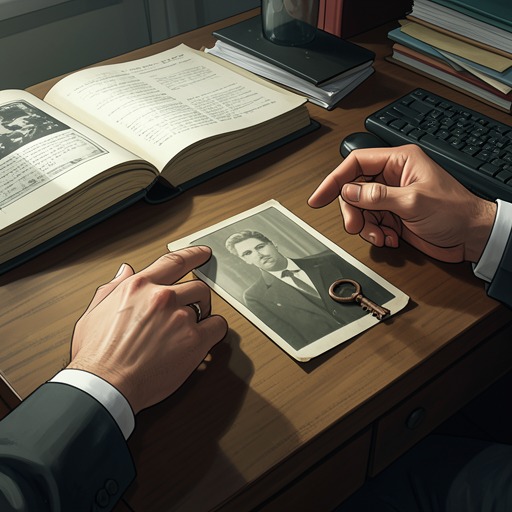
Hoffa's hair from inside the Mercury
I Heard You Paint HousesHoffa's hair from inside the Mercury is the key surviving physical trace connecting James R. Hoffa to the Maroon Mercury sedan in the Hoffa disappearance. Recovered from the rear passenger-side headrest, preserved after a 1975 search, and identified by DNA decades later, it gave forensic weight to Frank Sheeran’s account of how Hoffa was brought into the car and helped turn a disputed confession into a claim supported by material evidence.
Recovery and Preservation
In 1975, while investigating the disappearance, the FBI searched the Maroon Mercury and recovered a hair from the headrest of the rear passenger-side seat. Stan Hunterton, then a young assistant United States attorney in Detroit, drafted the search warrant and argued successfully against a mob lawyer’s motion to return the hair and other seized material to the car’s owner. That decision kept the strand available for later testing.
The hair’s evidentiary importance therefore depended not only on its recovery but on its preservation. Hunterton later wrote to the book’s author that he had helped prevent the evidence from being returned; by the time DNA testing became possible, the retained sample could be examined rather than merely described in an old investigative record.
DNA Identification and the Confession
On September 7, 2001, the FBI announced that DNA testing had identified the hair as Hoffa’s. The result connected him to the rear passenger seat of the Mercury, a location central to Sheeran’s account. Sheeran had told the author in 1999 that he lured Hoffa into that rear seat, although Hoffa, according to the account, always insisted on sitting in the front passenger seat, or shotgun position.
The identification did not by itself establish who had put Hoffa in the car or what happened afterward. Its significance was corroborative: it supported a specific part of Sheeran’s narrative with physical evidence recovered independently from the vehicle. The author judged the confession and the DNA result together sufficient to convict Sheeran, while distinguishing the strength of that combined case from the hair’s narrower finding—that Hoffa had occupied the seat where it was discovered.
Disputed Accounts and Corroboration
Chuckie O’Brien, Hoffa’s foster son and the car’s driver in Sheeran’s account, denied that Hoffa had been in the Mercury and passed a lie detector test. The author said the FBI had already undermined O’Brien’s alibi, and treated that weakness as additional corroboration of Sheeran’s confession. Sheeran, by contrast, described O’Brien as an innocent dupe who believed he was taking Hoffa to a mob meeting. The hair did not settle every dispute between these accounts, but its location gave the competing claims a concrete point of contact.
The book presents the strand as one piece in an accumulating case rather than as a self-sufficient solution. After the FBI’s announcement, Sheeran and the author searched for and found the house Sheeran had described as the place of Hoffa’s death. The account treats the DNA result, the details of the car, and the later identification of the house as separate corroborating traces that gathered force together.
Place in the Book’s Evidence
The hair also anchors the book’s account of how oral testimony was tested against records and physical evidence. The author’s interviews with Sheeran began in 1991, stopped after Sheeran became uneasy about questioning, and resumed after Sheeran contacted him again in 1999. The author describes the interviews as conducted with attention to protecting Sheeran’s legal rights; later, Sheeran read and approved each chapter and the complete manuscript.
Before the Detroit house search, Sheeran had admitted to the author that he was the shooter. He later agreed to speak publicly to a Fox News correspondent and stated that he had shot Hoffa twice in the back of the head. During his final illness, he also went on videotape and stood behind the book’s account of what happened to Hoffa. Those later confirmations remain testimony; the preserved hair is different in kind, a physical remnant whose DNA identification independently corroborated a central detail of the story.