Italy
I Heard You Paint HousesItaly is the defining landscape of Frank Sheeran’s wartime recollections, a country he crossed as a rifleman in the 45th Infantry Division during World War II. Sicily, Salerno, Monte Cassino, Anzio, and Rome form more than a sequence of campaign settings: together they trace an education in fear, obedience, survival, and killing. Italy also becomes a personal link to Russell Bufalino, whose later friendship with Sheeran grew partly around the fact that Sheeran had passed through his town during the war.
The Italian Campaign as Personal History
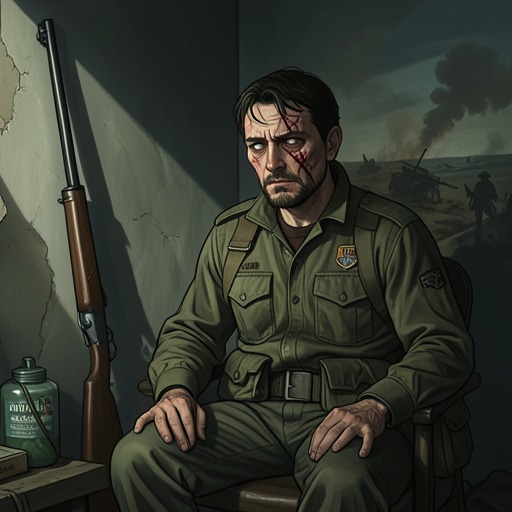
Sheeran described his wartime service in Italy as unusually prolonged. The Army credited him with 411 days of actual combat, far above the roughly eighty days he understood to be the average for a veteran, and awarded him an extra twenty dollars a month. He recalled being pinned down in a dugout at Anzio and surviving repeated firefights without being hit by German bullets or shrapnel. That survival did not make the experience abstract: it was sustained exposure to combat that, in the book’s account, taught him to kill in cold blood.
The narration presents this history retrospectively. Sheeran was reluctant to discuss combat, and the interviewer spent two years helping him accept that the experience was worth talking about. Sheeran later tracked down the 45th Infantry Division’s 202-page official Combat Report, using it alongside his memories to reconstruct a campaign that was difficult to narrate directly. Italy therefore appears both as the place where the fighting happened and as a past that had to be pieced together, with documentary detail supporting memories that did not always arrive readily.
Sicily and Salerno
Sheeran remembered Sicily as the easiest part of the war. He described Italian soldiers surrendering with their suitcases packed, and recalled that Mussolini’s surrender was followed by the Germans taking over the fighting from the Italians. The Sicilian people, he said, were friendly. In Catania, he saw homemade spaghetti drying on clotheslines, an ordinary domestic image set against the advancing army. The detail remained meaningful after the war: Russell Bufalino liked that Sheeran had gone right through his town, though the book does not identify the town by name.
The contrast with Salerno was stark. In September 1943, Sheeran and other soldiers leapt from landing craft into the Mediterranean while German shells exploded around them. Their immediate task was to advance about 1,000 yards and secure a beachhead; each man carried a shovel, and they began digging in under artillery fire. German planes strafed their position, and when German soldiers appeared, the riflemen fired. Sheeran remembered knowing that he was shooting but could not recall the first time he fired at an enemy soldier. The troops nearly lost the beachhead, and he emphasized that fear was universal, whether or not a soldier admitted it.
Monte Cassino and Anzio
After pushing north from Naples toward Rome, Sheeran’s unit reached the foothills around Monte Cassino in November 1943 and remained pinned down for more than two months. A monastery above them served as a German observation post. Its eventual bombing, intended to remove that advantage, instead left rubble that the Germans could use for protection. In January 1944, an assault on the German line failed and drove the attackers back down the mountain. Patrols sometimes went out to capture German soldiers for interrogation; much of the time, the men tried to stay dry and avoid being hit.
The pressure of the campaign altered Sheeran’s attachments to other soldiers. He learned not to become close to many people because men he liked were killed. Young replacements could arrive and die before their boots had dried. He recalled being close to Diggsy, and the strain of seeing him shot twice. After a brief rest near Naples at the former Italian king’s palace in Casserta, Sheeran’s unit boarded landing craft for Anzio. The landing was intended to strike the German flank and help the main force break through at Monte Cassino.
At Anzio, the division repelled the German effort to erase the beachhead, then endured months of holding and waiting under constant bombardment. More than 6,000 Allied lives were lost during that period. In May, the force facing the Germans at Monte Cassino broke through; by the end of the month, 150,000 exhausted soldiers moved out of their dugouts at Anzio and linked up with the advancing force from the south. Sheeran’s own later recollection of being pinned down in a dugout gives that campaign history an individual point of reference.
Rome and the Road Beyond Italy
Sheeran recalled entering Rome without a fight. The city was treated as an open city, though he noted that some bombing still occurred. His account shifts briefly from combat to civilian life: sidewalk cafés, lunch, wine, and the sight of Italian women walking past. Soldiers were issued chocolate, cheese, and chopped eggs in cans; local people had little, a disparity Sheeran used to explain the soldiers’ fraternizing with women despite military regulations. The relative ease of Rome follows the fear and bombardment of the earlier campaign without erasing them.
The Italian fighting continued before Sheeran’s unit embarked for the invasion of southern France, Operation Dragoon, on August 14, 1944. The landing met resistance, which he characterized as harassment rather than heavy fire, but he stressed that even limited gunfire remained dangerous. Italy is thus one major stage in a wider European war, not the end of his military trajectory. Its decisive significance lies in the combination of prolonged combat and survival that shaped Sheeran’s account of himself, while its landscapes also supplied a point of recognition in his later relationship with Bufalino.