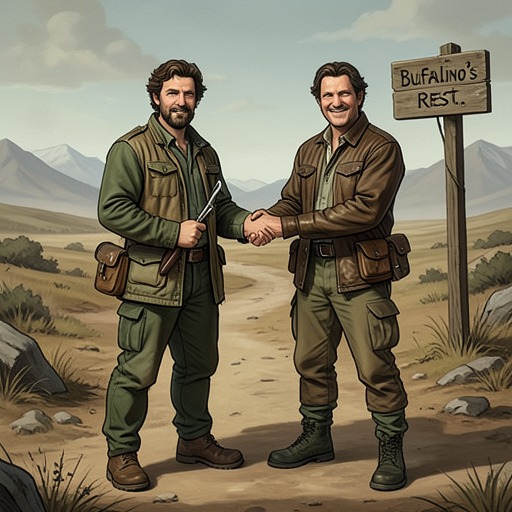
Jimmy Hoffa and Russell Bufalino: Mutual Trust and Entanglement in the Disappearance Plot
I Heard You Paint HousesThe relationship between Jimmy Hoffa and Russell Bufalino joined personal loyalty to the criminal and labor networks around Hoffa. Hoffa’s penciled note, “Russ & Frank,” found beside his telephone after he disappeared, placed Bufalino alongside Frank Sheeran as one of the trusted figures closest to him. The book presents that intimacy as the basis of their influence—and as the reason their names became entangled with the disappearance. Much of the account comes through Sheeran’s retrospective narration, so its claims about private meetings and the plot must be read as his testimony, not as independently demonstrated fact.
From Personal Trust to a Wider Network
Bufalino’s friendship with Hoffa was bound up with his growing relationship with Sheeran. Sheeran recounts driving Bufalino to Apalachin in November 1957, dropping him at a house without knowing what the visit meant. The following day, arrests at the Apalachin meeting exposed the scale of the gathering and the reach of the criminal network to which Bufalino belonged. Sheeran then understood why Bufalino had previously asked him to drive him to places where he conducted business in person. The episode shows how a personal service—providing a ride—could place Sheeran near a powerful network before he grasped its full significance.
Sheeran describes becoming Bufalino’s friend through repeated acts of ordinary familiarity: the men drank wine together, spoke Italian, exchanged food and homemade wine, and asked after each other’s families. Bufalino knew Sheeran’s wife and asked about his children; Sheeran knew Bufalino’s wife and brought him prosciutto bread and sausages. These details make the bond more than a working association. They also establish a route by which trust and access could travel: Bufalino called Sheeran when he needed a driver, and Sheeran later recommended a lawyer during Bufalino’s long deportation proceedings. After Bufalino lost his final appeal and faced removal to Italy, Sheeran’s recommendation helped secure a refusal by the Italian government to accept him. Bufalino was grateful.
Hoffa and Bufalino’s bond, as Sheeran characterizes it, rested on a shared understanding of personal reliability. He says Bufalino sincerely liked Hoffa and respected him as a man who was hard but fair. Their common measure was a person’s word: once either gave it, Sheeran says, the other could count on it, for good or ill. That kind of trust mattered in a relationship crossing formal boundaries. Bufalino could act as a friend and political ally to Hoffa while also occupying a position in organized crime that gave his support a different weight from an ordinary union endorsement.
Support Through Prison and Union Politics
When Hoffa entered Lewisburg in 1967, the prison’s rules sharply limited contact: nonlawyer visits were restricted to three hours a month and to family members, inmates had no phone privileges, and letters could be sent to only seven approved relatives or lawyers. Union officers could neither visit nor write. Hoffa nonetheless retained access to a battery of lawyers, including Bufalino’s associate Bill Bufalino, who visited as a lawyer and adviser. Sheeran, too, remained part of Hoffa’s circle. He recounts arranging construction-job interviews for inmates at the table beside Hoffa during visits, then using a shirt tug as a signal to speak privately with Hoffa. The prison encounter thus became both a personal visit and a means of maintaining outside connections.
The relationship was not limited to prison counsel or political strategy. Sheeran remembers paying three dollars to eat lunch with Hoffa, giving him his meatballs on spaghetti Wednesdays, and sometimes visiting without conducting business. These small exchanges sit beside the larger work of carrying messages and supporting Hoffa’s efforts. Sheeran also says money was being directed to Attorney General John Mitchell while Hoffa was incarcerated, in hopes of securing parole or a pardon, and identifies Bufalino among those trying to help him get out. In this account, their alliance endured through both intimate routine and consequential intervention.
By 1974, however, the prospect of Hoffa’s return to power strained his ties to other allies. Sheeran reports that rumors were circulating about future limits on pension-fund loans and that Tony Pro was campaigning against Hoffa. Bufalino told Sheeran that the fund’s lending capacity was finite regardless of who controlled it, but said he remained for Hoffa and that old friends still supported him. After Bufalino won acquittal in an upstate New York extortion trial, he took Sheeran to meet Fat Tony Salerno at the Vesuvio Restaurant. They explained that Hoffa and Tony Pro had a personal dispute over Tony Pro’s pension and asked Salerno not to obstruct Hoffa at the 1976 convention. Salerno said he would not stand in Hoffa’s way, though he would not order Tony Pro to comply.
A Private Meeting and a Public Warning
The next crucial encounter was staged around a private appreciation gathering for Sheeran at Broadway Eddie’s. Its apparent purpose was a celebration; according to Sheeran, Bufalino had arranged it as a meeting with Hoffa. About sixty people attended, but only Hoffa, Bufalino, Angelo Bruno, and Sheeran sat together to eat. The conversation turned to Hoffa’s intention to run again for the union presidency. Bufalino urged him to wait four years and run in 1980. Hoffa answered that it was his union and said he intended to take care of those who had wronged him.
Sheeran recalls Bufalino then telling Hoffa that men above him felt Hoffa had failed to show appreciation, and quietly alluding to Dallas. Hoffa did not answer. Bufalino ended the exchange by turning to Bruno and making small talk. As Sheeran understood the scene, the wider group of allies opposed Hoffa’s candidacy, and Bufalino was conveying that opposition rather than speaking only for himself. Before the men left, Bufalino took Sheeran aside and told him that some people had a serious problem with Hoffa and that Sheeran should explain it to him. Sheeran replied that Hoffa was difficult to talk to; Bufalino insisted that Hoffa had no choice. The friendship had become a channel for warning as well as support.
Sheeran says he later reported that Hoffa still intended to run in 1976 and had spoken of records and lists that would become public if anything unnatural happened to him. Bufalino called Hoffa’s thinking distorted and wondered why he would not simply go away. Sheeran also recounts making a drop for Hoffa at the Market Inn, though he says he did not know what the package contained. He describes growing wary of conversations with Hoffa because he expected to repeat them to Bufalino. The account shows the two relationships beginning to pull Sheeran in opposing directions: he was close enough to Hoffa to carry messages, but close enough to Bufalino to report them.
Disappearance and the Suspicion of Intimacy
The book places the disappearance inside a plan built around the wedding of Bill Bufalino’s daughter, scheduled for August 1, 1975, two days after Hoffa vanished. Sheeran says he and Bufalino, with their wives and Bufalino’s sister-in-law, were to drive to Detroit for the wedding, where more than five hundred people were expected. In his version, the wedding helped make it plausible that Bufalino and Tony Pro would be in the Detroit area and available to meet Hoffa. The dispute over Tony Pro’s million-dollar pension, Sheeran claims, served as a decoy to draw Hoffa out.
Hoffa’s meeting was arranged for 2:30 p.m. on July 30 at the Machus Red Fox Restaurant outside Detroit. Tony Giacalone had arranged it; Tony Pro and Tony Jack were expected, ostensibly to make peace between Hoffa and Tony Pro. Hoffa was seen in the restaurant parking lot but did not return home. Five days later, the FBI noted a meeting at the Vesuvio Restaurant attended by Bufalino, Sheeran, Tony Pro, Sal Briguglio, and Salerno. Sheeran describes it as a report to Salerno about how the disappearance had been carried out and about any loose ends, while stressing that Detroit’s sanction was necessary because the operation took place on its territory. Those are consequential claims in the narrator’s account, not proof supplied by the scene itself.
The investigation gives the relationship its final public meaning. The FBI devoted 200 agents to the disappearance and compiled seventy volumes, more than 16,000 pages, in the HOFFEX file. A memorandum listed Sheeran and Bufalino among seven early suspects; with Tony Giacalone and Chuckie O’Brien added, the FBI’s group totaled nine. The list does not itself establish guilt, but it shows that Hoffa’s close associates were central to the investigation. In the book’s opening image, the family’s discovery of “Russ & Frank” on the yellow pad turns private trust into a troubling clue: the people who could get near Hoffa were also the people whose proximity made them suspects.
Meaning of the Relationship
The account’s force lies in the reversal of loyalty’s meaning. Bufalino’s friendship with Hoffa appears in shared confidence, prison support, political advocacy, and Sheeran’s insistence that their bond was sincere. Yet the same intimacy that made Bufalino a trusted ally also made him, in the book’s reconstruction, a plausible participant in the decisions surrounding Hoffa’s disappearance. The relationship is therefore neither simply friendship nor merely a political alliance: it is a bond embedded in networks of authority, favors, and sanctioned action, where personal trust could enable access and where a warning could mark the limits of support. The yellow-pad note remains its compact emblem—two names written beside a telephone, carrying both the memory of closeness and the suspicion that closeness could be dangerous.