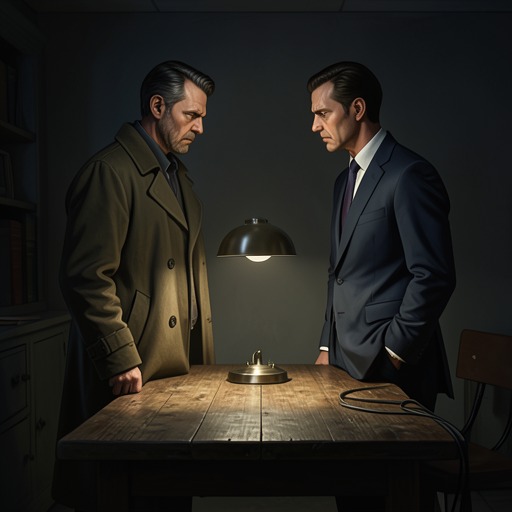
Jimmy Hoffa's imprisonment
I Heard You Paint HousesJimmy Hoffa’s imprisonment began with an eight-year sentence for jury tampering and continued as a contest over who could still reach him, speak for him, and shape his future. At the Federal Correctional Institution, Lewisburg, restrictions sharply limited ordinary prisoners’ contact with the outside world; Hoffa’s legal resources and trusted intermediaries, however, allowed prison to become both a place of confinement and an operating base for his union and political affairs.
Conviction and Sentence
Hoffa’s imprisonment grew out of the Nashville Test Fleet case, in which prosecutors alleged that he and others had tampered with jurors. Investigators had arranged for Edward Grady Partin to enter Hoffa’s circle during the trial. At the October 1962 proceedings, Partin served as a guard outside Hoffa’s hotel suite, while Walter Sheridan supplied him with a recording device and instructed him to watch for attempts to bribe jurors. One prospective juror, an insurance broker, reported that a neighbor had offered him $10,000 in hundred-dollar bills to vote for acquittal. The judge excused him after requiring him to identify the neighbor; other prospective jurors were dismissed after reporting calls from a supposed reporter seeking their opinions about Hoffa.
The case against Hoffa turned on whether Partin had been planted inside the defense camp and whether his testimony should therefore be excluded. Three months into the Chattanooga jury-tampering trial, with the defense apparently close to victory, the government called Partin as its final witness. The defense objected that his presence violated Hoffa’s right to counsel. After a four-hour hearing, the judge accepted the government’s account: Partin had volunteered to attend, reported suspected ongoing jury tampering to Sheridan, and had not discussed the Test Fleet defense with him. The judge allowed him to testify. Partin then described Hoffa’s boasts about attempts to influence jurors, including attempts he said Hoffa had discussed before or while they were happening. Prosecutor James Neal argued that the events confirmed Partin’s account; the defense denounced the prosecution as a frame-up and attacked Sheridan and Robert F. Kennedy.
On March 12, 1964, Hoffa received eight years. Judge Frank W. Wilson characterized the conduct as knowing and corrupt, emphasizing that Hoffa had continued after the trial judge reported information about an alleged attempt to bribe a juror. The judge said Hoffa had tampered with “the very soul of this nation.” His three codefendants received three years each; a jury fixer in a separate trial received five years, and Nashville lawyer Tommy Osborn received three and a half. Hoffa, the person the account identifies as the architect of the scheme and its only direct beneficiary, received the longest sentence.
Life Under Lewisburg’s Rules
Hoffa entered Lewisburg on March 7, 1967. Prison rules allowed him three hours of monthly visits from nonlawyers on a family-only list. Inmates had no phone privileges, and they could write to only seven people drawn from relatives and lawyers; incoming and outgoing letters were screened. Union officers could neither visit nor write to him. Active-case lawyers were exempt from those limits, and Hoffa’s son, a union lawyer, could visit as often as once a week. The difference between the rules and Hoffa’s practical access was substantial: his pending Chicago-case appeal and his legal team brought multiple lawyers through the prison, while he was also eligible for a parole hearing in November 1969, two and a half years after entering.
Sheeran describes the prison’s visiting room as a place where legal consultation and informal business could occur side by side. Young inmates who lacked the means or relatives to use their limited visiting hours could be introduced to Sheeran through supposed job interviews. Hoffa would sit nearby with one of his lawyers. When Sheeran pulled on his shirt, the signal meant that the young man should leave for the prison’s “buck house,” giving Hoffa and Sheeran an opportunity to discuss business; guards, according to Sheeran, looked away. The routine depended on both the formal exception for lawyers and an informal accommodation with staff, which Sheeran associated with gifts to guards at Christmas.
The visits also had an ordinary, companionable rhythm. For three dollars, visitors could join inmates for lunch; on Wednesdays the meal was spaghetti and meatballs. Sheeran says Hoffa loved the dish and that he gave him his own meatballs, sometimes visiting without any business to discuss. Their prison conversations also returned to old stories: Hoffa teased Sheeran about the watermelon he and Bill Isabel had eaten at the Edgewater Beach Hotel, not knowing that they had filled it with two quarts of rum. Hoffa learned the trick in prison from people associated with Tony Pro. Such exchanges made the visiting room more than a channel for instructions: it preserved the habits and private jokes of a relationship otherwise bounded by institutional rules.
Sheeran, Work, and the Prison’s Informal Network
Sheeran says Hoffa asked him to help some younger inmates find construction jobs, because having work waiting could improve their chances of making parole. One man named Gary did get a job; after his release, someone arranged to have him killed. The episode places the prison’s employment contacts within a harsher world beyond its walls: a job could support a parole bid, but release did not ensure safety.
Charlie Allen was another inmate Hoffa asked Sheeran to help. Allen was serving time for bank robbery, and Sheeran says Hoffa looked out for him. Sheeran helped him get work, let him accompany and drive him, and later put him on the payroll as an organizer for Teamsters Local 326. Allen later became an FBI informant against Sheeran. In Sheeran’s account, the reversal was especially bitter because Allen had first been someone Hoffa pitied and someone Sheeran had helped at Hoffa’s request. The prison relationship thus extended into later labor and criminal investigations, where an act of assistance became part of the history of betrayal.
Hoffa also used Sheeran to maintain contact with legal and political intermediaries. Sheeran says he carried messages for lawyers and mob figures, and that money was being sent to John Mitchell while Hoffa was imprisoned in pursuit of parole or a pardon. The money, he says, came from Las Vegas skim or Hoffa’s own funds, while associates including Russell Bufalino, Frank Fitzsimmons, Carlos Marcello, and Santo Trafficante tried to help secure his release. Hoffa initially suspected Frank Fitzsimmons of insufficient effort rather than betrayal. These claims present imprisonment not as the suspension of Hoffa’s network, but as a condition that made intermediaries, money, and access to counsel more important.
Appeals, Pardon, and Release
Hoffa’s jury-tampering appeals had been exhausted by the time he entered Lewisburg, but his Chicago case was still on appeal. The Supreme Court agreed to hear his challenge to the use of Partin, considering whether Partin’s presence at the Andrew Jackson Hotel violated Hoffa’s constitutional right to counsel. Sheridan later recalled that the prosecution was uncertain how the justices would rule. The account also describes an attempt to pressure Justice William Brennan through a threat to close his brother’s brewery if Brennan voted against Hoffa. The Court nevertheless ruled against Hoffa on the merits. Brennan joined the majority opinion by Potter Stewart; Chief Justice Earl Warren dissented, calling the government’s secret use of Partin an affront to the fairness of federal law enforcement.
Hoffa’s preparations for a long sentence had included changes to the International Brotherhood of Teamsters constitution at the July 1966 Miami Beach convention. He created the office of general vice president, empowered to run the union if the president went to prison, and installed Frank Fitzsimmons in the post. Hoffa also increased his annual salary from $75,000 to $100,000, with a provision that it would continue during imprisonment. Delegates approved payment of his past legal costs, which stood at $1,277,680 at the convention, and his future legal expenses as well. The arrangements made his sentence less likely to remove him from the union’s financial and political life.
A further effort came through Partin. In his autobiography, Hoffa described a deposition Partin gave his lawyers on March 27, 1971, as a twenty-nine-page confession. The account disputes that description, saying it did not amount to Partin admitting that he had framed Hoffa. It also reports that the deposition was exchanged for the Hoffa camp’s effort to place Partin in a potentially profitable business venture with Audie Murphy. The episode shows how the search for relief from confinement could draw on business arrangements as well as appeals and testimony.
On December 16, 1971, Morris Shenker filed a pardon petition with the White House. Rather than follow the established route through the Department of Justice, prosecutors, the FBI, and the sentencing judges, it was marked approved by Attorney General John Mitchell. Sheeran recalls visiting Lewisburg shortly before Christmas and reading the pardon papers while Hoffa met with Shenker. In Sheeran’s recollection, the document said Hoffa could leave immediately rather than wait until November 1975, when good time would have made him eligible for release; he says it did not mention a restriction on running for union office until 1980. He recalls the prison gathering as celebratory, with Hoffa expecting a few months in Florida before returning to union politics. The account therefore ends the imprisonment with release, but not with a clean break: even as Hoffa left prison, the terms and consequences of his freedom remained entangled with the political arrangements made on his behalf.