Jimmy Hoffa–Edward Grady Partin relationship
I Heard You Paint HousesThe relationship between Jimmy Hoffa and Edward Grady Partin is defined by a consequential misjudgment: Hoffa treated Partin as a man he could trust with violent talk and accounts of jury interference, but Partin reported what he heard to Walter Sheridan and ultimately testified against him. Their connection shifted from an apparent opportunity for Hoffa to recruit or confide in a tough Louisiana official to a courtroom confrontation in which Partin’s recollections helped expose Hoffa’s role in jury tampering.
An Assumed Ally
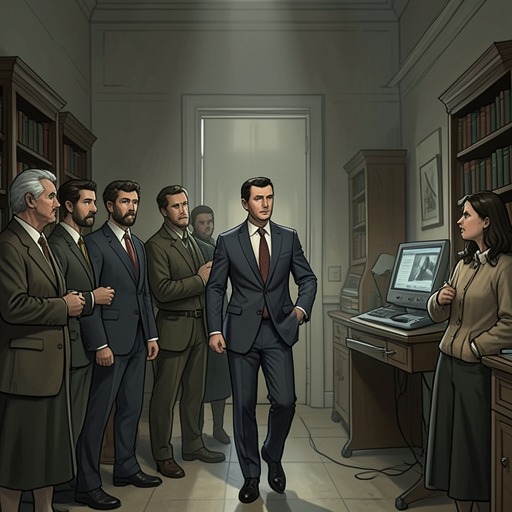
In the summer of 1962, Hoffa spoke to Partin alone in his office at the Teamsters’ Washington headquarters, known as “the marble palace.” Hoffa was enraged at Bobby Kennedy. He asked whether Partin knew anything about plastic explosives, then said he knew where to obtain a gun silencer. He described Kennedy’s lack of personal security and his habit of traveling alone in a convertible, framing the attorney general as an easy target. The reported words were explicit: “I’ve got to do something about that son of a bitch Bobby Kennedy. He’s got to go.”
Partin was not an obvious figure for Hoffa to treat as a confidant, but Hoffa appears to have read his circumstances as signs of usefulness and allegiance. Partin was president of a Teamsters local in Baton Rouge, Louisiana, a large, tough-looking man with a criminal record from his youth. He was also out on bail on a kidnapping charge arising from a family custody dispute involving a trucker in his local, and under indictment for diverting $1,659 in union funds to himself. Hoffa seems to have inferred from Partin’s toughness, legal troubles, and Louisiana connections that he belonged to the criminal world Hoffa could summon.
That inference included an assumption about Carlos Marcello, the Louisiana crime figure: Hoffa believed Partin must be in Marcello’s pocket. Partin later described Hoffa as having assumed that, because he was from Louisiana, he was “in Marcello’s hip pocket.” Yet Hoffa never asked Partin whether he would carry out the implied assignment before discussing the proposed killing. The episode therefore exposes a gap between Hoffa’s confidence in his own reading of people and the actual relationship: he treated Partin’s background as proof of shared loyalties, while Partin’s response was to report the conversation.
Partin Reports Hoffa
Partin took the threat to the Get Hoffa Squad, led by Walter Sheridan. Sheridan considered the account extraordinary and asked the FBI to give Partin a lie detector test; Partin passed emphatically. Sheridan then reported the threat against Bobby Kennedy to the attorney general. The sequence made Partin more than a recipient of Hoffa’s violent talk: he became a source whose account entered the government’s effort against Hoffa.
The account reached the public only indirectly. At a private Washington dinner, President John F. Kennedy told journalist Ben Bradlee that Hoffa was plotting to kill his brother. Bradlee sought confirmation from Bobby Kennedy, who asked him not to publish the story because it might frighten potential witnesses in the organized-crime cases he was supervising. Bradlee did not print it. Though this episode did not bring Partin and Hoffa face to face, it shows the larger consequence of Partin’s report: the alleged threat was treated as serious at the highest levels, yet officials also worried that public exposure could damage the investigations in which Partin’s cooperation mattered.
Partin later reported another kind of evidence to Sheridan, this time involving jury interference during the Nashville Test Fleet proceedings. After the jury had been selected and the trial had begun, Partin warned that the president of a Nashville Teamsters local intended to offer a state trooper’s wife a bribe; she was serving on the jury. Sheridan checked the juror information, and agents followed the local president to a deserted road, where he met the trooper in the patrol car. Partin’s information set in motion surveillance and a prosecution effort to remove the juror without disclosing the source of the tip.
At the resulting hearing, Hoffa gave the Teamsters official a five-finger signal, and the man invoked the Fifth Amendment. The trooper initially denied wrongdoing, then admitted under questioning by Judge Miller that the official had offered him promotion and advancement in exchange for an unspecified future favor. Partin’s role was not that of a courtroom accuser in this episode; his report helped investigators uncover an attempted approach to a juror’s household. But it also contributed to the broader pattern of evidence later presented against Hoffa: efforts to affect the jury were occurring around the trial, and Hoffa’s associates were implicated in them.
From Informant to Surprise Witness
Months later, Partin’s place in the conflict became unmistakable. He had been kept out of sight in a cabin on Lookout Mountain, Tennessee. On the final day of the Chattanooga jury-tampering trial, roughly three months into the proceedings and when Hoffa appeared close to prevailing, Partin entered the courtroom as the government’s last witness. The defense objected at once, accusing prosecutors of planting a mole in its camp and arguing that this would violate Hoffa’s right to counsel. If Partin had been improperly placed with the defense, his testimony could have been excluded.
The government maintained that Partin had volunteered to attend the trial and had been told by Sheridan, a former FBI agent and nonlawyer, to watch for evidence of ongoing jury tampering. Partin reported such evidence to Sheridan, who passed it to prosecutors; Partin had not discussed with Sheridan what he heard in Nashville about the Test Fleet case or Hoffa’s defense in that case. After a four-hour hearing, the judge accepted the government’s account and allowed Partin to testify before the jury. The distinction mattered: the court treated Partin as an observer reporting new alleged misconduct, not as an infiltrator planted to obtain information about the defense.
Hoffa glared at Partin as he took the stand, but Partin was not intimidated. He linked Hoffa to specific instances of jury tampering by recounting Hoffa’s own boasts about attempted bribes, made before or while the attempts were occurring. The testimony transformed Partin’s position from the man Hoffa had presumed to be available for a violent assignment into a witness describing Hoffa as the directing force behind efforts to manipulate jurors. What had seemed private talk between men Hoffa assumed to share a world of criminal understandings was now evidence before a jury.
The Reversal’s Consequences
The cross-examination lasted almost five days. Rather than weakening under repeated questioning, Partin grew more effective. When a defense lawyer accused him of rehearsing his testimony, Partin answered, “If I had it rehearsed you would have heard a lot more than you did. I forgot some things.” The reply turned the charge of preparation into a claim of incomplete recollection, while the sustained examination left the central conflict between Hoffa and Partin in full view.
The pressure surrounding the testimony was not confined to the courtroom. One night early in Partin’s appearance, a shotgun was fired into the Baton Rouge home of his business agent and close friend. Hoffa, meanwhile, repeatedly shouted obscenities at Sheridan during trial breaks, publicly berated his own attorneys, and threatened prosecutor James Neal that he would hound him for the rest of his life. These episodes establish the atmosphere around Partin’s testimony without proving who fired the shotgun or assigning responsibility for it. Hoffa’s hostility toward Sheridan and the prosecution also contrasted with Partin’s persistence under cross-examination.
When Hoffa later took the stand, he was unsettled by the possibility that the government had recorded what he had said to Partin in Nashville. He hedged rather than directly denying many of the statements attributed to him, trying to explain them away. The testimony against him concerned jury-tampering incidents that bribed jurors had already described; an unequivocal denial that he had made the reported comments to Partin might have mattered, but Hoffa’s fear of electronic surveillance kept him from offering one. Thus the original misjudgment reached its most damaging consequence: Hoffa had spoken to Partin as though their presumed affinities made disclosure safe, and Partin’s later testimony helped leave him unable to answer the prosecution’s account plainly. Their relationship became a study in failed certainty—Hoffa’s confidence that he knew what Partin was, reversed by Partin’s decision to report and testify.