Joey Glimco
I Heard You Paint HousesJoey Glimco, also identified as Giuseppe Primavera, is depicted as a powerful Chicago union figure whose reach extended well beyond one taxi local. In Frank Sheeran’s account, Glimco had authority across multiple locals and trades, and he enlisted Sheeran to settle disputes through pressure and intimidation. Their association places Glimco at the intersection of union control, organized crime, and the book’s wider network of personal alliances.
Chicago Power and Criminal Connections
Sheeran first heard about Glimco when Bill Bufalino told him that a Chicago problem needed attention. Glimco ran the taxi local there and had trucks on the waterfront; Sheeran initially did not know him. Russell Bufalino later identified him as Giuseppe Primavera, said he had been associated with Al Capone and was important in the Chicago outfit, and described his criminal record as including a couple of murder arrests. During the McClellan Committee hearings, Glimco took the Fifth in response to every question, including whether he knew Jimmy Hoffa.
The book places Glimco within a network that crossed cities and organizations. Sheeran was sent to Chicago, stayed with Bill and Sam Bufalino at the Edgewater Beach Hotel, and met Glimco there. Bill explained that Glimco handled important problems for Chicago locals beyond his own. Jimmy Hoffa later told Sheeran to remain in Chicago, where he would work under Glimco. The arrangement made Glimco a local point of contact for a worker dispatched from elsewhere, and a channel through which Hoffa’s directives could reach Chicago disputes.
Glimco’s influence was not limited to the cab trade. Sheeran describes him as holding fifteen cab locals outright, in addition to other Teamsters locals in different trades and unions he controlled behind the scenes. That breadth helps explain why a challenge to one local mattered to him: a successful breakaway could become an example for others. His power in this account consists not just of formal union positions, but of the ability to make resistance costly.
Sheeran’s Work for Glimco
One early Chicago episode begins with Sheeran getting lost in Cicero while looking for Glimco. He entered a bar to ask for directions and found himself surrounded by about twenty rough-looking men, each carrying a weapon. The men kept him there while calls were made; Glimco then arrived in person and took him to the bar where they were supposed to meet. The scene introduces Glimco through the tense environment around his work, but also shows him personally managing the connection to his new associate.
Glimco’s immediate problem was a freight hauler resisting the union and refusing to rehire a dismissed shop steward. The refusal damaged Glimco’s standing with his men, so he asked Sheeran to handle it. Sheeran said that no one needed to have a house painted; instead, he asked for a case of Coca-Cola bottles and one of Glimco’s men. From a bridge near the freight company, they dropped bottles onto trucks as they passed underneath. The noise frightened drivers, and trucks crashed into the bridge abutment. Eventually the drivers refused to take trucks out of the yard, and the company rehired the shop steward, though it did not pay him back wages. The episode shows a labor dispute being settled not through negotiation but by creating a physical danger that disrupted the employer’s operation.
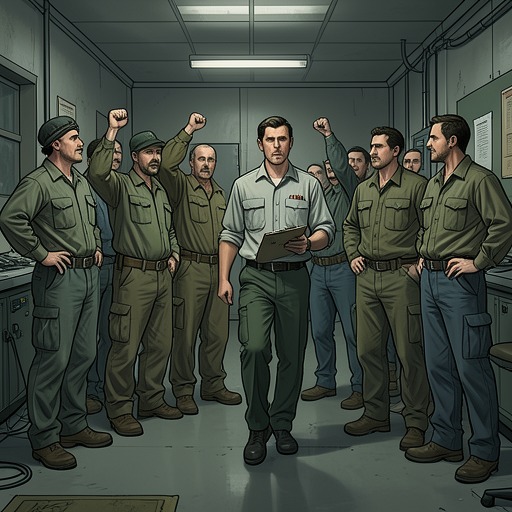
Sheeran’s later assignment makes that coercive method more explicit. Before and after a Teamsters convention, Hoffa sent him back to Chicago to work directly under Glimco. Rebels at Teamsters Local 777 wanted to separate their taxi local from the Teamsters; Paul Hall’s Seafarers International Union, affiliated with the AFL-CIO, was backing them and expected to take over if the local became independent. Dominic Abata led the rebels and had collected enough signed cards to bring the question to an election.
Sheeran acknowledges that the dissidents may have had reasons for wanting to leave. Glimco, however, faced a wider organizational risk: if Local 777 broke away without consequences, other locals might follow. In Sheeran’s telling, Glimco therefore wanted the departure to be painful enough to warn the rest of his network, even if he ultimately lost the local. The contest was both a dispute over representation and a demonstration of who could enforce discipline across the organization.
The Message to Dominic Abata
Before Abata received round-the-clock police protection, Glimco’s scouts reported his location. Glimco instructed Sheeran to give the rebels what he called “a little message,” which Sheeran understood to mean a show of force without bringing a gun. Sheeran went with two muscle men sent from Philadelphia. They approached a cinder-block building behind a chain-link fence, where about fifty men suddenly came out toward them. Sheeran’s companions ran; he stayed where he was.
Sheeran challenged the crowd, saying, “I know who you all are. If you go after me you better kill me. If you don’t I’ll be back and I’ll kill you.” Abata replied, “We know who you are.” Sheeran then offered to fight Abata’s two best men, adding that he might take on three. The exchange ends in the supplied account without establishing what followed or how the Local 777 dispute was resolved. What it does show is the form Glimco’s instruction took: a union conflict was answered with a face-to-face threat, while Sheeran’s reputation and willingness to stand alone served as the message.
Place in the Wider Network
Glimco also appears in the book’s account of meetings among figures from different regions. Sheeran says he regularly drove with Russell Bufalino to Joe Sonken’s Gold Coast Lounge in Hollywood, Florida, where people from around the country met. Bufalino met there with Santo Trafficante and Carlos Marcello; Sheeran also encountered Trafficante’s lawyer, Frank Ragano. These passages place Glimco within the same broader world of cross-city connections, although they do not establish that he attended those Florida meetings.
The book’s retrospective record of the investigation into Jimmy Hoffa’s disappearance likewise identifies Glimco as part of the surrounding network without making him a documented participant in a specific act. On August 4, 1975, five days after Hoffa disappeared, the FBI noted a meeting at the Vesuvio Restaurant attended by Russell Bufalino, Frank Sheeran, Tony Provenzano, and Salvatore Briguglio, among others. The HOFFEX file’s initial list named seven men, including Sheeran and Bufalino; the account says that adding Tony Giacalone and Chuckie O’Brien brought the total to nine suspects. Glimco is not named in those lists or among the attendees at the Vesuvio meeting. His significance in the narrative rests instead on the Chicago labor network and the coercive work Sheeran says he carried out under Glimco’s direction.
Narrative Role
Glimco is drawn less through private history than through the authority others attribute to him and the tasks he assigns. The narrative moves from a taxi local to a freight company, then to an attempted breakaway by Local 777; in each case, organizational power becomes visible when someone resists it. His connection to Hoffa gives these Chicago episodes a national frame, while his use of Sheeran shows how personal loyalty and labor authority could operate together. The portrait remains grounded in Sheeran’s recollections: Glimco is presented as a commanding figure in that account, but the book’s available details do not supply a fuller biography or settle the ultimate outcome of the Local 777 confrontation.