Machus Red Fox Restaurant
I Heard You Paint HousesThe Machus Red Fox Restaurant, on Telegraph Road outside Detroit, is the failed meeting place at the center of Frank Sheeran’s account of Jimmy Hoffa’s disappearance. Hoffa was expected there to meet Tony Provenzano and Anthony Giacalone, but neither arrived. Sheeran’s narrative instead places Hoffa in the restaurant’s parking lot, waiting for people who would not come, before a car drew alongside him. The restaurant matters both as a specific point in the account and as the public, recognizable landmark around which Sheeran later mapped a concealed operation.
Setting and Approach
The restaurant stood on Telegraph Road, a main artery leading into Detroit. In Sheeran’s later directions, the approach continues south on Telegraph past the restaurant, then turns left onto Seven Mile Road. After about half a mile, the route crosses a roadway bridge over a small creek; another bridge, a nearby footbridge, and a turn lead to a house with brown shingles, a high backyard fence, and a detached garage. Sheeran said that this house was only a few miles from the restaurant. His account binds the two sites together through a short sequence of roads and crossings rather than a long journey across the city.
The restaurant also served as a fixed reference point when Charles Brandt later drove to Detroit to locate the house Sheeran had described. Brandt recorded Sheeran’s directions, including the detail of the footbridge. On the drive, Sheeran said he passed the restaurant without concern that Hoffa would recognize him. He described his own height and upright posture as making his face difficult to identify from a car. These details belong to Sheeran’s account of the route and his own movements; they do not independently establish who else was present or what happened inside the restaurant.
The Appointment and the Waiting
The planned meeting was presented as an effort to reconcile Hoffa and Provenzano, with Giacalone expected to help make peace between them. The dispute over Provenzano’s million-dollar pension was, in Sheeran’s version, a pretext to draw Hoffa out. A family wedding scheduled for August 1, two days after the disappearance, provided another reason Hoffa might believe that Provenzano and Russell Bufalino would be in the Detroit area. Sheeran later characterized these circumstances as part of the setup, rather than evidence that the pension dispute itself was the real purpose of the meeting.
The account gives more than one appointment time. The arranged meeting with Provenzano and Giacalone was set for 2:30 in the afternoon, while Sheeran said he was supposed to meet Hoffa at 2:00 and that Hoffa would wait for him at the restaurant. Sheeran also claimed that he passed the restaurant on the way to the house while Hoffa waited in vain for him. The distinction matters: the restaurant was the advertised rendezvous for the two expected mediators, but Sheeran’s later description also makes it the place where his own absence was part of the deception.
According to Sheeran, the two expected visitors were not there. Giacalone was at a Detroit health club, while Provenzano was in New Jersey at his union hall, where Sheeran believed the FBI was watching him. The gap between the meeting’s stated purpose and the participants’ actual whereabouts is central to Sheeran’s explanation of how Hoffa was brought to the area without the promised reconciliation taking place.
The Parking Lot
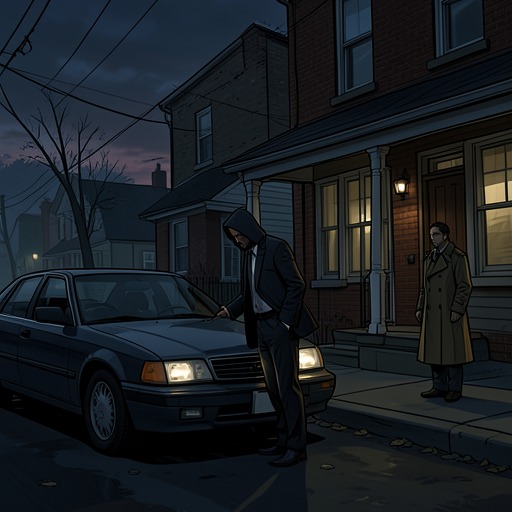
Sheeran’s scene places the restaurant’s parking lot in broad daylight after the lunch crowd had begun to leave. Trees along Telegraph Road, he recalled, gave the lot some privacy. Hoffa’s green Pontiac was parked off to one side. In the account, Chuckie O’Brien and Salvatore Briguglio arrived in a car and positioned themselves where they could see Hoffa and reach him before he reached his own vehicle. They waited rather than going inside to fetch him.
Hoffa then appeared from the area of a hardware store behind the restaurant. Sheeran described him wearing a short-sleeved pullover sport shirt and dark slacks, looking around impatiently for Sheeran or the two expected mediators. Sheeran’s account says Hoffa did not have a weapon on him. O’Brien slowly pulled the car up to Hoffa, who stopped; the narrative emphasizes the rage in his eyes before O’Brien apologized for being late. The parking lot thus becomes the point where an appointment that seemed to promise negotiation turns into an approach by different men in a different car.
Place in the Account and Its Evidence
The restaurant’s significance rests on a recollection presented as part of a history built from interviews with Sheeran, many tape-recorded. Brandt first interviewed him in 1991, but Sheeran ended that initial interview after admitting more than he was comfortable with. After renewed contact in 1999, the interviews continued for four years. Sheeran read and approved the chapters and the complete manuscript. That process gives the restaurant its place in a detailed testimony, while also making clear that the account is mediated through Sheeran’s memories and Brandt’s questioning.
Sheeran had admitted to Brandt that he was the shooter in the Hoffa case before Brandt took him to Detroit to find the house. In a later meeting with a Fox News correspondent, Sheeran gave directions that included the footbridge and, for the first time to someone other than Brandt, publicly said that he had shot Hoffa twice in the back of the head. In his final recorded confirmation, he stood behind the book’s account of what happened to Hoffa. The restaurant is therefore not merely a backdrop in the narrative: it is the named, public rendezvous against which Sheeran’s later route, claimed absence, and account of the killing are organized.