Nixon commutes Jimmy Hoffa's sentence and bars union management
I Heard You Paint HousesNixon’s commutation freed Jimmy Hoffa from the Federal Correctional Institution, Lewisburg, on December 23, 1971, but it was not an unconditional restoration of his power. The order reduced his sentence and enabled his immediate release while forbidding him to manage any labor organization, directly or indirectly, before March 6, 1980; violating that condition would void the commutation. In Frank Sheeran’s account, the decisive turn came not only with Hoffa’s release, but when the restriction appeared in the final papers in Detroit—after the men celebrating in prison believed no such ban had been imposed.
From Prison to the Pardon Petition
Hoffa entered Lewisburg on March 7, 1967, while appeals in his Chicago case were still pending. Prison rules limited non-lawyer visits to three hours a month, restricted visitors to family, barred telephone privileges, and allowed letters to only seven relatives or lawyers, with all correspondence screened. Union officers could neither visit nor write to him. His son, a union lawyer, was an exception and could visit as often as once a week; lawyers working on active cases could also see him without the same limits. Those legal visits provided a channel for advice and messages even as ordinary contact with the union was cut off.
Several lawyers helped keep Hoffa’s affairs moving. Frank Ragano visited and carried messages between Hoffa, the union, and mob figures. Morris Shenker handled Hoffa’s parole strategy and the maneuvers surrounding a possible presidential pardon, while Bill Bufalino visited as lawyer and adviser. Sheeran also recalled money being sent to Attorney General John Mitchell while Hoffa was imprisoned, in hopes of securing parole or a pardon. According to his account, the funds came from a Las Vegas skim or Hoffa’s own money; he said the people involved were trying to help Hoffa get out. At a Labor Day rally in Detroit, International Brotherhood of Teamsters president Frank Fitzsimmons publicly urged President Richard Nixon to pardon him.
On December 16, 1971, Shenker filed a pardon petition at the White House. The petition bypassed the ordinary process, which would have sought responses from the Department of Justice, prosecutors, the FBI, and the sentencing judges. Instead, John Mitchell marked it approved. The speed and route of the filing set the commutation apart from the procedures that had ordinarily governed such petitions.
The Prison Reading and the Final Order
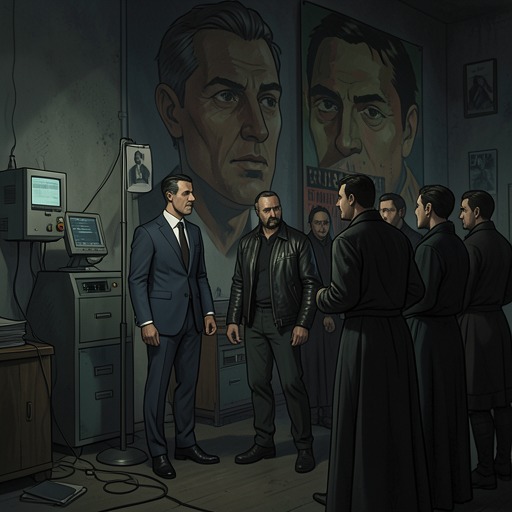
Sheeran recalled visiting Hoffa at Lewisburg just before Christmas, where Shenker was present with the pardon papers. Sheeran sat at another table with a young inmate; a guard looked the other way as the papers were passed to him. As he read them, he understood that Hoffa would be released immediately rather than serve until November 1975, when good-time credit would have made him eligible for release. He said the papers he saw in the prison dining room contained no prohibition on Hoffa running for office until 1980. Hoffa and his supporters, Sheeran remembered, were happy and spoke of a Florida vacation before Hoffa returned to action. In that room, he said, there was no controversy.
The official Executive Grant of Clemency, signed by Nixon on December 23, reduced Hoffa’s thirteen-year sentence to six and a half years. With good-time credit, that reduction meant immediate release. But when Hoffa and his supporters read the final papers in Detroit, they found a condition absent from the papers Sheeran said he had seen in prison: Hoffa could not directly or indirectly manage a labor organization before March 6, 1980. If he failed to comply, the commutation would be void in its entirety. The restriction meant that he could not return to union management or run for office in 1976. Sheeran described the late appearance of that clause as the final double-cross, while acknowledging that Hoffa had hoped to reclaim power.
Release, Parole, and Political Caution
Hoffa walked out of Lewisburg on the day Nixon signed the grant. He flew first to his married daughter Barbara Crancer’s home in St. Louis to spend Christmas with his family, then returned to Detroit to register with the federal parole and probation office. Although the commutation released him from prison, he remained on parole until the full six-and-a-half-year term expired in March 1973. From Detroit, he planned a three-month respite in Florida. On January 5, 1972, he flew to his Miami Beach apartment; Frank Ragano greeted him at the airport as a mark of respect from Santo Trafficante and Carlos Marcello, who could not appear because Hoffa was a federal parolee and was not permitted to associate with organized-crime figures or convicted felons.
Hoffa publicly supported Nixon in 1972. On ABC’s Issues and Answers on February 12, he said he would support the president, and Sheeran’s account presents that stance as caution: Hoffa had experience enough to distrust the administration’s fairness, but would not provoke it while still on parole by attacking Fitzsimmons. In July, Fitzsimmons’s executive board endorsed Nixon’s reelection by a vote of 19 to 1. Hoffa’s release therefore did not end the conflict over his return. The commutation gave him freedom while placing a long-term legal barrier between him and the union he had sought to reclaim.
The Disputed Meaning of Clemency
The episode turns on a sharp difference between release and restoration. In prison, the papers Sheeran says he read appeared to promise freedom without the union-management restriction. The final instrument delivered in Detroit made freedom conditional: the sentence was cut, but Hoffa’s direct or indirect control of a labor organization was barred until 1980, with the commutation itself at stake if he violated the term. The gap between those two readings shaped the immediate celebration at Lewisburg and the anger that followed in Detroit.
Sheeran’s account presents the commutation through the perspective of a participant who had carried messages and read legal documents on Hoffa’s behalf. He insisted that he would have noticed the restriction had it appeared in the prison papers, and recalled the group believing Hoffa was getting what he had paid for. That recollection does not erase the distinction between the papers he says he saw and the signed order that governed Hoffa’s release. Instead, it makes that distinction the event’s central reversal: the door opened, but the condition attached to it blocked Hoffa’s political and union ambitions for years.