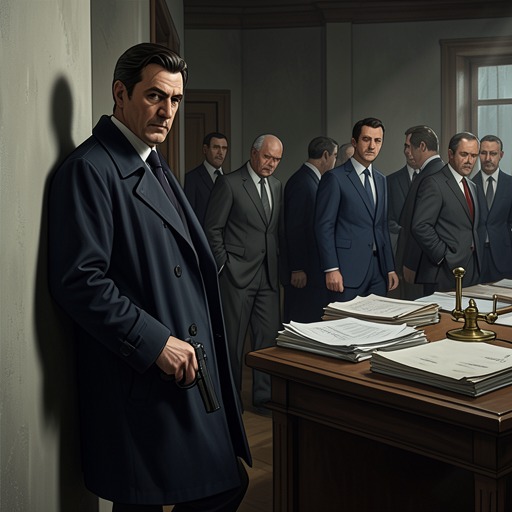
Sam Giancana's 1975 murder at home
I Heard You Paint HousesSam Giancana’s murder is recounted as a close-range killing in his kitchen, four days before he was scheduled to testify before the United States Senate about the Central Intelligence Agency’s use of organized crime in a plot against Fidel Castro. In the book’s telling, the assassination follows a public exposure of Giancana’s and Rosario Bufalino’s alleged intelligence work and turns the danger of speaking into a literal warning. The account supplies a setting, a sequence, and a political context, but does not identify the killer or establish who ordered the murder.
Giancana’s Reach and Political Ties
The narrative first establishes the scale of Giancana’s influence. It portrays him as a Chicago boss whose activities and connections reached beyond the city: he had moved into Dallas, held casino interests in Havana, and opened a Lake Tahoe casino with Frank Sinatra. Jack Ruby is described as part of his organization. The account also connects Giancana to Judith Campbell, who was said to have been involved with both him and John F. Kennedy while Kennedy was president.
These details cast Giancana as more than a local underworld figure. In the narrator’s account, he had helped Kennedy’s election, then felt betrayed when Kennedy’s administration allowed Robert F. Kennedy to pursue organized-crime figures. The contrast between political assistance and subsequent prosecution forms part of the book’s explanation of Giancana’s place in a network where criminal power, public office, and media attention overlapped. It does not, by itself, establish a motive for his murder.
Public Exposure and the Senate Subpoena
The narrative places a burst of publicity immediately before the killing. A week before Giancana was murdered, Time reported that he and Rosario Bufalino had worked on behalf of the Central Intelligence Agency in connection with the 1961 Bay of Pigs invasion and a 1962 plot to kill Castro. The book emphasizes Bufalino’s aversion to seeing his name in print, making the news coverage a conspicuous pressure point in the account.
Giancana had also been subpoenaed to testify about the agency’s recruitment of organized crime to assassinate Castro. His killing came four days before that appearance. The Senate inquiry and the magazine story are presented as converging pressures, but the chronology alone does not prove that either caused the murder. A separate finding cited in the book gives the intelligence context further weight: the Church Committee concluded that Bufalino was part of a conspiracy involving poison pills intended for use against Castro before the Bay of Pigs invasion. That finding concerns the Castro plot, not responsibility for Giancana’s death.
The Killing in the Kitchen
The account places Giancana at home, in his kitchen, when he was killed. It describes the assailant firing first into the back of his head and then six times beneath his chin, calling the manner of the killing “Sicilian style” and interpreting it as a sign that Giancana had been careless with his mouth. The scene is chilling in its intimacy: the killer, the narrative suggests, could get close enough to share an ordinary domestic moment with him. But the killer is not named, and the book offers no independently established identity for the person who fired the shots.
The narrator invokes Rosario Bufalino’s saying, “When in doubt have no doubt.” In context, the phrase gives the killing the hard certainty of mob warning and response. It is the narrator’s framing of the violence, not proof of the order behind it. The episode is thus presented both as a murder and as a message about the consequences of speaking where powerful people might be exposed.
Account, Evidence, and Uncertainty
The episode reaches the reader through Frank Sheeran’s first-person narrative in a book built from interviews conducted by Charles Brandt. Brandt began interviewing Sheeran in 1991; after Sheeran ended the first session, the interviews resumed following a meeting in 1999 and continued for four years. Sheeran read and approved the chapters and later the manuscript. Those circumstances help explain how the account was assembled, but approval and repetition do not independently verify every claim in it.
The book’s presentation therefore keeps two kinds of material in view: the public record of reporting, subpoenas, and the Church Committee’s findings about the Castro operation, and the narrator’s account of how Giancana died. The former supports the surrounding political context; it does not identify the murderer. The event remains starkly narrated but unresolved in its central questions: who killed Giancana, and whether the exposure and impending testimony precipitated the killing.