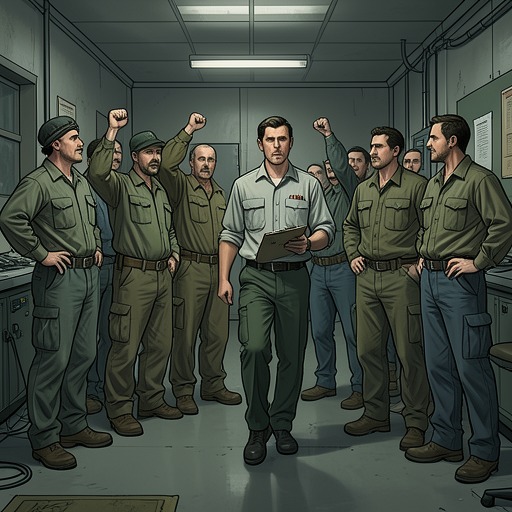
The Enemy Within
I Heard You Paint HousesThe Enemy Within is Bobby Kennedy’s account of organized crime and labor unions, shaped by his three years as chief counsel to the McClellan Committee. Its title gives the book’s central argument a compact image: the danger it describes is not outside the country but embedded within its institutions. Kennedy’s identification of Jimmy Hoffa and some of his leading allies as fitting a notorious criminal prototype made that claim pointedly political, and the book’s attempted adaptation drew warnings intended to stop the story from reaching movie audiences.
A title grounded in the hearings
At the conclusion of his three years with the McClellan Committee, Kennedy published a bestselling book that named organized-crime figures and narrated their deeds for a larger public. He called it The Enemy Within. The title’s force lies in its placement of the threat: organized crime appears not as a distant underworld separate from civic life, but as a power operating within the nation’s institutions and labor organizations.
Kennedy made that argument explicit in his assessment of Hoffa and his associates. He wrote, “But there was no group that better fits the prototype of the old Al Capone syndicate than Jimmy Hoffa and some of his chief lieutenants in and out of the union.” The comparison joined union leadership to a familiar criminal model and made the book’s broad title concrete in a specific target. It also stood in direct opposition to Hoffa’s public account. In speeches to Teamsters members, Hoffa called allegations about racketeers and crooks a smokescreen meant to return workers to a time when employers could discard them like worn-out trucks. The book instead presented the criminal connections as the substance of the problem, not a diversion from labor’s interests.
From investigation to a national campaign
The book extended the committee’s hearings beyond the people questioned in Washington. Kennedy had encountered notorious gangsters and racketeers through the investigation; in print, he named figures and recounted their conduct for a broader readership. Its title therefore served both as a description of the subject and as a public warning about organized crime’s reach.
The book also preceded a more direct law-enforcement campaign. For the following three years, Kennedy served as attorney general, drew up a list of gangsters to target, and pursued arrests and imprisonment. He expanded the use of informants and wiretapping, while pressing the federal government—and FBI Director J. Edgar Hoover in particular—to recognize organized crime and use federal power against it. Within that campaign, Hoffa was Kennedy’s most personal target and, in his view, a major danger to the nation. Yet Hoffa continued to slip through the net, leaving the book’s accusation in unresolved tension with the campaign’s incomplete pursuit of its central adversary.
The abandoned screen adaptation
The book’s claims proved contentious beyond the printed page. Twentieth Century Fox commissioned a screenplay by Budd Schulberg, the writer of On the Waterfront, but abandoned the project. Columbia Pictures later considered taking it on and also withdrew. Schulberg recounted that a labor tough warned Fox’s new head that Teamster drivers would refuse to deliver the film prints; if the prints reached theaters by other means, stink bombs would drive audiences out.
The pressure was reinforced by a warning letter to Columbia from Bill Bufalino, a Teamsters lawyer who was also Hoffa’s lawyer. Schulberg said the letter represented Fox’s abandonment as prudent and urged Columbia to make the same choice. The two studios’ retreat did not alter the book’s argument, but it showed that the conflict described by its title extended to the circulation of the story itself: an account of organized power faced efforts to prevent its adaptation from reaching the public.