Voice
I Heard You Paint HousesVoice, short for Voice of Teamsters Local 107, was a rebel faction challenging Jimmy Hoffa’s control of Teamsters Local 107 in Philadelphia. Its rise turned a dispute over local leadership into a contest over the shape of the International Brotherhood of Teamsters: whether Hoffa could bring divided locals into line behind a national contract, or whether rebels and resistant local officials could preserve their own power. In the book’s account, Voice remained active even after Hoffa’s allies defeated it at the ballot box.
Formation and political setting
Voice emerged amid conflict in Philadelphia and was described as trying to do what Dominic Abata had done in Chicago. Hoffa suspected that Paul Hall and the AFL-CIO were backing the rebels. The account places the faction among several competing challenges to the existing leadership, rather than presenting Philadelphia as a simple two-sided contest: Raymond Cohen headed Local 107, Joey McGreal had a separate, less formal group, and the Betterment Committee offered another opposition current.
The dispute had material stakes. Local control could enable leaders to arrange labor peace with employers while receiving payments under the table, a practice Frank Sheeran described in connection with Cohen. Sheeran said he did not extort employers after Hoffa gave him his own local in Wilmington, Delaware, in 1966; that contrast underscores how the book distinguishes his claimed approach from the local practices at the center of the Philadelphia struggle. Voice, meanwhile, was identified as a more organized challenge, one that forced an election and continued to agitate against Hoffa’s allies.
Confrontation in Philadelphia
The conflict also took a physical form. Paul Hall brought a muscle crew to Philadelphia and housed its members at the Seafarers International Union hall near Oregon Avenue and Fourth Street. Sheeran, sent back to Philadelphia by Hoffa with several members of the Chicago crew, went to inspect the building. The front door was locked, but he could see rows of bunk beds through a plate-glass wall facing Fourth Street.
Sheeran returned with a panel truck borrowed from the Local 107 lot and eight or nine men. He gave each man a white hat so he could distinguish his own side, then drove the truck over the sidewalk hedge and through the plate glass at 6:30 in the morning. The men inside had been sleeping; Sheeran’s group attacked with fists as they got out of their bunks. Police arrived from across the area. The episode shows the physical coercion surrounding the Philadelphia labor dispute, but the account identifies Hall’s crew as the immediate target; it does not establish that every member of that crew belonged to Voice.
Elections and Hoffa’s intervention
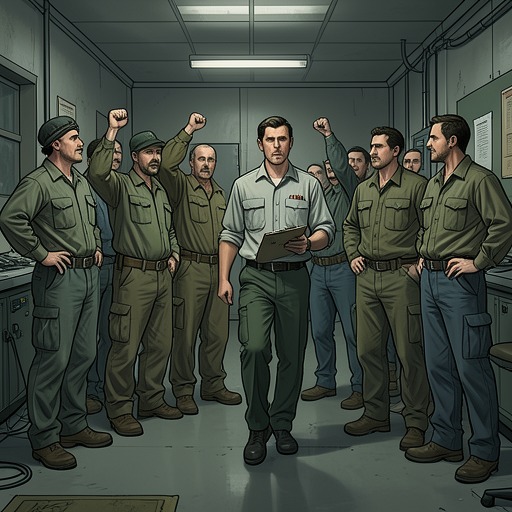
Voice forced an election at Teamsters Local 107, prompting Hoffa’s allies to hold a rally and bring Hoffa in to address the membership. Police proposed taking him in through a back entrance so he would not have to pass Voice supporters holding signs mounted on wooden posts. Hoffa refused. Sheeran walked down the aisle beside him; the account describes boos farther back, but no aggressive incident along their path. Hoffa argued for solidarity and for the benefits he said he was securing for members. The election was close, but his side won by a few hundred votes.
That victory checked Voice without ending it. Sheeran says the faction slowed after the rally, while Cohen became more accommodating after the experience of nearly losing and needing Hoffa’s help. The earlier election, held a few months before, had been narrower still: Voice lost by 600 votes in a local of 11,000 members, and the result was set aside because anti-Voice violence had dominated the contest. The book thus distinguishes two outcomes: an election invalidated amid violence, followed by another contest in which Hoffa campaigned vigorously and his side again prevailed.
Hoffa spent fourteen weeks at the Warwick Hotel campaigning before the April 1963 election. Rather than rely on violence in that campaign, he explained the anticipated improvements in wages and pensions under his plans for the union. His side defeated Voice again, bringing the fourth-largest Teamsters local back into line. Hoffa promised to let past grievances go; the result also left Cohen owing him loyalty in negotiations with Philadelphia trucking companies.
The national contract and the faction’s significance
Voice’s challenge mattered beyond the local election because Hoffa was trying to establish a Master Freight Agreement, a single contract covering Teamsters across the country. The plan aimed to standardize wages, benefits, and pensions and replace negotiations between individual companies and scattered locals with national bargaining. In the book’s account, Philadelphia was a particularly difficult obstacle: Cohen resisted giving up power, Voice and other rebel groups continued to agitate, and trucking companies took advantage of the divisions by refusing to cooperate on an area-wide agreement.
Hoffa’s response linked the local fight to the larger bargaining campaign. He threatened strikes at trucking terminals outside Philadelphia to bring companies around, while his allies fought the rebels in an effort to consolidate the union. The narrator presents this strategy as both consequential and coercive: defeating Voice helped Hoffa secure local alignment, but that alignment was part of a broader effort to make employers and locals negotiate on terms set through a unified union. Voice’s continued presence after its defeats keeps the outcome from reading as a complete resolution. It was slowed and beaten electorally, yet its challenge exposed how national union power depended on contests for authority inside individual locals.